If Murdoch's empire needs a home, India awaits
Rupert Murdoch, it seems, may be able to defuse at least some of his troubles at News Corp by selling his three remaining British newspapers.
Rupert Murdoch, it seems, may be able to defuse at least some of his troubles at News Corp by selling his three remaining British newspapers.
But new questions immediately arise: Who will be their foolhardy buyer, given that two of the papers lose money? And what will Murdoch do with the nest egg of $12 billion (Dh44 billion) he had planned to offer for an increased stake in British Sky Broadcasting?
Certainly, Murdoch could do much worse than look east, especially to India, where he revolutionised the news and entertainment media in the early 1990s with his satellite television channels and where he has been steadily expanding his empire.
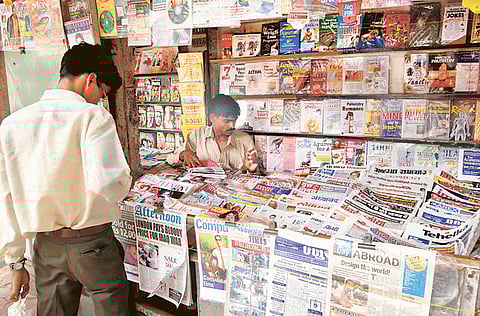
In India, where more than 500 satellite television channels have opened in the last two decades, daily newspapers are also multiplying at an astonishing rate — increasing by 40 per cent to 2,700 between 2005 and 2009. Newspaper executives in the West can only gaze enviously at India's 32 per cent year-on-year rise in advertising spending.
There is much more growth to come. "India's newspaper publishing market, which has 356 million readers, may expand 6.8 per cent annually to $4.1 billion by 2014," Bloomberg News reported in February.
Global ambitions
Last year, India's largest media company, Bennett Coleman & Co, which owns the Times of India, the world's highest-circulated English broadsheet daily, declared its global ambitions by buying Virgin Radio from the British tycoon Richard Branson; it is now planning an IPO within two years.
But India's news media boom, like the UK phone-hacking scandal, is also a cautionary example, showing that when it comes to the press's responsibility and freedom, more can amount to less, and that the supposed watchdog of democracy can quickly turn into its most insidious enemy within.
More than a decade ago, in what now seems an innocent era, I wrote in the Financial Times of the creeping ‘Murdochisation' of the Indian news media. I meant primarily the growing dominance of advertiser-friendly infotainment in major newspapers such as the Times of India and the Hindustan Times.
Every day, and often on the front page, these once-stodgy newspapers were carrying reports of parties at five-star hotels and fawning profiles of film stars, musicians, cricketers and fashion designers, consisting of such useful information as their eating and dieting habits, romantic preferences, favourite holiday destinations, champagnes, colours and dogs. Meanwhile, advertiser-unfriendly news such as the suicides of tens of thousands of farmers, or human rights violations in Kashmir, often went unreported or were relegated to the inside pages.
Alarming picture
"A good newspaper," Arthur Miller wrote, "is a nation talking to itself." And most English-language newspapers in India presented, within a few years of Murdoch's arrival, an alarming picture of the nation's public life.
Things have got much worse since then. Many more newspapers and television channels have sprouted in the past decade of rapid economic growth. But their emphasis continues to be, as the Economist put it last week, on "sensationalist, ‘Bollywoodised' coverage of celebrities." Also, "most news outlets are openly partisan," featuring what seem to be many an overeager understudy for Glenn Beck and Keith Olbermann.
More disturbingly, the editorial departments in many of India's major newspapers and television channels are now open to the highest bidder: political parties, corporations, celebrities, indeed anyone who can afford to can secure favourable coverage for themselves with a simple cash transaction. What Indians call ‘paid news' is not confined to a few small-town rags. As the Financial Times reported last year, ‘private treaties,' the business of selling news coverage in exchange for corporate stock, was ‘pioneered by the Times of India a few years ago, and is now widespread in India's national and regional press."


