Gulf states are relatively insulated from Brexit
The set of reforms regional economies are opting for is what will drive performance
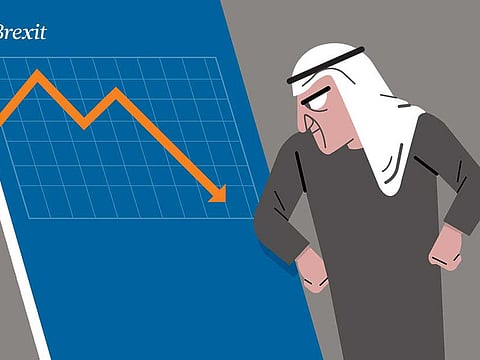
The UK’s decision to leave the European Union triggered volatility in global financial markets not seen since the financial crisis of 2008, but also left investors with more questions than answers as to the future of the Eurozone and the UK’s role outside it.
Stocks in the Gulf region weren’t spared either in a global rout that stretched from London to Sydney. The immediate impact was a flight to safe assets, while risk assets capitulated. Growth driven commodities, like oil, struggled in the Brexit aftermath, with obvious negative read across for this region.
While there is little doubt that the UK referendum result caught many in the markets off-guard, the initial knee-jerk sentiment-driven reaction by GCC stocks was to be expected.
Such a seismic political event has the potential to keep investors and markets on edge for months to come as the full implications of Brexit take effect. During this period, credit spreads and equity risk premia will continue to reflect a high degree of uncertainty.
But this shouldn’t have any lasting impact on the GCC. Most importantly, it won’t likely derail the push by the countries to liberalise their economies and capital markets.
We continue to be encouraged by the reform momentum that remains in check throughout the GCC. From the UAE’s deregulation of petrol prices to the planned introduction of value added tax (VAT), the commitment shown to implementing prudent fiscal policy and diversifying economies away from oil should be applauded.
Nowhere else is such progress more noticeable than in Saudi Arabia, where a series of stock market reforms — under the guise of the kingdom’s ambitious ‘Vision 2030’ plan — is just the sort of ambitious and proactive policymaking that investors want to see.
Indeed, we have seen more effort towards reform in the past six months, than we have in the last decade, and the positive changes keep coming.
Just last week, the Saudi Capital Market Authority announced a slew of regulatory amendments, amongst them, the rules allowing qualified foreign financial institutions (QFIs) to invest in the kingdom’s debt market. In addition to committing to improve the market infrastructure by addressing the trade settlement duration (to T+2) and covered short selling — both to come into effect by the first half of 2017, the CMA has dictated that the minimum amount of assets under management that QFIs must hold to invest directly in Saudi stocks be lowered to 3.75 billion Saudi riyals (Dh3.66 billion), from 18.75 billion riyals.
Make no mistake, it is positive signals such as these that will ultimately drive markets in the GCC region forward, Brexit or no Brexit.
In many ways, the GCC is protected from the uncertainty that is currently stalking stock markets throughout Europe. For a start, in our view, the interconnectedness between financial institutions in the GCC and the UK financial system is limited, making it unlikely that any financial, or liquidity, issues will spill over to the GCC in a meaningful way.
It should also be noted that the peg between GCC currencies and the dollar has helped ensure equities avoided much of the currency volatility experienced by some other emerging-market economies.
Another supportive factor for local markets is dividend yield. When the outlook for economic growth darkens, investors traditionally gravitate towards companies where there is more conviction in their outlook.
These tend to be companies that have high cashflow, operate in industries with significant barriers to entry, and are also under-leveraged. With an average dividend yield of 4.5 per cent, the GCC is home to companies that pay as much as 7.5 per cent, are well capitalised, and operationally sound.
Dividends aside, there are still some risks for the GCC in the immediate post-Brexit environment. Dubai, perhaps, is the one regional location that is susceptible to a UK slowdown since its economy is more open to foreign investment, trade, and tourism. It is these sectors that could struggle should ‘Brexit’ drag on the UK economy in the months ahead.
From a macroeconomic point of view, a Europe-induced recession led by the UK will be felt in the GCC mainly through lower oil and commodity prices. But even then the GCC is already operating under the premise of lower oil prices for an extended period of time.
Governments have already been leading initiatives on the cost side and revenue side to try and tackle this development. In fact, sovereign ratings by agencies like Moody’s and S&P Global Ratings already reflect a $40 a barrel oil price until 2019 in their credit assessments, which remain mostly supportive.
At this stage, no one quite fully understands how the UK unwind from Europe will evolve. Until there is greater clarity on this path, volatility will be a frequent visitor on stocks markets around the world.
In the GCC though, it is the path to market liberalisation that will provide the most comfort.
— The writer is Chief Investment Officer for Mena Equities at Franklin Templeton Investments (ME) Limited.


