A banker who likes to groove to the beat
next Goldman Sachs chief David Solomon can DJ with the best
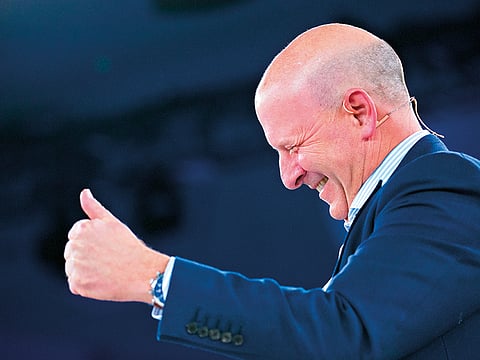
As bake-offs go it was pretty unusual: A part-time disc jockey and a karate black belt vying to be the next leader of arguably the world’s most influential bank.
On March 12, Goldman Sachs Group picked the DJ.
David M. Solomon, 56, a longtime investment banker, has been anointed as the sole heir apparent to Goldman’s chief executive, Lloyd C. Blankfein. The decision was signalled with the abrupt retirement of Solomon’s lone rival for the job, Harvey M. Schwartz.
A decade removed from a global financial crisis, Goldman remains a potent symbol of Wall Street’s enduring power, and its chief executive perhaps the banking industry’s most prominent spokesman. The firm possesses unparalleled leverage in Washington, thanks in part to its track record of funnelling executives into senior government posts.
Even the Trump administration, which rode a populist wave to electoral victory, is stocked with Goldman alumni, including Treasury Secretary Steven Mnuchin and the departing White House economic adviser Gary Cohn. Goldman is also an adviser to many of America’s — and the world’s — largest companies, ranging from stalwarts like Walt Disney to upstarts like Uber.
“There are other, larger companies, but Goldman’s an icon,” said Charles Elson, a corporate governance expert at the University of Delaware. “And it’s occupied a prominent role in American finance for probably almost 70 or 80 years.”
Blankfein has led the firm for nearly a dozen years since his predecessor, Henry M. Paulson junior, departed to be the Treasury secretary under President George W. Bush. Blankfein has joked that he intends to die at his desk, but he has signalled to people inside Goldman that he may leave as chief executive as early as this year.
The possibility that Blankfein could soon step away intensified the competition between Solomon and Schwartz, who twice pressed the board for an answer in recent months. For more than a year — since Cohn stepped down as the firm’s president to be the director of the National Economic Council — Solomon and Schwartz have been auditioning to be Blankfein’s successor. Each man held the title of president.
In February, Goldman’s board met at its headquarters and evaluated the two candidates. Blankfein offered his view, and the directors decided Solomon was their man, according to a person who was briefed on the meeting.
The anticipated elevation of Solomon, a Goldman veteran who moonlights under the name DJ D-Sol, spinning electronic-dance music, marks a strategic shift for the bank. Solomon, a native of New York, was a rare outsider to join Goldman as a partner when he was hired from Bear Stearns in 1999. He is a schmoozer who recognises the importance of projecting a positive, inclusive image of the bank to its clients, its employees and the public.
Traditional business model
Unlike Blankfein and Schwartz, Solomon is not steeped in the firm’s cut-throat trading culture.
“He’s client-centric, direct and candid,” Bennett Goodman, a senior managing director of the private-equity firm Blackstone, said. “You never doubt he’ll tell you what he really believes even when it’s not what you want to hear.”
The leadership transition comes at a time when Goldman’s traditional business model is under siege. Its bond-trading business, once a huge component of the firm’s revenue, which hit nearly $1 billion (Dh3.67 billion) a week in 2009, is now a shadow of its former self. The bank’s limited presence in countries like Saudi Arabia and Mexico have meant Goldman has been left out of some lucrative transactions.
And its belated attempts to muscle its way into businesses such as consumer lending have failed to transform the company into a real competitor of commercial banks like JPMorgan Chase and Citigroup.
Since his elevation to president was announced in late 2016, Solomon has been working to address those shortcomings. In spring 2017, he and Schwartz presented directors with a plan to generate $5 billion a year in additional revenue starting in several years. It called for expanding Goldman’s investment-banking franchise to mid-size US cities.
At the same time, Solomon strayed beyond the traditional mold of a Wall Street power broker. He demanded, for example, that Goldman’s recruiters increase their hiring of women with the goal of eventually reaching total gender parity.
To many inside Goldman, Solomon’s ascension was far from a sure thing. Solomon himself was among the sceptics; associates said that he had told them that the top job was Schwartz’s to lose.
Schwartz, who had been Goldman’s chief financial officer, knew the firm’s business model cold and had played a central role in the firm’s trading business during its heyday. Solomon, on the other hand, had won the respect of the banking division but was less well-known in other parts of the bank.
Horse race
For the past year, the relationship between Schwartz and Solomon has been chilly at times. They had never been close personally and, while striving to work together professionally, subordinates could tell that both men knew they were in the midst of a horse race.
Schwartz recently confided to friends that he was worried about being “Gary’ed”, said people familiar with the conversations. It was a reference to what happened to Cohn, who remained Goldman’s president for more than 10 years in hopes of taking over from Blankfein, before joining the Trump administration.
Late in 2017, Schwartz approached Goldman’s lead director, the private-equity executive Adebayo O. Ogunlesi, with an ultimatum. Schwartz said that unless he was tapped as chief executive in the coming months, he would resign. Ogunlesi was non-committal.
Schwartz reiterated his demand to Ogunlesi earlier this year. The move didn’t work as intended. On February 21, during a meeting at Goldman’s headquarters, the board took up the succession question in earnest. Blankfein expressed his preference for Solomon, said the person who was briefed on the meeting, and the board agreed.
Blankfein then left for a business trip to Asia and didn’t tell Solomon the news for more than a week. Schwartz was notified this past week. He immediately decided to retire, capping a career that started on Black Monday, the day in October 1987 when the stock market plunged 22 per cent.
Blankfein announced Schwartz’s exit and Solomon’s promotion to be the firm’s sole president at a weekly management committee early March 12.
During the gathering, Blankfein also equivocated on his own time frame for retiring. He said that a “Wall Street Journal” article last week that said he could leave by the end of this year might be right or might be wrong, the people said.


