Australia's new PM a trailblazer
Shocking end to reign of prime minister Rudd who was erstwhile darling of masses
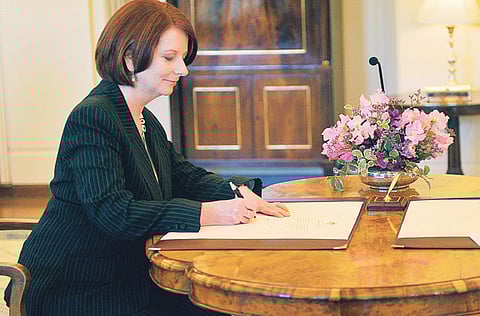
Canberra: For a woman who was once written off as prime ministerial material for being "deliberately barren'' -- a cruel jibe at her childless status -- Julia Gillard has delivered handsomely.
Early yesterday (Thursday) morning, she became Australia's 27th and the first ever woman Prime Minister, a political development that took place with such lightning speed that it seemed improbable just 12 hours earlier.
Until 7.30pm on Wednesday, Gillard's aides were telling journalists that "nothing had changed" in her position on a leadership challenge to Kevin Rudd. She wasn't interested.
Then, shortly before 11pm, after Rudd announced the leadership contest, she fronted a press conference to issue a terse one-liner. "I will be a candidate for the leadership ballot tomorrow morning."
A night can be a lifetime in politics.
Sure enough, minutes after the Australian Labor Party's caucus meeting at 9am AEST yesterday (Thursday), it was announced that Gillard had won the ballot unchallenged after Rudd withdrew from the contest when he realised he did not have the numbers and no longer enjoyed the party's support.
It was a shocking and brutal end to a first-term prime minister, who just two-and-a-half years ago was the darling of the Australian masses.
Riding on the revulsion felt for former prime minister John Howard and his decade-old government by the vast majority of the Australian public, Rudd had swept to power in November 2007 in a landslide in which Howard had lost his own parliamentary seat -- one which he had held for 32 years.
Now, Rudd's tenure has ended as messily as Howard's. He has fallen victim to internal Labor Party factionalism, attributed in large part to his decision to take on the powerful mining industry. In the 2010 Budget last month, Mr Rudd had imposed a 40 per cent "resources super profits tax" on the industry -- a measure that drew a furious response from the mining coglomerates, who unleashed a A$100 million media campaign to fight the tax.
Among Ms Gillard's first announcements yesterday (Thursday) was a review of the unpopular tax, saying she was "opening the door" to negotiations with the mining bosses.
Another crucial blow to Mr Rudd was the failure of his Emissions Trading Scheme, in which he sought to make Australia a world leader on reducing carbon emissions notwithstanding the lack of a global agreement at Copenhagen. The Opposition blocked the Bill's passage and then mounted an unrelenting attack on Mr Rudd for failing to get it through.
Combined with the negative publicity blitz on the mining super tax, the effect on Mr Rudd's leadership was catastrophic. His popularity slumped in the opinion polls, and it became only a matter of time before the circling sharks from the ALP's powerful Right faction moved in for the kill.
Still, the speed of his ouster was astounding. ALP power brokers felt Ms Gillard had a better chance of winning the next election, due before February next year, with the Opposition beginning to regroup after a damaging leadership struggle that saw Tony Abbott replace millionaire Malcolm Turnbull as the leader of the Liberal-National coalition last November.
Ms Gillard's rise to the top is a dream come true for the feminist movement, which has campaigned for this day since the 1960s. Along with Governor-General Quentin Bryce, the two women now hold the two most powerful positions in the land. Interestingly, American-born Christina Keneally is the premier of the state of New South Wales and fellow ALP politician Anna Bligh heads Queensland.
Ms Gillard, the 48-year-old Welsh-born daughter of a coal miner, has degrees in the arts and law from the University of Melbourne. The family migrated to Adelaide when she was a child and she is quoted as saying that her childhood ambition was to be a school teacher. Her partner, Tim Mathieson, is a hairdresser. They have no children, a fact that prompted Liberal Senator Bill Heffernan to once remark that she was "deliberately barren" and would therefore "never understand the electorate".
She has a wealth of experience in politics and government, having held important portfolios including Immigration, Population, Health, Education, and Workplace and Industrial Relations both in opposition and in government.
She has her work cut out for her. Her first priority will be to unify the ALP, which has been badly damaged by the leadership tussle, and win the next election or risk being the leader of Australia's first government in 88 years to be turfed out of office after only one term.
An emotional Mr Rudd said at his farewell press conference that he had "given it all and done his absolute best."
Sometimes, in politics, that isn't enough.


