US unveils one-way drone squadron in Mideast to counter Iran's Shaheds
US launches Scorpion Strike task force to field $35k drones using Iran’s playbook design
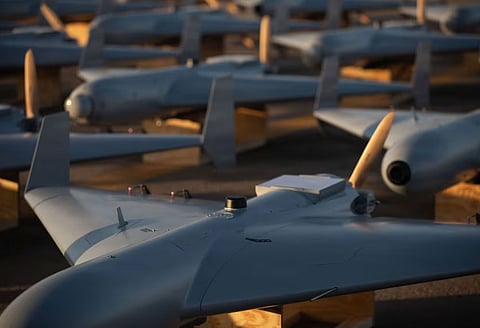
Dubai: US Central Command (CENTCOM) has created a new task force to oversee America’s first one-way-attack drone squadron in the Middle East, marking a dramatic shift in Washington’s response to Iran’s expanding unmanned capabilities, CNN has reported.
Task Force Scorpion Strike, announced on Wednesday, will manage a fleet of Low-cost Unmanned Combat Attack System (LUCAS) drones — cheap, long-range, autonomous systems reverse-engineered from Iranian Shahed drones that have reshaped battlefields from the Red Sea to Ukraine.
The move comes four months after CENTCOM issued orders to accelerate the acquisition of affordable unmanned technologies, recognising that adversaries’ low-cost weapons were outpacing traditional US precision systems.
Flipping Iran’s playbook
A US defence official told CNN the Pentagon “got hold of an Iranian Shahed,” examined it, and worked with several US companies to reverse-engineer the airframe, guidance and launch methods. The result: a 10-foot platform that “pretty much follows the Shahed design,” but with US manufacturing standards and reliability.
The Iranian-origin Shahed-136 has become one of the world’s most disruptive weapons, frequently used by Tehran and its proxy militias to harass US bases in Iraq, Syria and Jordan, and extensively deployed by Russia to strike Ukrainian critical infrastructure.
Drones in modern war
What is a one-way attack drone?
A low-cost, unmanned aircraft designed to crash into a target and detonate on impact — essentially a guided, precision kamikaze weapon.
Shahed-136
Iranian-designed
Used by Iran and its proxies, and by Russia in Ukraine
Slow, cheap, long-range, difficult to stop in large numbers
LUCAS (Low-cost Unmanned Combat Attack System)
US reverse-engineered response to Shahed
Estimated cost: $35,000 each
Autonomous, long range
Launched from catapults, rocket-assist systems or vehicles
Why they matter
Overwhelm defences through swarming
Target radar, energy facilities, ships or military bases
Change the economics of war: $35k attacker vs. $2 million interceptor
Trend
Military is shifting from “fewer, expensive missiles” to “many, cheap drones.”
“LUCAS drones deployed by CENTCOM have an extensive range and are designed to operate autonomously,” CENTCOM said, adding they can be launched from catapults, rocket-assisted systems, and mobile ground vehicles. Each LUCAS drone reportedly costs about $35,000 — a fraction of most US missiles.
The number of drones in the new squadron remains classified. A US official said only that “many” are already deployed in the region and “more will be coming.”
Response to two years of drone warfare
The US military has faced a steady barrage of unmanned attacks in the Middle East since October 2023, when Hamas’ assault on Israel triggered months of retaliatory strikes and proxy escalation.
Iran-backed militias targeted US outposts dozens of times. In one attack at a remote base in Jordan, three American service members were killed. In the Red Sea, Houthi fighters launched wave after wave of drones and missiles at commercial shipping. And in 2024, Iran fired roughly 170 drones and over 120 ballistic missiles toward Israel, almost all intercepted by Israel, the US and allied forces.
CENTCOM commander Adm. Brad Cooper said the new task force “sets the conditions for using innovation as a deterrent,” signaling the US intends to counter low-cost attacks with low-cost solutions rather than expensive, scarcity-limited interceptors.
For years, US doctrine has favored highly precise, costly systems — a strategy that, officials admit, allowed Iran to flood the battlespace with cheap, expendable drones. “Now we’re flipping the script,” a defense official said.
Task Force Scorpion Strike reportedly consists of nearly two dozen personnel, many drawn from US Special Operations Command–Central. Not all are deployed forward in theater.
The squadron’s exact location in the Middle East remains undisclosed.


