Netanyahu asks for pardon mid-trial: Legal risks, political fallout and what’s next
Israel’s president weighs request strictly according to ‘best interests of Israel’
Dubai: Israeli Prime Minister Benjamin Netanyahu has made an unprecedented request for a presidential pardon while still on trial for corruption — a move that has triggered political uproar, raised legal questions and further exposed the deep divides in Israeli society.
President Isaac Herzog has vowed to weigh the request strictly according to “the best interests of the State of Israel,” stressing that the matter will be handled “correctly and precisely.”
Netanyahu, who denies all wrongdoing, says a pardon would help “lower the flames” at a moment of national strain.
Also Read: Why is Israeli PM Netanyahu on trial?
Here’s what you need to know.
Why is Netanyahu asking for a pardon now?
Netanyahu says the multi-year corruption cases have become a national burden and are “tearing Israel apart.”
He argues that concluding the trial swiftly — through a pardon — would help heal the nation at a time of major regional instability involving Hamas, Hezbollah and Iran.
His request also cites a public appeal from US President Donald Trump, who urged Herzog to pardon Netanyahu and later sent a formal letter calling the prosecution “political” and “unjustified.”
The request spans 111 pages and does not include an admission of guilt.
Can Netanyahu legally receive a pardon before conviction?
Yes — but it is extremely rare.
Israel’s president has broad constitutional power to grant pardons, even before a verdict.
However, legal scholars say that doing so mid-trial could undermine the rule of law and the principle that all citizens are equal before the courts.
Typically, presidents address pardon requests after all legal proceedings end.
A pre-conviction pardon has almost no precedent in Israel.
Herzog will seek opinions from the Justice Ministry’s pardons department and his own legal advisers before deciding.
What is Netanyahu accused of? The three cases explained
Case 1000 – The “Gifts Affair”
Charges: Fraud and breach of trust
Allegation: Netanyahu and his wife Sara received nearly $200,000 in luxury gifts — cigars, champagne, jewellery — from Hollywood producer Arnon Milchan and billionaire James Packer.
In return: He allegedly advanced Milchan’s interests, including visa lobbying and tax benefits.
Case 2000 – The “Netanyahu–Mozes Deal”
Charges: Fraud and breach of trust
Allegation: Netanyahu negotiated with Arnon Mozes, publisher of the newspaper Yedioth Ahronoth, for more positive coverage.
In return: He allegedly offered to curb circulation of Israel Hayom, a rival newspaper.
Case 4000 – The “Bezeq Affair”
Charges: Bribery, fraud, breach of trust
Allegation: As communications minister, Netanyahu approved regulatory benefits worth hundreds of millions of shekels for the telecom giant Bezeq.
In exchange: Bezeq’s former chairman, Shaul Elovitch, allegedly ensured favourable coverage of Netanyahu and his wife on the news site Walla, which he controlled.
This is considered the most serious case because bribery carries up to 10 years in prison.
Why is the trial taking so long?
Investigations began years before the 2019 indictments.
The trial started in May 2020 but faced delays due to:
Israel’s prolonged political deadlock (five elections in four years)
Netanyahu’s repeated requests for postponements, citing diplomatic and security demands
The wars in Gaza, Lebanon and against Iran
Critics, including families of Israeli hostages in Gaza, accuse Netanyahu of slowing proceedings to remain in office.
Netanyahu’s defence: ‘Deep state’ and political vendetta
Netanyahu says the cases are part of a conspiracy by the media, police, and judiciary to remove him from power.
He denies every allegation and has not admitted guilt in his pardon request.
He argues that ending the trial now would:
help stabilise Israel
reduce political tensions
allow him to focus on wartime leadership and diplomatic challenges
His supporters — including Defence Minister Israel Katz — say the country must “move forward.”
The criticism: ‘No one is above the law’
Opposition figures, legal experts and civil society groups say a pardon now would set a dangerous precedent.
Yair Lapid: No pardon should be granted “without an admission of guilt, remorse and immediate retirement from political life.”
Israel Democracy Institute: A pre-conviction pardon “threatens the rule of law.”
Watchdogs say it may suggest political leaders can escape accountability.
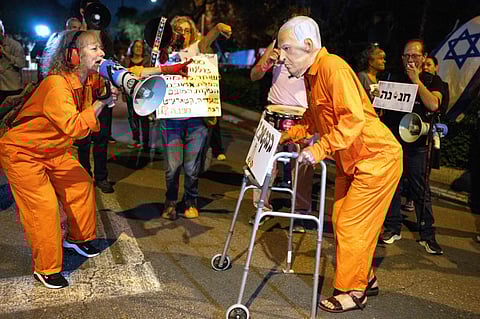
Protesters gathered outside the courthouse, some in orange prison suits, demanding that Netanyahu face trial like any citizen.
What happens next?
1. Justice Ministry’s pardons department will review the request.
2. Their opinion goes to the President’s legal adviser.
3. Herzog then makes the final call — he can accept, reject or delay.
4. The trial continues meanwhile; the request does not freeze proceedings.
Herzog has previously said he prefers a negotiated settlement between prosecutors and Netanyahu’s lawyers — potentially involving reduced charges in exchange for stepping back from political life. But no deal has materialised.
Context: Israel’s long history of corruption probes
Every Israeli prime minister since 1996 has faced corruption investigations:
Ehud Barak – campaign financing allegations
Ariel Sharon – bribery probe (Greek Island affair)
Ehud Olmert – convicted of bribery and served jail time
Netanyahu – multiple investigations, three indictments
Netanyahu is the only sitting prime minister ever to stand trial.
Netanyahu’s request is legally possible but politically explosive.
Approving it could reshape Israel’s political landscape — raising accusations of impunity — while rejecting it could prolong a trial already dragging into its fifth year.
President Herzog now faces one of the most sensitive decisions of his career, with powerful international voices, including Donald Trump, weighing in.


