Killing of women students stuns Italy
Rallies have been held to denounce femicide and demand tougher measures from government
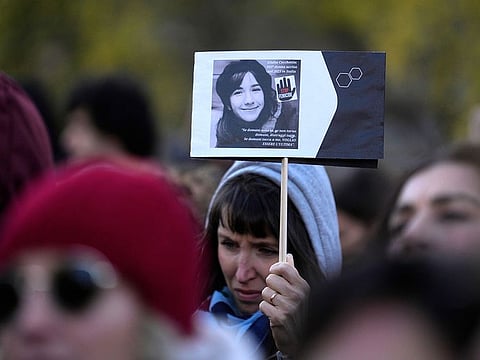
Rome: The brutal stabbings of two women students in Italy within days of each other have unleashed a wave of anger and calls for a “cultural revolution” against violence towards women.
The murder of Ilaria Sula and Sara Campanella in separate incidents in recent days come nearly a year and a half after the shocking killing of student Giulia Cecchettin by her ex-boyfriend, a high-profile case that many vowed would mark a turning point in Italy.
“Forever twins in an atrocious death”, read the Repubblica daily this week of the country’s latest femicides in a country where macho attitudes often still hold sway.
Sula, 22, a statistics student at Rome’s La Sapienza University, was stabbed in the neck by her ex-boyfriend, an architecture student. He confessed to the crime, according to news reports.
Several days after her March 25 disappearance, her body was found in a suitcase, abandoned in an unauthorised dump outside the capital.
Campanella, also 22, was killed in broad daylight Monday in Messina, Sicily, by a fellow student whom she had rejected but who had continued to stalk her.
She was stabbed in the middle of the street in front of numerous witnesses.
Her stalker had also confessed to police, according to local media.
In the wake of the killings, rallies have been held in the country to denounce femicide and demand tougher measures from the government to protect women.
“Another world is possible,” read a banner outside La Sapienza in Rome during a march attended by several hundred students on Wednesday.
“It’s not an impulse, it’s patriarchy,” read another at a rally in Messina, where thousands of people also joined a torchlight procession on Thursday evening for Campanella.
Italy’s newspaper of record, the Corriere della Sera called Thursday for a “cultural revolution” that would educate adolescents about “non-violence and respect for others.”
“This is a matter of urgency. We can’t wait any longer,” read the paper.
99 femicides last year
Ten women were killed by their partner or ex-partner in the first three months of this year, compared with 13 in the same period last year, according to interior ministry statistics.
Some 61 women were killed by their partner or ex-partner in 2024, with the number rising to 99 when family members were included in the list of perpetrators.
The deaths of the two young women have been a stark reminder of how little has changed since the November 2023 stabbing death of Cecchettin, a 22-year-old biomedical engineering student at the University of Padua.
Her ex-boyfriend Filippo Turetta, also 22, was sentenced in December to life imprisonment for kidnapping Cecchettin and stabbing her over 70 times before leaving her body in a gully.
Cecchettin’s murder provoked rage and disbelief in Italy, with hundreds of thousands of demonstrators taking to the streets calling for cultural change.
But critics say government responses until now have fallen short.
Most recently in March, to coincide with International Women’s Day, the government introduced a draft law to make femicide a crime in its own right, and no longer a simple variant of homicide.
The law already recognised aggravating circumstances where the killer was a husband or relative, but the change expanded this for crimes where the victim was targeted just because she was a woman.
Prime Minister Giorgia Meloni - Italy’s first woman premier - hailed the reform at the time as “a new step forward... towards tackling violence against women”.
But activists and opposition parties have criticised the hard-right government for its focus on penalties rather than education to address the cultural roots of the problem in a still largely patriarchal society.
Members of the government, including the education minister last November, have occasionally made links between femicide and immigration.
The alleged killer of Sula, who has Albanian origins, is of Filipino descent.
On Thursday, Justice Minister Carlo Nordio, a member of Meloni’s far-right Brothers of Italy party, drew outrage when he suggested young people from “some ethnicities... don’t have our sensitivity towards women”.
Official figures show that 94 percent of women murder victims in Italy were killed by other Italians.


