Philippines: War on 'text blasters' — ex-POGO phishers peddle scam machines that hijack your phone
Illegal SMS blasters fuel new wave of 'smishing' attacks despite POGO shutdown
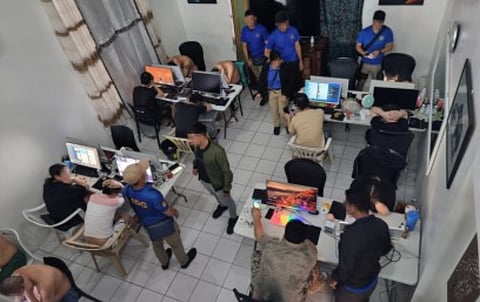
Manila: Authorities here are ramping up a nationwide crackdown on illegal "text blasters" — high-powered GSM devices — now peddled on Facebook Marketplace and online store Shopee by ex-workers from shuttered offshore gaming operations.
While centralised scam hubs have declined, the Philippine National Police (PNP) said they are battling "guerrilla-style" sales of the text blasters suspected to have been ripped from Philippine Offshore Gaming Operators (POGOs) shuttered in 2024.


The devices are then sold to petty criminals via social media. Authorities are now hunting vendors for violating data privacy and local radio control laws.
These text blasters once powered the massive offshore gaming scam empires banned as of December 31, 2024 in the Philippines.
PNP chief Gen. Jose Melencio Nartatez Jr. warned on Friday (May 8, 2026) that after the 2024 POGO ban gutted centralised fraud factories, rogue sellers are salvaging 32-port "blasters" (worth ₱20,000–₱40,000 each) from abandoned sites and hawking them piecemeal to small-time crooks for "smishing" (social media phishing) campaigns.
SMISHING, PHISHING: In the Philippines, "phishing" and "smishing" (SMS phishing) are types of cyber fraud that have been heavily linked to the illegal operations of Philippine Offshore Gaming Operators (POGOs) and their workers, even after the industry's official ban in December 2024. These scams involve deceptive messages (texts, emails) designed to trick individuals into revealing personal, financial, or banking information to STEAL MONEY.
"While we have seen a decline in centralised scam hubs since the 2024 POGO ban, we are now facing a guerrilla-style distribution. These devices are being pulled out from closed firms and sold individually to smaller criminal elements," Nartatez said, detailing recent busts.
Two Parañaque suspects were arrested with three 32-port units (₱120,000 total), while a Cavite seller was caught with dual 4G beasts (₱40,000).
How text blasters work
These blasters don't "phish" via WiFi — they masquerade as fake cell towers, hijacking nearby SIMs to blast malware-laden SMS en masse.
This helps them evade carrier filters.
In so doing, they fuel bank scams that have fleeced Filipinos of billions since POGO heyday.
Nartatez ordered the PNP Anti-Cybercrime Group (ACG) into 24/7 cyber patrols alongside the NTC, vowing zero tolerance.
“The danger of these text blasters lies in their ability to bypass traditional network security. Unlike internet-based scams, these devices act as portable cell sites, forcing nearby phones to receive unsolicited and often malicious messages,” Nartatez said.
Cyber patrols
He said the devices remain a major tool for large-scale "smishing" and "phishing" operations.
Nartatez has ordered the PNP-ACG to intensify cyber patrols and surveillance of online marketplaces to stop the proliferation of the scam devices.
According to Security Brief Asia, phishing and smishing (SMS phishing) have surged significantly in the Philippines, with reported phishing sites increasing by over 400% in 2025.
As of early 2026, smishing is the dominant threat, exploiting the country's high mobile penetration and the rapid adoption of digital banking and e-wallets.
"Scammers are increasingly using automation, artificial intelligence, and tailored social engineering to steal credentials and funds," the report stated.


