Pakistan: WHO’s mobile labour rooms to help pregnant women of ‘difficult areas’
2,000 deliveries a day reported from flooded districts, 8.2m in need of health assistance
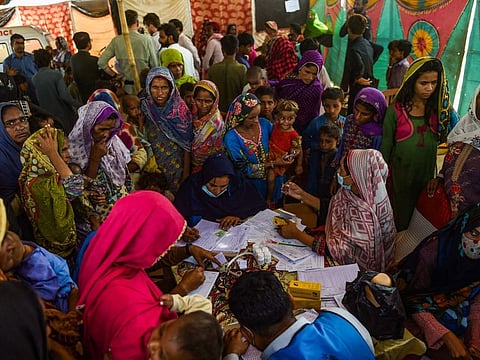
ISLAMABAD: In order to meet the overwhelming number of child births daily in the flooded areas — around 2,000 deliveries a day — the WHO has devised mobile labour room modality to reach the areas where women’s access to hospitals is difficult.
The World Health Organisation (WHO) has targeted 32 priority districts out of a total 84 affected by the recent floods in Sindh, Balochistan, KP and Punjab.
People, particularly women and children, there, are facing risk of diseases such as diarrhoea, cholera, malaria, dengue fever, skin infections and typhoid due to limited health services.
Country Representative of the WHO, Dr Palitha Mahipala, at a media briefing on Saturday spoke at length about the challenges his teams were facing in providing medical assistance to the flood-affectees and said it was a catastrophe whose scale was too huge and unheard of so far.
Referring to Pakistan’s National Disaster Management Authority (NDMA) figures, Dr Mahipala said around 580,000 people are currently displaced due to floods and one can see countless families sitting in camps along the roads waiting for food, health assistance. The situation is alarming particularly in Sindh and Balochistan, he said.
Malnutrition, stunting among kids to be addressed
Besides, malnutrition and stunting among children are also posing severe health risks, he said.
The WHO is working in close coordination with the government and the donor agencies as well as stakeholders on multiple fronts, said the Country Representative.
To meet the malnutrition challenges, 100 new nutrition stabilisation centres will start functioning in the next two week.
330 teams working in flood-hit areas
The WHO has already released $10 million (Dh36.73 million) to support health response to floods to treat the injured, deliver medical supplies to health facilities, and prevent the spread of infectious diseases and outbreaks.
Besides, $618,048 have been funded for providing essential medicines, emergency stockpiles, medical supplies, water purification kits, tanks, tents, ORS sachet and tents, he said, adding among provinces, support has been distributed in response to flood emergency.
The total support with medicines, equipment and other logistics stands at $2 million, he said adding medicines and diagnostics in the pipeline were over $5 million. The mobile clinics — vehicles to be donated amount to approximately $500,000.
Water and sanitation equipment partially distributed and some are in Karachi warehouse worth $ 174,000 while diagnostic worth $7.83 million are in pipeline under procurement.
The WHO has prepared dashboards including a logistics dashboard to provide an overview of its operations and the current situation in flood-hit areas, he said.
In the flood-hit areas, already 330 teams recruited and trained by the WHO are working for healthcare and medical assistance. The WHO has also provided 4 million water purification tablets.
The WHO has also undertaken construction of half of the fully-damaged 400 primary healthcare centres and 30 of them have already been completed, he said.


