Monks join rescue efforts as survivors shiver outdoors
Two days after the quake hit China 294 people are still missing
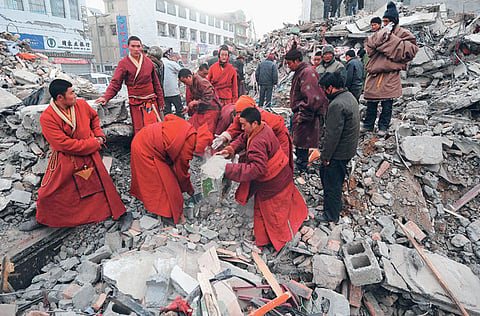
Jiegu: Rescuers probed the rubble for sounds or movement on Friday in a rush to find anyone buried alive more than 48 hours after an earthquake hit western China, killing at least 791 people. Many survivors shivered through a second night outdoors as they waited for tents to arrive in the remote, mountainous Tibetan area.
People with broken arms or legs cried in pain as medical teams could offer little more than injections. A doctor at the Qinghai provincial hospital, where the severely injured were being flown, said she had no idea how many were being treated because there was no time to count them all.
Stunned survivors wandered the dusty streets of Jiegu, where relief workers estimated 70 per cent to 90 per cent of the low-slung town of wood-and-mud housing had collapsed.
Hundreds gathered to sleep in a plaza around 15-metre tall statue of the mythical Tibetan King Gesar, wrapped in blankets taken from homes shattered by Wednesday morning's quakes.
Smoke rose from charcoal stoves dotting the plaza as some families brewed salty black tea, a Tibetan staple, and ate flat bread and fried noodles. Others complained there wasn't enough to eat and asked reporters to help them get food.
The official Xinhua News Agency reported on Friday afternoon that the death toll had risen to 791, with 294 missing. The report said 11,477 people were injured, 1,174 severely. The strongest of the quakes on Wednesday morning measured magnitude 6.9 by the US Geological Survey and 7.1 by China's earthquake administration.
Accommodation
China Central Television reported that about 40,000 tents would be in place by Saturday, enough to accommodate all survivors. Also on the way was more equipment to help probe for signs of life under the debris, it said.
Common tools include small cameras and microphones attached to poles that can be snaked into crevices as well as heat and motion sensors.
The remote mountain region's high altitude, about 4,000 metres, left some rescuers and even their sniffer dogs breathless or feeling ill.
At one collapsed building, about 70 civilians, including three dozen Tibetan monks in crimson robes, joined rescue workers on top of a pile of debris where people were believed to be trapped.
"One, two, three," the monks chanted, using wooden beams to try to push away a section of collapsed wall. They later tied ropes to a slab of concrete and dragged it away.
Xinhua quoted a local education official as saying 66 children and 10 teachers had died, mostly in three schools, but more remained missing.
Xu Lai, a spokesman for the Qinghai-based educational NGO Gesanghua, said the first and third grade classrooms at the Yushu No 3 Wanquan Elementary School crumbled because they were built with mud, instead of brick and cement. Xu was not sure how many bodies or survivors had been recovered at the school.
Thogong Golma, an employee at the Children's Home of Hope for orphans, said 30 of the home's children were missing, including many who attended classes at the No 3 Wanquan school.


