Shashi Tharoor slams proposed foreign funding Bill, government says no retrospective clause
MP warns Bill could disrupt charities, hospitals, schools serving millions across India
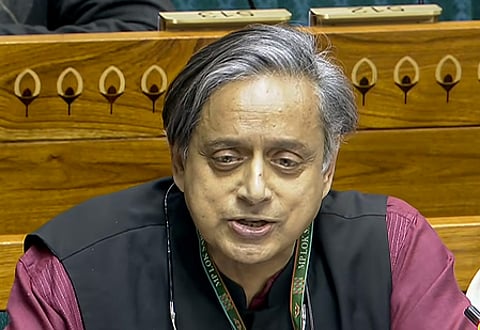
Dubai: Congress MP Shashi Tharoor has launched a scathing attack on the proposed Foreign Contribution (Regulation) Amendment Bill, 2026, calling it a “dangerous escalation in the centralisation of executive power” that “fundamentally rewrites the relationship between the Indian state and civil society”.
In a strongly worded column in The Indian Express, the Thiruvananthapuram MP accused the government of being “driven by its majoritarian ideology and allergy to independent voices”.
“The current government has increasingly reframed non-profit charities, think tanks and human rights groups not as development partners, but as sources of subversion and foreign manipulation. To neutralise these voices, the state has targeted their primary vulnerability: dependence on international philanthropy,” Tharoor wrote.
He said successive changes to the FCRA had already imposed heavy compliance burdens by banning sub-granting to grassroots organisations, slashing administrative spending limits and requiring all foreign donations to pass through a single New Delhi bank branch.
According to Tharoor, these measures had triggered an 87% drop in foreign funding, forcing thousands of secular and community-based organisations to shut down. He warned that the latest amendments, allowing the state to take over assets created with foreign contributions, threatened to “permanently cripple the sector”.
Describing the proposal as introducing “an unprecedented mechanism of control that bypasses traditional legal protections”, Tharoor said it would allow the government to take over assets when an organisation’s FCRA registration is cancelled, surrendered or expires.
What the Bill seeks to do — and the government’s reassurance
The Bill proposes to:
Create a Designated Authority to manage foreign contributions and assets created through them when an organisation’s FCRA registration is cancelled, surrendered or ceases.
Introduce the concept of “cessation” of an FCRA certificate if it is not renewed, renewal is refused or it expires.
Vest foreign contributions and assets created from them with the authority, which may return them if the organisation later regains registration. If not, the assets may permanently vest with the authority.
Ensure that if the asset is a place of worship, its religious character is maintained.
Government’s reassurance
Says the Bill will not apply retrospectively, addressing concerns over older assets.
Says the aim is continuity of management, not confiscation, during interruptions in FCRA registration.
Says assets can be returned if an organisation later secures a fresh or renewed FCRA registration.
Says religious institutions will continue to be managed according to the practices of their own faith.
Extreme instability
Drawing on his experience as a Kerala MP, Tharoor said Christian-run charitable trusts, schools, hospitals, medical colleges, diagnostic centres and welfare NGOs had served marginalised communities for more than a century, relying on a mix of local donations, domestic fees and foreign grants to provide affordable healthcare and education.
He warned that the proposed law could have serious consequences for the people who depend on these institutions.
“By linking an administrative decision on an FCRA licence directly to the physical confiscation of land and buildings, the Bill creates an environment of extreme instability. A single administrative delay or an adverse ruling by the Ministry of Home Affairs could instantaneously convert a functioning 500-bed charitable hospital into state property, disrupting essential public services and placing community assets under government control. The victims are the ordinary Indians who are the beneficiaries of these facilities,” Tharoor wrote.
Call to unite
Calling the Bill anti-democratic, he urged Opposition parties to unite against it, saying it was “a profound injustice” to subject institutions that had devoted generations to India’s development, education and healthcare to such “punitive statutory mechanisms”.
The criticism came as the Centre sought to allay concerns over the proposed legislation, signalling that it would not contain any retrospective provision. Government sources said the objective was to ensure continuity in the management of institutions if there was a break in FCRA registration rather than permanently confiscate assets.
They said a designated authority would act as an interim manager and assets could be returned if an organisation later secured a fresh or renewed FCRA registration. Officials also said places of worship would continue to be managed according to their respective religious practices.
According to the Ministry of Home Affairs, 13,520 organisations received Rs 557.4 billion (Rs 55,741 crore) in foreign contributions between 2019 and 2022. As of July 15, 2026, the FCRA portal showed 14,449 active FCRA certificates, while 22,498 had been cancelled and 15,212 were deemed expired.


