US tech giants unveil India deals at Delhi AI summit
Direct undersea connections from India to Singapore, South Africa and Australia planned
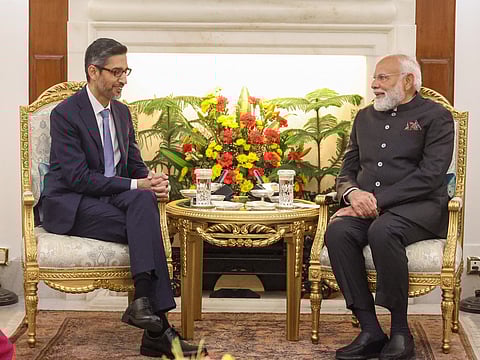
New Delhi: Google said it would build new subsea cables from India and chip titan Nvidia unveiled tie-ups with computing firms on Wednesday as tech giants rushed to announce deals and investments at a global AI conference in New Delhi.
The AI Impact Summit is the fourth annual gathering to discuss how to govern the fast-evolving technology - and also an opportunity for India to raise its profile in the booming sector.
“India’s going to have an extraordinary trajectory with AI and we want to be a partner,” Google CEO Sundar Pichai told reporters as the US firm unveiled a plan to boost connectivity to the South Asian country.
New direct undersea connections from India to Singapore, South Africa and Australia will be constructed, it said, touting faster connections as demand for computing power, including AI, ramps up.
AI hiring hotspots
Bengaluru leads AI recruitment with a 25.4% share of national job openings
Delhi-NCR close behind at 24.8%, driven by consulting, fintech, healthcare and public sector demand
Mumbai holds 19.2%, making the top three cities responsible for nearly 70% of AI roles
Bengaluru and Delhi-NCR together account for over half of India’s AI-related job listings
Key hiring domains:
Engineering (Software & Quality Assurance)
Data Science & Analytics
Customer Success, Service & Operations
Data basis: Analysis of 64,500+ active listings on Naukri.com (December 2025)
It is part of Google’s $15 billion investment announced in October to construct its largest AI data centre hub outside the United States, in Visakhapatnam, a port city in the southeastern state of Andhra Pradesh.
Also on Wednesday, the California-based Nvidia - the world’s most valuable company - said it was teaming up with three Indian cloud computing providers to provide advanced processors for data centres that can train and run AI systems.
India’s ambitions to become a leading force in artificial intelligence took centre stage at the India AI Impact Summit 2026, where global technology executives, policymakers, and international leaders highlighted both the transformative potential of AI and the urgent need for responsible governance.
Rapid digital adoption
Pichai, speaking during the summit , described the current period as a defining technological shift, calling it a “transformational moment” for India. He said artificial intelligence is poised to drive a decade-long wave of change shaped by rapid digital adoption, innovation, and new economic opportunities.
“It feels like the beginning of a decade-long change driven by technology, innovation, and large-scale adoption of AI,” Pichai said, underscoring India’s unique position due to its scale, talent pool, and expanding digital ecosystem.
Earlier in the day, Pichai met Prime Minister Narendra Modi on the sidelines of the summit, where discussions focused on India’s accelerating progress in artificial intelligence and opportunities for deeper collaboration between Google and the Indian government. Both leaders emphasised leveraging India’s vast base of students and technology professionals to expand AI research and real-world applications.
In a post on X, Pichai said the meeting explored how Google could support India’s broader AI agenda, including improving healthcare outcomes, expanding access to information across languages, supporting startups, and enhancing agricultural productivity.
India’s skilled youth
Prime Minister Modi described the interaction as forward-looking, highlighting India’s rapid advances in AI capabilities and the importance of partnerships with global technology leaders. He stressed the need to harness India’s skilled youth to strengthen the country’s leadership in emerging technologies.
Pichai also pointed to India’s remarkable digital transformation, noting that Indian users rank among the world’s highest adopters of voice-based and image-based search technologies — a trend he said reflects the country’s readiness to integrate AI tools at scale. He added that India has emerged as one of the largest markets for Google’s Gemini AI platform.
However, Pichai cautioned that the AI opportunity carries responsibilities. He stressed the importance of sustained investment in AI research, infrastructure, and foundational technologies to ensure benefits reach across sectors and society.
Global leaders attending the summit echoed similar themes, with many emphasising ethical frameworks and regulatory guardrails.
United Nations High Commissioner for Human Rights Volker Turk warned that while AI represents a powerful force for good, it also concentrates significant power that must be balanced by constraints.
“AI has an incredible force for good, but when you exercise power, you also need guardrails and constraints,” Turk said, arguing that human rights principles should guide technological deployment.
World Food Programme Deputy Executive Director Carl Skau highlighted how AI is already reshaping humanitarian operations. He said the agency’s vast data resources and global supply chain infrastructure provide a strategic advantage in deploying AI for logistics, forecasting, and crisis response.
“We have been using AI for several years… Bringing that together with AI really gives us a powerful tool,” Skau said.
The five-day summit, being held at Bharat Mandapam from February 16 to 20, has drawn participation from more than 110 countries, 30 international organisations, nearly 20 heads of state or government, and around 45 ministers. Organisers described the event as a key global platform for cooperation on AI governance, innovation, and inclusive development.
As debates around artificial intelligence intensify worldwide, India is increasingly presenting itself not only as a major AI market but as a central actor shaping how the technology evolves and is regulated globally.
-- With AFP & IANS inputs


![Global experts will examine how health data, genomics and digital tools could transform medicine during the Future Health Summit 2026. [Illustrative image]](http://media.assettype.com/gulfnews%2Fimport%2F2023%2F07%2F19%2FOPN-AI-HEALTHCARE_1896e7cdbff_large.jpg?w=320&auto=format%2Ccompress&fit=max)
