Mumbai metro masks cruel commute
Poor planning keeps financial city far from turning into another Shanghai
MUMBAI
Raghavendra Deshpande, weary of five-hour commutes to his job here, took a 20 per cent pay cut for a job nearer home. The city’s new metro rail isn’t going to change his mind.
The metro, Mumbai’s first, is due to start ferrying passengers by the end of March after repeated delays. The 12-kilometre (7.5-mile) line, built by a group led by billionaire Anil Ambani’s Reliance Infrastructure, aims to transport 600,000 people in a city of about 19 million.
“This is a trade-off I made because you don’t feel like a human being during the commute,” said Deshpande, 42, who three years ago took taxicabs or trains to cover 30 kilometres one way. “We were already late in deciding to build the metro, and the delay is adding to the misery.”
A decade after Prime Minister Manmohan Singh vowed to make Mumbai another Shanghai, creaky infrastructure, real estate that is among the most expensive in the world and urban squalor remain hallmarks of the nation’s financial capital.
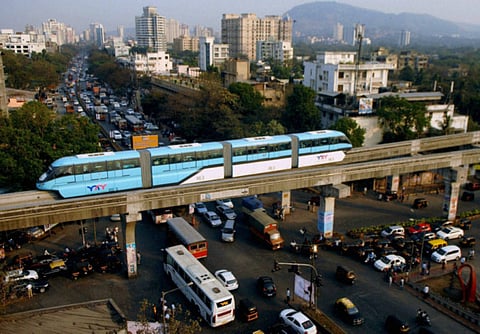
More than 3,500 people die annually in accidents involving state-run commuter trains. A newly built monorail and flyovers criss-cross the island city, almost touching crumbling buildings and defunct mills that linger from British colonial days.
Paralysed economy
Mumbai’s stasis is a symbol of the paralysis that is hobbling India’s $1.8 trillion (Dh6.61 trillion) economy as a string of investment projects remain stalled by delays in land acquisition, environmental clearances and graft allegations.
Singh’s Congress party-led coalition will face elections by May as voters grapple with an economy growing at a pace that’s close to a decade-low.
The Mumbai metropolitan region needs $60 billion of investment in public transportation over the next 20 years and the current plan falls short of needs, according to estimates by Shirish Sankhe, Mumbai-based director at McKinsey & Co. In a 2010 study, the consultant said India must spend $2.2 trillion by 2030 on urban transportation, housing and office space to boost infrastructure ranked below that of Guatemala and Namibia by the World Economic Forum.
Failure to boost infrastructure spending is hobbling growth while creating bottlenecks that fan inflation, said D.K. Joshi, an economist at Crisil Ltd., a local unit of Standard & Poor’s. “In some ways, the pace of infrastructure development is synonymous with the slow economic growth,” Joshi said. “Considering the importance of the city as a financial centre, a smooth transport system is a necessity and not a luxury.”
Slow-paced Mumbai
Mumbai’s slow pace of development contrasts with Shanghai, which today boasts of the world’s biggest rapid transit metro network covering about 560 kilometres, the No. 1 container port and two world class airports. India’s per capita spending on public works in cities is just 15 per cent of China’s and unless that is increased eightfold, it may jeopardise India’s growth prospects, according to McKinsey.
Knight Frank LLP last year ranked Mumbai the 16th most expensive city for residential space, placed just behind Tokyo and Los Angeles. Gleaming new glass and steel constructions where monthly rent costs as much as $6,500 jostle for space with the ubiquitous shanties and slums where an eight-by-eight foot shack with a tin roof is still a luxury for millions. An offshoot of the first train line started by the British-owned Great Indian Peninsula Railway in 1853 serves the teeming suburbs that have extended to Vashi on the mainland, where Deshpande lives and works, and far beyond.
Traffic snarls: Passenger traffic in Mumbai has surged sixfold since inception, while capacity has been augmented only 2.3 times, with each train on an average carrying 4,500 passengers versus the 1,750 capacity, according to Municipal Corporation of Greater Mumbai. Many of them hang on to the overstuffed trains from open exits and dart across busy tracks at stations during peak hours, resulting in 3,700 deaths every year and an equal number getting maimed, according to data obtained by Samir Zhaveri, a rail safety activist, through a Right To Information filing.
Billions on wheels: The Mumbai Metropolitan Region Development Authority (MMRDA) plans to spend Rs300 billion ($4.8 billion) on transportation in the next five years, a 50 per cent increase in allocation from the previous half-decade, according to Commissioner Urvinder Pal Singh Madan.
“Our objective is to help citizens get better facilities with the resources we have,” Madan said in a phone interview. “There’s little land available and implementing big projects in a densely populated city is a challenge unique to Mumbai.”
Metro mayhem: The metro, whose construction started in 2007, connects the northwestern suburb of Versova to Ghatkopar in the east and was originally scheduled to commence service at the end of 2011.
Lalit Jalan, chief executive officer of Reliance Infrastructure and spokesman Yuvraj Mehta declined to comment on the project and the delay in execution.
Just like the delayed project, a plan to build a second international airport in Navi Mumbai on the mainland has struggled to take off pending land approvals.
Monorail moment: A monorail opened in Mumbai earlier this month. On completion of its second phase, it may ferry at least 150,000 passengers a day — a fraction of the city’s commuter population — over a 20-kilometre stretch, according to the MMRDA’s website.
“It is essentially a feeder line that is best suited to congested areas with right-of-way issues and sharp turns,” said Rajeev Jyoti, who heads the rail business at Larsen & Toubro, India’s biggest engineering firm that is building the nation’s first monorail.
No meeting point: None of the new infrastructure can still match the British-era train system as there’s no coordination between the monorail, metro and the new airport projects, according to Sushi Shyamal, a partner at Ernst & Young in Mumbai.
“We talk of making Mumbai a Shanghai, but the cities aren’t even close to being comparable,” he said. “We are already behind. It is just poor planning.”


