India’s presidency of G20 will promote global unity: Prime Minister Narendra Modi
PM challenges bloc to go further to benefit humanity as a whole
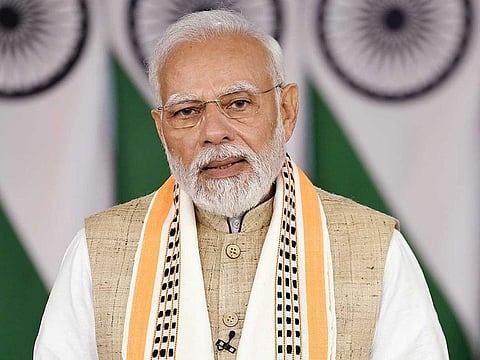
New Delhi: Prime Minister of India Narendra Modi has affirmed that India, during its presidency of the Group of Twenty (G20), will work to promote the universal sense of unity based on the theme “One Earth, One Family, One Future”.
“Today, we have the means to produce enough to meet the basic needs of all people in the world,” he stated.
In an article titled “One Earth, One Family, One Future”- India’s G20 Presidency: Towards a new paradigm of Globalisation”, Prime Minister Modi commended the previous 17 Presidencies of the G20, who delivered significant results - for ensuring macroeconomic stability, rationalising international taxation, relieving debt-burden on countries, among many other outcomes.
Following is the full text of Indian Prime Minister’s Op-Ed:
“Today, India commences its G20 Presidency.
The previous 17 Presidencies of the G20 delivered significant results - for ensuring macroeconomic stability, rationalising international taxation, relieving debt-burden on countries, among many other outcomes. We will benefit from these achievements, and build further upon them.
However, as India assumes this important mantle, I ask myself - can the G20 go further still? Can we catalyse a fundamental mindset shift, to benefit humanity as a whole?
I believe we can.
Our mindsets are shaped by our circumstances. Through all of history, humanity lived in scarcity. We fought for limited resources, because our survival depended on denying them to others. Confrontation and competition - between ideas, ideologies and identities - became the norm.
Unfortunately, we remain trapped in the same zero-sum mindset even today. We see it when countries fight over territory or resources. We see it when supplies of essential goods are weaponised. We see it when vaccines are hoarded by a few, even as billions remain vulnerable.
Some may argue that confrontation and greed are just human nature. I disagree. If humans were inherently selfish, what would explain the lasting appeal of so many spiritual traditions that advocate the fundamental oneness of us all?
One such tradition, popular in India, sees all living beings, and even inanimate things, as composed of the same five basic elements - the panch tatva of earth, water, fire, air and space. Harmony among these elements - within us and between us - is essential for our physical, social and environmental well-being.
Today, the greatest challenges we face - climate change, terrorism, and pandemics - can be solved not by fighting each other, but only by acting together.
Fortunately, today’s technology also gives us the means to address problems on a humanity-wide scale. The massive virtual worlds that we inhabit today demonstrate the scalability of digital technologies.
Housing one-sixth of humanity, and with its immense diversity of languages, religions, customs and beliefs, India is a microcosm of the world.
With the oldest-known traditions of collective decision-making, India contributes to the foundational DNA of democracy. As the mother of democracy, India’s national consensus is forged not by diktat, but by blending millions of free voices into one harmonious melody.
Today, India is the fastest growing large economy. Our citizen-centric governance model takes care of even our most marginalised citizens, while nurturing the creative genius of our talented youth.
We have tried to make national development not an exercise in top-down governance, but rather a citizen-led ‘people’s movement’.
We have leveraged technology to create digital public goods that are open, inclusive and interoperable. These have delivered revolutionary progress in fields as varied as social protection, financial inclusion, and electronic payments.
For all these reasons, India’s experiences can provide insights for possible global solutions.
During our G20 Presidency, we shall present India’s experiences, learnings and models as possible templates for others, particularly the developing world.
Our G20 priorities will be shaped in consultation with not just our G20 partners, but also our fellow-travellers in the global South, whose voice often goes unheard.
Our priorities will focus on healing our ‘One Earth’, creating harmony within our ‘One Family’ and giving hope for our ‘One Future’.
For imbuing hope in our future generations, we will encourage an honest conversation among the most powerful countries - on mitigating risks posed by weapons of mass destruction and enhancing global security.
India’s G20 agenda will be inclusive, ambitious, action-oriented, and decisive.
Let us join together to make India’s G20 Presidency a Presidency of healing, harmony and hope.
Let us work together to shape a new paradigm - of human-centric globalisation.”


