Indian Railways electrifies 99.2% of broad gauge network
Fourteen zones hit 100%; ministry says drive speeds up since 2014
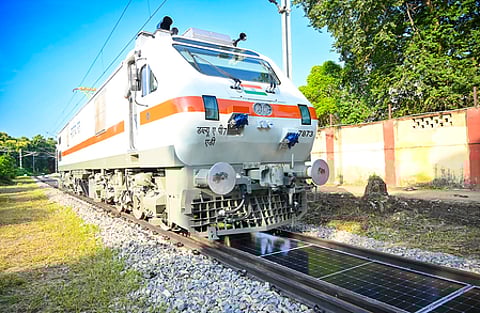
New Delhi: Indian Railways has electrified 99.2 per cent of its broad gauge network, marking a major milestone in India’s transport infrastructure push and placing the country ahead of several major railway systems globally, including the UK, Russia and China, according to a Ministry of Railways statement.
With this achievement, India has moved closer than ever to operating a fully electrified railway network. Fourteen railway zones — including Central, Eastern and Northern Railways — have completed 100 per cent electrification, while 25 states and Union Territories have also fully electrified their broad gauge lines.
Data shared by the government in a written reply to the Lok Sabha highlights the rapid pace of electrification over the past decade. Between 2014 and 2025, Indian Railways electrified 46,900 route kilometres, more than double the 21,801 route kilometres electrified during the previous six decades combined. The momentum has continued in recent years, with 7,188 route kilometres electrified in 2023–24 and a further 2,701 route kilometres in 2024–25.
Several major railway zones have now achieved complete electrification, including Central, East Coast, East Central, Eastern, Konkan Railway, Kolkata Metro, North Central, North Eastern, Northern, South Central, South East Central, South Eastern, West Central and Western Railways. Other zones such as North Western, Southern, Northeast Frontier and South Western Railways have crossed the 95 per cent electrification mark.
State-wise data also points to extensive coverage. The entire existing broad gauge network in Arunachal Pradesh, Meghalaya, Nagaland, Tripura and Mizoram has been fully electrified. Assam has achieved 92 per cent electrification, with work underway on the remaining sections. States such as Rajasthan, Tamil Nadu and Karnataka are nearing completion.
The ministry noted that timelines for completing electrification projects depend on several factors, including forest clearances, shifting of utilities, statutory approvals from multiple authorities, geological and topographical challenges, law-and-order conditions and climatic constraints that limit working months in certain regions.
Beyond operational efficiency, the electrification drive is a key pillar of India’s sustainability strategy. Rail transport emits significantly less carbon dioxide than road transport — about 11.5 grams of CO2 per tonne-kilometre compared with 101 grams for road freight. Overall, rail transport emits nearly 89 per cent less CO2 than road-based alternatives.
Indian Railways has also been expanding its use of renewable energy, with 898 MW of solar power commissioned across 2,626 stations nationwide.
The government has reiterated its commitment to achieving 100 per cent electrification and transitioning Indian Railways into a net-zero carbon emitter by 2030. All new railway lines and multi-tracking projects are now being sanctioned with electrification integrated from the outset, reinforcing the shift towards a cleaner, more efficient national rail network.


