Indian-origin academic among winners of maths 'Nobel' Fields Medal
Akshay Venkatesh, who made a mark as a child prodigy, is a professor at Stanford University
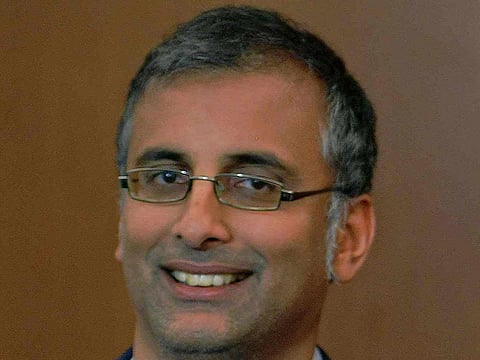
New York: Indian-origin academic Akshay Venkatesh has been awarded the Fields Medal, which is often called the Nobel Prize of mathematics.
The award to the 36-year-old academic was announced on Wednesday at the International Congress of Mathematicians in Rio de Janeiro.
Venkatesh, who made a mark as a child prodigy, is a professor at Stanford University and is set to move to the School of Mathematics of the Institute for Advanced Study at Princeton on August 15.
He is the second Indian-origin mathematician to win the prize after Manjul Bhargava, a Princeton University professor, who received it in 2014.
The other three winners of the medal awarded every four years usuallyto four mathematicians are Caucher Birkar, 40, of the University of Cambridge; Alessio Figalli, 34, of the Swiss Federal Institute of Technology, and Peter Scholze, of the University of Bonn.
The prize carries a gold medal and an award of Canadian $15,000.
Ali Nesin of Turkey was awarded on Wednesday at the Congress another prestigious award, the Leelavati Prize sponsored by Infosys for increasing public awareness of mathematics.
Nesin is the founder of the Mathematics Village, a unique institution offering short immersion courses in mathematics for high school and college students.
The prize is named for the treatise of 12th century mathematician Bhaskara II and carries a Rs 1 million-award.
Venkatesh was awarded the prize for his work in analytic number theory, homogeneous dynamics, topology, and representation theory.
The Institute for Advanced Study said he works "at the intersection of analytic number theory, algebraic number theory, and representation theory."
He won India's SASTRA Ramanujan Prize, founded by Shanmugha Arts, Science, Technology and Research Academy (SASTRA)
in Tamil Nadu in 2008 and the InfoSys Prize given by the Infosys Science Foundation in 2016.
Venkatesh moved to Australia from New Delhi with his parents when he was two years old.
When he was 12, he won medals at the International Physics Olympiad and International Mathematics Olympiad and joined the University of Western Australia at 14 and graduated with a first class honours degree at 15.
At 16, he started his post-graduate studies at Princeton University and completed his PhD when he was 22.
He was previously an instructor at Massachusetts Institute of the Technology, and an associate professor at New York University.
Fields Medal is stolen minutes after professor wins it
A medal regarded as the most prestigious in the world of mathematics has been stolen from a Cambridge professor just half an hour after he was awarded the prize in Rio de Janeiro.
Caucher Birkar was one of four joint winners of the Fields medal - regarded as the Nobel prize for maths - who were given the award at the International Congress of Mathematics on Wednesday
But within minutes, the award was stolen. The G1 news site said Birkar had left the medal in a briefcase with his cellphone and wallet on top of a table in the pavilion where the event was being held.
The event's security team later found the briefcase under a bench, but the medal was missing.
Rio's O Globo newspaper said the thief had already been identified from security camera footage.
Organisers lamented the theft in a statement. "The organizing committee of the International Congress of Mathematics profoundly regrets the disappearance of the briefcase of mathematician Cauchar Birkar, which contained the Fields medal he received at this morning's ceremony," they said. "Images recorded at the event are being analysed. The organising committee is cooperating with local police authorities in their investigation."
The congress is being held at Riocentro, a convention centre on the western edges of Rio - a city struggling with soaring crime rates.
Birkar was born in Iran and moved to the UK as a refugee two decades ago. The Fields medal was first awarded in 1936 and since 1950 is presented every four years to up to four mathematicians under 40.
Wednesday's theft was not the first problem the event has faced. On Sunday night a fire broke out at the pavilion hosting it when a sky lantern landed on it, causing the overnight team to evacuate.
"The roof caught fire," one of the workers told the Guardian. "We tried to contain it inside but there was no way. The whole roof caught fire. We had to evacuate the area, and we had to move to another pavilion. Everything we had set up we had to mount again."


