A floral tribute to Bengaluru — India’s Garden City
Catch nocturnal blossoms of Bengaluru in one of Asia’s oldest and largest flower bazaars
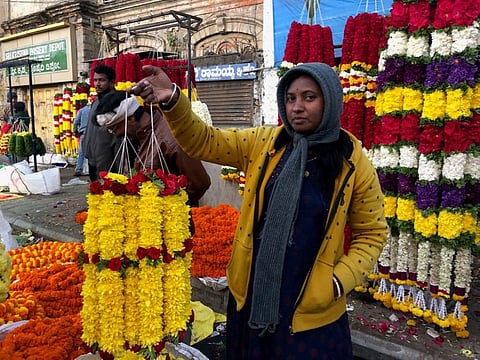
Bengaluru: Bengaluru is one of India’s most cosmopolitan cities, drawing people from all walks of life, from across the country as well as overseas, thanks to its status as the IT capital of India.
Until a few decades ago, the city was a laidback little capital of the southern Indian state of Karnataka, known for its sprawling gardens and numerous parks, giving it the first of its many epithets — the garden city of India.
Though the city has lost most of its old world charm, mutating into a thriving yet congested metropolis — known as much for its traffic jams as for its IT infrastructure and educational institutions — some of its major gardens have continued to bloom in today’s highly polluted atmosphere.
Apart from its perennial blooms at the centuries old Lal Bagh developed by Hyder Ali and Tipu Sultan and the British developed Cubbon Park as well as the colourful annual spring blossoms, the city maintains another blossoming tradition — its nocturnal flower bazaar at the Krishna Rajendra (KR) Market.
Floral fascination
Flowers have been essential to life in India since ancient times. Whether in prayers, birth, death, rituals, healing or ceremonies, flowers are present at all occasions in India.
Bengaluru’s tryst with flowers goes long back, when it was little more than a small administrative town, surrounded by little hamlets growing a range of flowers and bringing it to Bengaluru’s KR or City Market every morning.
This more than a century old tradition has continued into our times, albeit in a much frenzied iteration, turning the historic market into one of Asia’s biggest flower bazaars.
Every midnight, when the rest of the city is fast asleep, the more than 100-year-old Krishna Rajendra Market wakes up to a riot of fragrances and colours.
Suppliers and merchants begin to converge into the intricate network of shops, stalls and kiosks between 1am and 2am setting up for a long night of floral haggling and fragrant transactions.
Redolent rhythm
As the bazaar gets into its redolent rhythm, Subbalakshmi takes her usual position at the underground section of the market with her large flower baskets.
The 49-year-old has been following this routine for the last 30 years and starting her day around flowers has now become like a ritual for her.
Kickstarting her day at around 2am, the mother of two walks her way from home, opening her business at around 4am.
“When I started this business, I was a young mother looking to feed my children as our family fell on hard times. To maintain this unusual nocturnal routine was tough initially, but overtime I got used to it,” said Subbalakhsmi, who is originally from Tamil Nadu.
From a reluctant small-time vendor, Subbalakhmi, who is popularly known as Subbakka (Sister Subba) in the market, has turned into a seasoned businesswoman, making an average daily business of around Rs10,000 and employing several women in her neighbourhood.
“Over the years I learned the tricks of business and grew into this role. Every morning before I head back home I purchase the flowers and employ the women in the neighbourhood to make garlands on a daily wage basis. The next day I bring the baskets of garlands and sell them in the market. I hire porters to transport the merchandise. This is a well set arrangement,” added Subbalakshmi, detailing her routine.
The market supports thousands of families like that of Subbalakhsmi.
Apart from vendors, hawkers and wholesalers, the flower bazaar supports hundreds of farmers who bring their harvests regularly to the market and return home satiat-ed.
But, how did this tradition begin?
“Some hundred years ago, Bengaluru was a small town and there were dozens of villages around it. Every evening farmers from the villages would harvest their flowers and bring them to the market to sell them off. Since, in those days there was no transportation system at night or early in the morning, they had to reach the market in the evening and wait overnight. Gradually as more people gathered in the market overnight and transactions took place, the tradition of night market started,” said SVC Ashok, a veteran wholesale trader in the market.
Ashok started as a small time hawker around three decades back and now owns two wholesale shops selling around 500 kilogrammes of flowers, mainly roses, daily.
“Flower is a big business here. We have flowers coming from neighbouring districts and different parts of the state. Some varieties come from Andhra Pradesh and Tamil Nadu as well. Apart from local business most of the flowers are exported, largely to European countries,” said Ashok, who employs eight people to run his two shops that are open for business from 3am to 8pm.
The flower market has 148 wholesale shops, 160 retail outlets and numerous smaller stalls, apart from countless vendors and hawkers who do their business on the streets around the market.
Leafy life
At 220,000 tonnes, Karnataka produces 75 per cent of India’s flowers a majority of which is exported to Europe and other parts of the world.
The state has 30,900 hectares of land cultivated for flowers, housing India’s only international flower auction centre in Bengaluru.
Ranging from chrysanthemum, rose, marigold and jasmine, to lavender, aster and lotus, a wide variety of flowers are produced in the state and most of these flowers go through the Flower Bazaar of Bengaluru.
Flowers add colour and fragrance to our lives, they add beauty to our world, they are a part of nature that are accessible and can be worn easily.
To notice the sheer variety of flowers and people’s fascination with them, a visit to Krishna Rajendra Market is must when you are in and around Bengaluru. But, make sure you don’t visit during festival days, you will literally get lost in the jostling crowd!
Scented geranium leaves
Apart from flowers, the market also offers herbs, edible leaves and scented leaves and barks. Ravi Kumar is among the few vendors who sells scented geranium leaves in the market that are used in garlands and for decorations. “I sell more than 300 kilos of geranium leaves daily. There is a big demand for these. These leaves come from Chitradurga every day, the rate keeps changing, currently we are selling these for Rs120 per kg. This is a good business because there is very little competition,” said Kumar, who works and lives in the market to save the hassle of travelling and logistics.
-- Shafaat Shahbandari, founder-editor of Thousand Shades of India, is a freelance journalist based in Bengaluru


