Broad Peak avalanche: 3 climbers still missing as rescuers recover 7 bodies
Operation backed by drones, military helicopters, high-altitude rescue teams
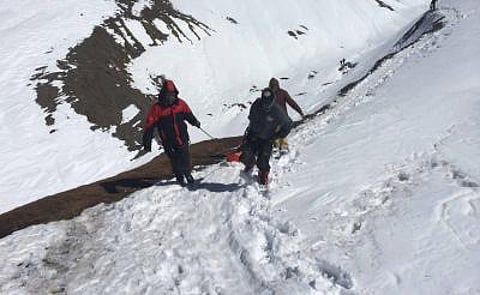
The search for climbers on Pakistan’s Broad Peak has entered a grim new phase, with three members of a 10-person international expedition still unaccounted for after rescuers recovered seven bodies, including renowned British-Nepali mountaineer Nirmal “Nims” Purja.
The latest recovery operation is backed by Pakistani military helicopters and high-altitude rescue teams.
On Sunday (August 2), rescuers recovered the body of Purja, BBC reported, citing the Alpine Club of Pakistan.
His body he was found about 5,700m up the mountain.
Get it: Fast, verified news for FREE ... download the Gulf News app — simply click here
Using drones, three further bodies have been sighted and recovered: Chinese climber Zhong Wang, and Nepali climbers Nima Sherpa and Kilu Sherpa, according to the Associated Press.
That brings the number of recovered bodies to seven.
Earlier, rescuers recovered and identified the bodies of Nadhira Ahmed Abdullah Al Harthy of Oman, Pur Bahadur Gurung of Nepal and Mallory Geis of the United States.
On Wednesday, the bodies of Purja, Chinese climber Zhong Wang, Nima Sherpa, and Kilu Sherpa have been successfully recovered and have now arrived safely at Base Camp following an “exceptionally challenging and technically demanding” operation, The Independent reported, citing the Alpine Club of Pakistan.
An avalanche swept away a 10-member international expedition.
Search teams brought down three other bodies on 1 Aug. The bodies will be transported to a military hospital in Skardu when weather conditions permit, local officials said.
The July 30, 2026 avalanche struck Broad Peak, which rises to 8,047 meters (26,401 feet) in Pakistan's Gilgit-Baltistan region as the climbers were ascending toward the summit. Broad Peak is the world's 12th-highest mountain situated in Karakoram range, a region known for its frequent avalanches and rapidly shifting weather.
How many are still missing?
Three climbers remain missing from the 10-member expedition.
That is a significant update from earlier reports, which had put the number missing at six or seven as rescue teams worked to identify and recover bodies from the avalanche debris.
The changing figures reflect the difficulty of confirming identities and reaching bodies buried or scattered in extremely dangerous terrain.
A race against altitude, weather and terrain
Broad Peak is the world's 12th-highest mountain and one of Pakistan's five 8,000-meter peaks. The mountain is part of the Karakoram range, where steep terrain, unstable snow, high winds, freezing temperatures and rapidly changing weather make rescue operations extraordinarily difficult.
The rescue effort has involved Pakistani military helicopters, specialist teams and experienced Sherpa climbers.
Weather repeatedly interrupted operations, forcing rescuers to suspend searches before returning when conditions permitted.
The Alpine Club of Pakistan described the recovery effort as one of the most technically difficult conducted on the mountain.
The altitude is itself a major obstacle. At elevations above 8,000 meters, climbers operate in the so-called “death zone,” where the human body cannot acclimatize indefinitely because of the extremely thin air.
The loss of Nirmal Purja
Among those killed was Nirmal “Nims” Purja, one of the world's best-known high-altitude mountaineers.
Purja, a Nepali-born British citizen and former Gurkha and Special Forces soldier, became internationally famous after climbing all 14 of the world's 8,000-metre peaks in just six months and six days, setting a record that dramatically shortened the previous benchmark.
His death has added international attention to what is already one of Pakistan's deadliest recent mountaineering disasters.
A fellow leading climber, Mingma Gyalje Sherpa, reportedly helped recover Purja's body from the mountain.
An international tragedy
The expedition brought together climbers from several countries, underscoring how Pakistan's high mountains have become a major destination for elite mountaineering.
The victims recovered so far include climbers from Nepal, Oman, Pakistan, China, Britain and the United States.
Officials have been coordinating with the relevant embassies as remains are transported from the mountain when weather and logistics allow.
What happens next?
The immediate priority remains locating the three climbers still unaccounted for and determining whether recovery is possible without putting additional rescuers at unacceptable risk.
At this stage, the operation is primarily a search-and-recovery mission, rather than a conventional rescue of survivors, given the time elapsed since the July 30 avalanche and the number of bodies already recovered.


