Arab youth long for democratic reforms
Survey reveals young generation's fears, hopes and aspirations amid recent events in the region
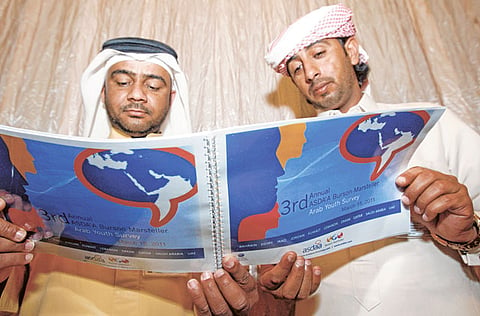
Dubai: While living in a democracy has been a strong desire for Arab youth, the uprisings have increased their demand for change, a survey has found.
Last year 65 per cent of youth said living in a democratic country was important, but following political unrest in the region, the number shot up to 92 per cent.
"The youth of the Arab world have been ignored for too long," said Asda'a Burson-Marsteller CEO Sunil John, as results of an extensive survey of 2,500 young Arabs was announced yesterday.
"Recent events in Tunisia, Egypt and Libya have shown just how important those hopes and aspirations are, and just how dangerous it is to ignore them," he explained.
Amid political tumult in the Middle East, democracy is the highest priority for Arab youth, public relations company Asda'a Burson-Marsteller has found.
About 2,000 young Arabs from the UAE, Bahrain, Kuwait, Oman, Qatar, Saudi Arabia, Egypt, Jordan, Lebanon and Iraq between the ages of 18 and 24 participated in the survey last year.
A further 500 were interviewed shortly after uprisings in Tunisia, Egypt and Libya this year and it was found "the importance of democracy is greater than ever".
Cusp of change
Based on the survey before and after protests swept the Middle East, "the moods and feelings of a generation on the cusp of change" have been revealed, said John.
The first Arab Youth Survey was carried out in 2008.
Frustration and disillusionment with the status quo in their respective countries has also increased. Support for protests in the region is strong for the most part and so is belief in the positive impact they have brought about.
Domestic stability was very important to almost 90 per cent of the youth, while living without fear of terrorism has increased from 58 per cent to 77 per cent.
Concerns over the rising cost of living and corruption continue to escalate among young people, officials said.
The survey found political views are becoming increasingly liberal and youth perceive global powers, including the United Kingdom, United States, France, Germany, more favourably. China and India are viewed somewhat less positively.
"During this period of seismic change across much of the Arab world, it is more important than ever that we understand the hopes, fears and aspirations of the region's youth," said Mark Penn, worldwide CEO of Burson-Marsteller.
- 65% said living in a democracy was "very important" in 2010
- 92% said living in a democracy was "very important" in 2011
- 48% ranked rising cost of living as one of the greatest challenges
- 43% are concerned about gap between the rich and poor
- 61% believe their country is heading in the right direction
Important findings
- A desire for democracy
- Anxiety about the rising cost of living
- Concern over the gap between rich and poor
- Less optimism about economic recovery and the future
- Widening education gaps between the GCC and other Arab countries.
- Increasing preference to work in the private sector and start businesses
- Internet making inroads and growing importance of social media
- Television is the most trusted news source
- Traditional values are paramount and parents' influence grows
- Positive perception of global powers and increasing sense of global citizenship


