‘What will happen to our son if COVID-19 hits us?’
Married New York medical workers fear the worst in fight against coronavirus
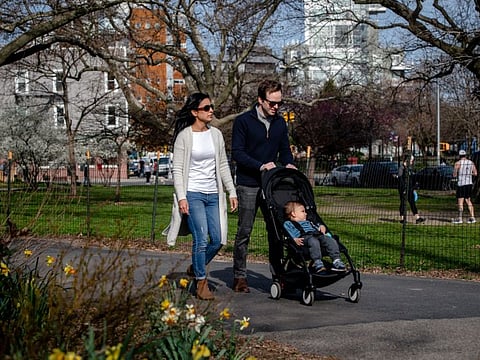


New York: A few nights ago, after their 18-month-old son Nolan went to sleep, Adam Hill and Neena Budhraja sat down on the living room couch in their apartment in Greenpoint, Brooklyn. Pen and paper in hand, they turned their attention to a pressing need: figuring out who would be Nolan’s legal guardian if the coronavirus swept them away.
They aren’t just anxious parents. Hill, 37, is an emergency room doctor at Elmhurst Hospital Center in Queens. Budhraja, 39, is a physician assistant in the emergency room at Woodhull Medical and Mental Health Center in Brooklyn.
Elmhurst and Woodhull are among the New York City public hospitals that have been most overwhelmed by the virus, and for the past month, the couple’s days and nights have been a blur of intubating terrified patients, navigating stretchers in crowded hallways and searching for clean equipment.
The pandemic is putting unimagined strain on medical workers, exposing them to dangers and emotional stress unlike anything they have ever experienced. At least 100,000 people in the city, and probably many more, have been infected with the virus. More than 13,500 have died of the virus or are presumed to have, at least 26 of them public hospital employees.
Hill reads a Facebook page for emergency health care workers and sees how everyone is struggling. One couple sent their children to live with relatives. Another doctor has decamped to his basement, where he FaceTimes with his children upstairs. Yet another is living at an airport hotel.
Not many options
Hill and Budhraja don’t have those options. They take turns diving into harm’s way and then returning to each other and to Nolan. Budhraja has thought about quitting, and then lashed herself for doing so. “I would feel like I am abandoning everyone,” she said.
She paused, and then added: “But it’s not so simple.”
One of Hill’s emergency room colleagues at Elmhurst died in the past week. Budhraja recently showed up for a Sunday shift to learn that a longtime colleague had died after battling the virus for two weeks.
The woman left behind a daughter, a freshman in college. Before she learned she had been infected, Budhraja’s colleague told her that what worried her most was that she might bring the virus home and make her family sick.
Budhraja had the same worry. They all do.
“It’s all very emotional and it’s already such a stressful time to have that on top of everything else,” Budhraja said. Since the woman’s death, a second colleague and a retired one have died of the virus as well.
Early warning
To Hill, it was clear by early March that something was wrong. Men in their 30s and 40s who were otherwise healthy were showing up at the ER with fevers or trouble breathing. They would deteriorate rapidly, gasping for air within a few hours.
A few weeks ago, he said, he felt “overwhelmed but pretty optimistic, that we will get through this, and I still have that same optimism. But it is definitely becoming clouded by fatigue.”
“Also, there’s a sort of looming shadow over “ His voice trailed off as he began to choke up.
The hospital recently installed huge fans in the emergency room to suck out dirty air and hopefully keep the virus from spreading. The fans are “so, so loud,” Hill said. Alarms go off constantly from equipment that is monitoring the breathing of patients on ventilators. Hill wears a respirator that a friend bought him at Sherwin Williams. He and his colleagues are losing their voices from yelling over the noise of the fans and the alarms and trying to be heard through the equipment covering their faces that muffles their voices.
“It’s sadly comical,” he said.
At Woodhull, Budhraja puts on her own armour. She covers her scrubs with a gown that hides her wrists. Her long black hair is tied in a bun. She wears an N95 mask, a face shield, a cap and gloves. She uses the same face mask for two straight shifts, instead of changing it between patients as standard protocol calls for.
It just felt like a battlefield. It felt like everybody was on vents and everyone was so sick and there was no room and wasn’t enough staff. It was very chaotic.Neena Budhraja, physician assistant
When her shift ends, she tapes her N95 mask to the inside of her locker, and wipes down her face shield and stethoscope with alcohol. She changes out of her scrubs in a bathroom, leaves her sneakers and takes a packed subway or bus home. The trains are uncomfortably crowded these days because of the drastic service cuts since the outbreak began.
When she gets to the apartment, she runs away from Nolan, throws her airtight bag of dirty scrubs into the laundry room - where they will sit for at least 48 hours before she washes them - and takes a shower.
Colleague’s death
The day Budhraja learned of her emergency room colleague’s death was the worst so far. She called it a turning point for Woodhull: the overcrowded emergency room, the lack of isolation rooms, the hallways jammed with people on stretchers waiting days for a spot in intensive care to open up.
“It just felt like a battlefield,” she recalled. “It felt like everybody was on vents and everyone was so sick and there was no room and wasn’t enough staff. It was very chaotic.”
Emergency room staff members are used to seeing their interventions make a difference. Now, she said, “it feels like you are not making any progress.”
When she came home that day, she told Hill that maybe she should quit.
“But then what - Adam would live in a hotel and I wouldn’t see him for months?” she said. “He wouldn’t see his son for months? To take him away from him, when he comes home looking shellshocked after every shift, it doesn’t feel right. “
“There comes some guilt too,” she said, choking back tears. “This need to help all these people, but at same time what if doing so you are hurting your own family? It’s tough.”
If anything were to happen to Nolan, Budhraja said, “it would be devastating.”
So they all take their temperatures twice a day and hope for the best. On their days off together, they take Nolan to the park.
The night they sat on the couch ironing out a will and deciding on a guardian for Nolan, they had to go three deep: Who would take care of Nolan if the appointed guardian died? Who would take care of him if the second relative also died?
Decline in patient numbers
Over the past 10 days, they have seen a steady decline in new virus patients at their hospitals. But the fear that they will get sick remains, particularly as colleagues test positive. And doctors at Elmhurst worry that if people stop social distancing too soon, a second wave of cases will inundate the hospital.
A few days ago, after Budhraja left at 6.30am for her 12-hour shift, Hill got out of bed, gave Nolan his bottle and breakfast and let him run wild around the apartment.
“It usually gives me enough time to make a coffee and sit down,” he said.
But this time, he said, he found himself “crying uncontrollably, just finally letting out all the emotions from the past month.”
“Right when I am crying he happens to crawl up on the couch and put himself in my lap and started talking nonsense,” he continued. “It just brought me back.”
“If I didn’t have Nolan and Neena here to be with and sort of remember why we do all this to begin with, it would be much more difficult than it already is.”


