Weary and divided, Americans prepare to vote
Citizens across generations feel American society has never been this polarised in living memory
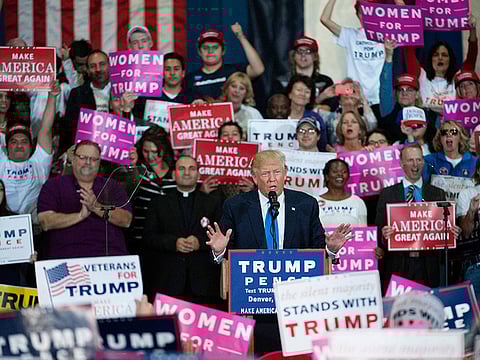
Washington: A day before Americans vote, and several words that voters have used sum up much of the country’s feeling: “weary,” “anxious” and “terrified.”
“It’s really tense here,” said a voter in North Carolina.
As of late on November 6, most national polls show Hillary Clinton leading Donald Trump by 1-5 percentage points.
However, the US electoral college system means that who wins the vote in individual states matters far more than the national popular vote, and polls in key battleground states suggest a close race. Widely referenced data analysts at FiveThirtyEight gave Clinton a 64.9 per cent chance of winning late on November 6, compared to 35 per cent for Trump.
While most Americans will vote on November 8, more than 40 million Americans have already voted via early voting or absentee voting, the Washington Post reported on November 5. The extent to which early voting options are offered varies widely by state, and early voting numbers are not reliable predictors of final electoral outcomes.
Several battleground states will play critical roles, including Florida, North Carolina, Pennsylvania, New Hampshire, Ohio, Virginia, Iowa and several others. Residents in these states have been “barraged,” as one voter in Iowa put it, with TV ads, online ads, phone calls, mailings and campaign events.
Voters in Virginia, Florida, North Carolina and Iowa told Gulf News that they are anxious for the election to be over. At the same time, many care deeply about the outcome.
Many Americans — across generations — feel that American society has never been this polarised in living memory. Supporters of Clinton and Trump both tend to be feel that, if the other candidate wins, the consequences will be catastrophic and feel that they will lose their country as they know and love it.
“If Clinton wins this thing, the country I know is gone,” said a voter in Iowa. “Watching the presidential campaign unfold, I have found myself praying many times for the soul of our country,” wrote Muslim-American Samar Ali in The Hill.
Many Americans are unhappy with the choice of either Clinton or Trump — with unfavourability ratings ranging from 54-60 per cent for both candidates.
Yet, even Republicans who do not like Trump and Democrats who do not like Clinton still often feel that the country’s fundamental values and future is on the line in this election. Many voters express concern about maintaining relationships with family, friends and colleagues who disagree in such a polarised environment.
Many Clinton supporters see Trump as a unique threat to American democracy, basic freedoms, the economy and US security. They believe that he has callously played on racial and ethnic divides. While even many Trump voters find his comments about women off-putting, Clinton supporters tend to see his attitudes toward women much more strongly — as misogynistic and dangerous.
Many Trump opponents also see him as petty, impulsive and living in a fantasy land in which evidence and truth are meaningless.
Trump voters often feel deep abhorrence of Clinton. They see her as a criminal who has escaped justice, a liar and an arrogant elitist. Some happily embrace Trump’s negative portrayals of immigrants and African-Americans; others are uncomfortable with some of these comments and his attitude toward women but are glad to see an “outsider” breaking down what they see as liberal “political correctness.”
Many strongly agree with Trump’s anti-immigrant and antitrade positions and want a president who will appoint a conservative justice to the Supreme Court. Many Trump supporters dislike changing demographics and social morals and blame the Democrats — and sometimes the Republican “establishment” — for those.
Voters on both sides fear violence during and after the election. Republicans fear that the election will be rigged, as Trump has repeatedly suggested.
Democrats worry that Republicans will try to intimidate voters in Democratic areas.
People on both sides think that the other side might incite violence after the election.
“I am afraid that if Trump loses, because the people who supported him are so radical, I am concerned that there’s going to be some kind of retaliation,” said a voter in Florida. “Trump supporters feel that ‘This is OUR country and we’re taking it back to a time that was better’ — that speaks volumes to people who were not part of the ‘better.’ People who oppose that are also very angry,” said a voter in North Carolina.
— The writer is a senior journalist based in Washington


