US flights resume after nationwide ground stop: What travellers need to know
FAA works to restore normalcy after longest flight halt in 25 years
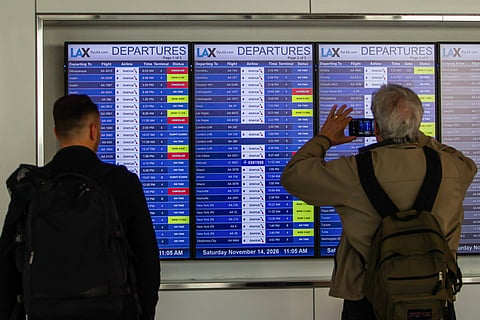
Officials have assured passengers that US airspace is safe and operational after a nationwide ground stop, initiated as a precaution, caused massive disruptions to air travel.
The longest flight stoppage in 25 years, lasting more than four hours, ended at around 8.15pm ET on Friday, allowing some domestic flights to take off from US airports. Of the 41,000 flights scheduled for Saturday, the Federal Aviation Administration (FAA) expected as many as 5,000 to be cancelled.
Get updated faster and for FREE: Download the Gulf News app now - simply click here.
Officials said the air traffic control system was operational on Saturday and expected airline schedules to fully recover by the end of Sunday, ahead of the upcoming Thanksgiving travel rush.
"We will still have delays and cancellations today, but that will set us up for a full recovery tomorrow," FAA Administrator Bryan Bedford said on Saturday. "I do think the worst is behind us, but we still do have a significant amount of recovery work to do."
Secretary of Homeland Security Markwayne Mullin said there was no indication that the failure was related to a cyberattack and that no lives had been at risk.
Here's what to know:
Flights have resumed, but disruption continues
The system was stable on Saturday following Friday's massive disruption, Bedford said. Several thousand flights were able to operate after the ground stop, but around 12,000 scheduled flights were ultimately unable to take off on Friday, he said.
Officials acknowledged the disruption but stressed that safety remained their top priority.
Bedford apologised to stranded travellers and thanked air traffic controllers, pilots and flight attendants for managing the fallout. He said officials were confident that the system was operating safely, adding that they would keep aircraft on the ground if there were any safety concerns.
However, aviation experts warned that it could take days for airlines to return to normal operations, particularly after flights were diverted and aircraft and crew schedules were disrupted.
Why was the nationwide ground stop imposed?
A contractor had been working on replacing a section of the air traffic control system's old, discontinued copper wiring with new fibre-optic cables at a remote location on Friday afternoon, Secretary of Transportation Sean Duffy said on Saturday.
However, the router at that location began overloading the air traffic control system, causing intermittent disruptions to communications and radar feeds.
Duffy said the system experienced more than 1,000 connection attempts every four to five seconds, affecting communications with aircraft and disrupting radar feeds.
When officials could not quickly identify the cause of the overload, they decided to ground flights nationwide.
"We did that out of an abundance of caution," Bedford said, adding that officials stood by the decision. "I'm sorry that we put you through this, but we did it for the right reasons."
Officials stressed that the ground stop was not the result of a system outage or malicious activity by a foreign actor. Duffy said officials were investigating whether contractor error or a faulty router was responsible.
Bedford said intermittent frequency instability affected as many as 17 of the country's 22 regional air traffic control centres.
How does a problem on the ground affect flights across the US?
The US air traffic control network relies on a complex telecommunications system connecting regional control centres with remote radio transmitter and receiver sites.
According to Michael McCormick, a former FAA airspace manager and aviation professor at Embry-Riddle Aeronautical University, the network is one of the largest telecommunications systems in the country.
The FAA operates 22 regional air traffic control centres that oversee aircraft flying between departure and arrival airports, particularly at higher altitudes.
These centres are part of a three-layer system that guides aircraft:
Airport control towers: Direct aircraft during take-off and landing at airports with control towers.
Terminal radar approach control centres: Guide aircraft as they move away from or approach airports.
Regional air traffic control centres: Take over flights at higher altitudes and manage aircraft travelling between airports.
As aircraft travel, responsibility for monitoring them is transferred from one controller to another. Each handover requires the aircraft's details to appear on the next controller's radar display before communication is transferred.
Stephen Creamer, president of the Air Traffic Control Association, explained that the handover process ensures pilots can communicate with the next controller responsible for their airspace.
The regional centres rely on remote radio transmitter and receiver sites to maintain communication with aircraft. These sites are connected to control centres through telecommunications networks.
The network's dependence on these connections means a technical fault at a remote location can have consequences far beyond the immediate area.
Bedford said Friday's disruption was different from a localised failure because the problem affected the wider communications network.
"The thing that was unique about this is that it was a type of failure that wasn't local because it was part of the communication system," he said. "It propagated around the country."
Why can one technical failure cause days of flight disruption?
The impact of a nationwide ground stop extends beyond aircraft that are directly affected at the time.
Airlines operate interconnected flight schedules, with aircraft travelling from one destination to another throughout the day. A delayed or diverted flight can affect subsequent services, including long-haul and international routes.
Aviation consultant Andrew Charlton said the knock-on effects could be significant because aircraft do not simply fly between two destinations and stop. They continue to other airports, creating a chain reaction when schedules are disrupted.
This can affect aircraft availability, crew rotations and onward connections, making it difficult for airlines to restore their schedules immediately.
McCormick also pointed to the unpredictable nature of the communications problem, describing it as a rolling outage that could affect one regional control centre before easing and then disrupting another.
A similar incident occurred in September at Newark Liberty International Airport, where radar communications with aircraft were temporarily lost after railway construction workers inadvertently cut a backup fibre-optic line. The disruption forced the FAA to cancel hundreds of flights to and from the airport.
However, Friday's incident was different because the communications instability spread across multiple regional control centres.
Can pilots communicate if air traffic control systems fail?
Aviation experts said aircraft have several backup systems that allow pilots to maintain communication and operate safely during disruptions.
Pilots can communicate directly with other aircraft using radio frequencies. Many aircraft also have satellite phone systems, while onboard equipment can alert pilots to the presence of nearby aircraft.
Control towers can also use high-intensity light signals to communicate with pilots if radio communication is unavailable. These signals help indicate whether it is safe for an aircraft to move or descend.
Planes that were already in the air when Friday's ground stop was imposed were able to land safely using established procedures, Duffy said.
John Hansman, an aeronautics professor at the Massachusetts Institute of Technology, said aviation has several backup systems to help aircraft operate safely during communication disruptions.
"We have a number of backup systems that allow the airplanes to fly safely to the extent that air traffic control can still communicate directly with the radio," he said.
Airlines waive change fees for affected passengers
Airlines are obligated to offer passengers free rebooking on another flight or a full refund if their flight is cancelled.
Bedford said the administration was working closely with airlines and that carriers were waiving their usual terms and conditions.
Some airlines were allowing passengers with travel scheduled for Friday and Saturday to rebook, while others extended the offer to those with existing reservations for Sunday and even Monday.
Bedford advised passengers to contact their airlines for further information.
US air traffic control system undergoing modernisation
The air traffic control modernisation programme began last year after Congress approved $12.5 billion in funding.
The project involves replacing outdated copper wiring with fibre-optic lines and gradually upgrading old radio systems at airports.
About 70 per cent of the copper wiring has already been replaced with fibre, officials said on Saturday.
However, the work remains incomplete. Duffy and the White House are pushing for an additional $30 billion to complete the modernisation programme.
Microsoft outage unrelated to flight stoppage
Microsoft said on Saturday that services had been fully restored following its own major outage earlier in the week.
There was no indication that the FAA ground stop was related to the service disruption that took Outlook and other services offline on Thursday, according to a company spokesperson.
More than 430 million people use Microsoft 365 apps, the company said on its website. Problems began emerging around midday on Thursday in the US, with users reporting disruptions to Microsoft 365 services, including Outlook, Teams and the AI assistant Copilot.


