Trump demands 1% US interest rate after Fed delivers first hike in three years
US president says America has world's strongest credit as Fed raises rates to 3.75%-4%
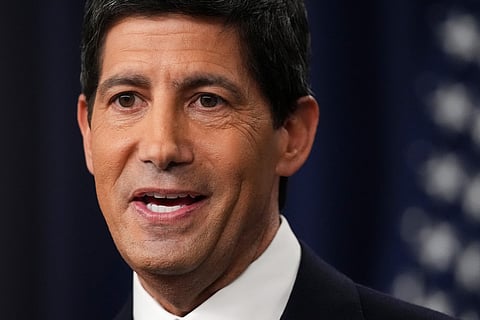
US President Donald Trump has renewed his demand for dramatically lower interest rates, saying the Federal Reserve should cut its benchmark rate to 1% or less, hours after the central bank raised borrowing costs for the first time in more than three years.
“Interest Rates in the United States should be 1%, or less, because we are the Best Credit in the World — BY FAR,” Trump said in a post on September 16.
“LOWER THE INTEREST RATES FOR THE UNITED STATES OF AMERICA, AND FAST!” he added.
Trump also argued that the US economy is “BOOMING with new Investment” and said the country could generate at least $1.5 trillion a year by ending trade with countries with which it runs deficits.
Get it: Fast, verified news for FREE ... download the Gulf News app — simply click here
His comments came immediately after the Federal Reserve raised its benchmark federal funds rate by 0.25 percentage point to 3.75%-4%, the first increase since July 2023.
Why Trump wants rates at 1%
Trump's argument is that the US, as the world's largest economy and issuer of the dollar, should be able to borrow more cheaply because of its perceived creditworthiness.
But a country's creditworthiness and its central-bank policy rate are different things.
The Federal Reserve sets the federal funds rate primarily to influence inflation and economic activity.
Treasury borrowing costs, meanwhile, are determined in financial markets and reflect factors including expected inflation, economic growth, demand for US government debt and perceptions of future monetary policy.
The Fed said after its latest meeting that inflation remains elevated and that the rate increase was intended to bring inflation back to its 2% target more quickly. The decision was unanimous, 12-0.
Fed moves in the opposite direction
The latest increase puts the Fed directly at odds with Trump's publicly stated preference for much lower borrowing costs.
The central bank's new projections show a median federal funds rate of 4.1% at the end of 2026, followed by 4.1% in 2027 and 3.9% in 2028. The median projections are therefore nowhere near Trump's proposed 1% rate.
Fed officials also raised their inflation outlook. The median projection for personal consumption expenditures inflation is 3.7% for 2026, before falling to 2.3% in 2027 and 2.1% in 2028.
The Fed projects economic growth of 2.3% in 2026 and unemployment of about 4.1%, suggesting policymakers currently see the economy as capable of absorbing tighter monetary policy while inflation remains above target.
Why the Fed is raising rates
The latest decision marks a sharp change from expectations earlier in the year that the central bank could reduce rates.
Fed Chair Kevin Warsh, who took over earlier this year, has warned that inflation remains too high. The central bank's latest statement said economic activity was expanding at a solid pace, productivity growth was strong and capital investment remained robust.
Energy prices have also become a major complication. The ongoing US-Israel conflict with Iran has disrupted energy markets and pushed up oil and fuel costs, adding to inflationary pressure.
The Fed therefore faces a difficult trade-off: keeping rates high enough to contain inflation while avoiding unnecessarily restricting economic growth and investment.
Trump and the Fed
Trump's latest demand continues a long-running dispute over monetary policy.
He has repeatedly argued that high US interest rates put the country at a competitive disadvantage and has pressed the Fed to reduce borrowing costs.
In the days before the September meeting, Trump said no country should have lower interest rates than the United States.
The latest post is notable because Trump made the demand shortly after the Fed's decision rather than before it. He did not, however, directly attack Warsh in the post.
The dispute also raises questions about the independence of the Federal Reserve. The central bank is designed to make monetary-policy decisions based on its statutory objectives — maximum employment and stable prices — rather than presidential preferences.
What would a 1% rate mean?
A federal funds rate of 1% would represent a dramatic reduction from the current 3.75%-4% target range.
Lower rates generally reduce financing costs across the economy, although the effect is not immediate or uniform. They can make mortgages, business loans and other forms of credit cheaper, potentially encouraging investment and spending.
They can also increase demand and potentially add to inflationary pressure if the economy is already operating strongly.
For savers, lower interest rates can mean reduced returns on deposits and some fixed-income investments. For borrowers, the effect can be the opposite.
That is why the Fed does not simply set rates according to the government's borrowing costs or the country's credit rating.
The bigger issue: US debt
Trump's argument comes as the US government faces enormous borrowing requirements.
The United States benefits from issuing debt in its own currency and from the dollar's central role in global finance. US Treasury securities are also widely held by investors and institutions around the world.
But this does not mean the government can borrow at any desired interest rate.
If investors expect higher inflation or larger future government borrowing, they may demand higher yields on Treasury securities. Those yields can also rise even when the Fed cuts its policy rate.
The distinction is particularly important because the federal funds rate is not the same as the interest rate the US government pays on all its debt.
What happens next?
The immediate focus will be on whether the Fed follows September's increase with additional hikes.
The Fed's September projections show that policymakers remain divided over the appropriate path, with the median projection pointing to a federal funds rate of 4.1% at the end of this year.


