Trump declares Fentanyl a 'weapon of mass destruction' in escalating war on opioids
Move likens synthetic opioid to a chemical agent more potent than conventional narcotics
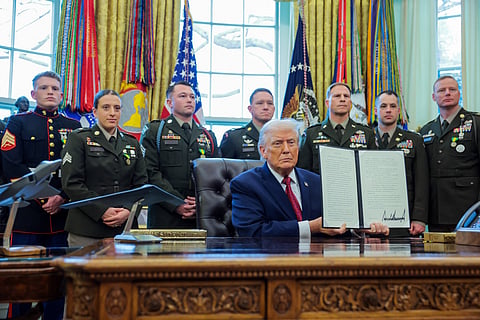
In a sweeping executive action aimed at crippling international drug cartels, US President Donald J. Trump signed an order on Monday designating illicit fentanyl and its key precursor chemicals as weapons of mass destruction (WMD).
The order likened the synthetic opioid to a chemical agent more potent than conventional narcotics.


The move, announced via a White House X post empowers federal agencies to deploy national security tools — including sanctions, intelligence operations, and military support — to dismantle trafficking networks flooding US communities with the deadly substance.
The executive order, titled “Designating Fentanyl as a Weapon of Mass Destruction,” was inked during a White House ceremony where Trump awarded the newly created Mexican Border Defence Medal to service members for their roles in border security operations.
Crisis
Flanked by military leaders in dress uniforms, Trump emphasised the crisis’s scale, stating: “No bomb does what this is doing”, and estimating 200,000 to 300,000 annual US deaths from fentanyl overdoses —figures that position it as the leading killer of Americans aged 18 to 45.
“With this historic executive order I will sign today, we’re formally classifying fentanyl as a weapon of mass destruction, which is what it is,” Trump declared, rejecting the use of an auto-pen in a nod to the order’s gravity.
Lethal threat redefined
Fentanyl, a synthetic opioid 50 to 100 times more potent than morphine, requires just two milligrams — a dose equivalent to a few grains of salt — for a lethal effect.
The White House fact sheet accompanying the order describes it as “closer to a chemical weapon than a narcotic”, warning of its potential for “concentrated, large-scale terror attacks” by adversaries.
Primary sources trace most illicit fentanyl to Chinese chemical suppliers and Mexican cartels, with precursors smuggled across the southern border.
The designation directs the Departments of Defense (DoD), Homeland Security (DHS), and Justice (DOJ) to revise protocols: DoD and DHS must update chemical incident response plans to include fentanyl threats, while DOJ gains expanded authority to prosecute traffickers under WMD statutes.
This could enable sanctions against foreign entities, enhanced intelligence sharing, and even limited military actions against cartel strongholds — echoing Trump’s past threats of designating cartels as terrorist organisations.
The move has sparked heated debate.
The debate over fentanyl centers on balancing public health approaches with stricter enforcement amid a surge in overdose deaths.
Fentanyl, a potent synthetic opioid, has driven tens of thousands of annual US fatalities in recent years, often laced into other drugs like counterfeit pills.
Core Issues
Overdose deaths, especially among those aged 18-45, have prompted polarised responses. Republicans criticise border security failures, likening fentanyl casualties to major wars.
In the past, the Biden administration highlighted seizures of millions of doses.
States like Tennessee, Iowa, and over 30 others have enacted harsh laws, including drug-induced homicide charges for distributing fentanyl.
Critics argue these undermine addiction treatment and harm reduction, favouring expanded healthcare, housing, and mental health instead.
Oregon's 2020 decriminalization faced backlash, leading to recriminalisation pushes. Experts warn political rhetoric overshadows complex solutions like addressing xylazine and nitazenes, new threats from Mexican cartels and Chinese precursors.


