Hurricane Isaias: Hundreds of thousands without power in US
Flooded roads and downed trees as Isaias batters Gulf Coast communities
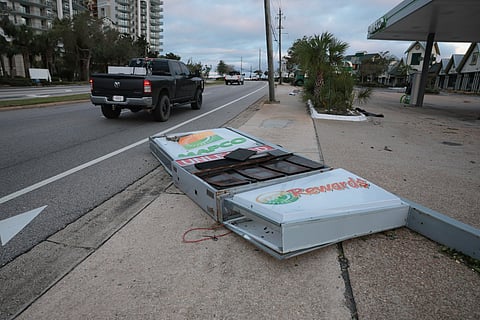
Hundreds of thousands of people in Alabama and Florida’s Panhandle were without power early Saturday after Isaias struck the US Gulf Coast as a dangerous hurricane, leaving flooded roads and downed trees in its wake as it moved inland.
The storm made landfall on Friday as a Category 2 hurricane before moving north through Alabama, where its wind speeds dropped sharply. However, the threat of life-threatening storm surges remained for parts of the Florida Panhandle, while heavy rain and potential flooding were forecast across much of the Southeast over the weekend.
Get updated faster and for FREE: Download the Gulf News app now - simply click here.
Isaias was about 25 miles (40km) south-southwest of Montgomery, Alabama, and nearly 105 miles (170km) south of Birmingham, with maximum sustained winds of 35mph (55kph), the National Hurricane Centre (NHC) said on Saturday.
Forecasters also warned that conditions could trigger tornadoes across parts of the Florida Panhandle, Georgia and the Carolinas.
Flooding and power cuts reported
Isaias made landfall near Destin, Florida, as the first hurricane of the Atlantic season. Hurricane-force winds battered the Gulf shoreline in the low-lying coastal region, known for its white-sand beaches, holiday homes, waterfront bars and seafood restaurants.
“The storm is here. Buckle down at this point. Don’t be getting out on the roads,” Florida Governor Ron DeSantis said at a news conference on Friday.
Roads in Destin were flooded, while police in nearby Pensacola urged residents to stay off the streets because of debris on roadways. Although the full extent of the damage was not immediately known, residents posted pictures online showing fallen trees and power lines. A video shared on social media showed a roof being torn off an inn in Pensacola.
Some counties in the Panhandle temporarily suspended emergency response operations on Friday night because of dangerous conditions.
Parts of southern Alabama were also flooded. Officials in Mobile reported fallen trees and power lines, while roads in Houston County, in the southeastern corner of the state, were closed because of similar conditions.
More than 726,000 customers in Florida and Alabama were without power early Saturday, according to PowerOutage.com.
Residents describe intense winds
Tim Mowry, who rode out the storm at his home in Pensacola, said the wind was so intense that it sounded like a train whistle as it blew through a gap in his patio door.
He lost power at around 4.30pm but was able to use a generator. Standing water covered his backyard, and parts of his fence were torn down. However, he said the storm had not been as severe as he had expected.
“As far as Pensacola-wise, we really got fortunate,” Mowry said.
His son, who lives about 15 minutes away, tried to drive to his home after losing power but had to turn back because fallen trees and power lines blocked the roads, Mowry said.
Heavy rain and flooding expected to continue
Despite weakening, Isaias was forecast to bring heavy rain as it moved inland. Between 4 and 8 inches (10 to 20cm), or potentially more, was expected through the weekend across southern Alabama, the Florida Panhandle, the Big Bend region and southwestern Georgia.
The storm was also expected to bring heavy rain and potential flooding to much of the Southeast over the weekend, before affecting parts of the Midwest and Northeast into Monday.
Flights grounded as Trump cancels visit
The storm disrupted air travel on Friday, grounding most flights at several airports in the Florida Panhandle, including all flights to and from Destin–Fort Walton Beach Airport.
President Donald Trump also cancelled plans to attend Saturday’s football game between the University of Georgia and the University of Alabama in Tuscaloosa, saying he did not want to disrupt emergency response efforts.
Other storms threaten Mexico and California
Meanwhile, in the Pacific, Hurricane Simon strengthened into a Category 4 storm as it approached Mexico’s coast.
Tropical Storm Rachel was also expected to bring strong winds and heavy rain to northern Mexico and Southern California over the weekend.


