How two visions are dividing a nation
The poor immigrant who helped found America vs the wealthy demagogue preaching anger
Soon after becoming the 44th US president, Barack Obama hosted a poetry jam in the East Room of the White House. One performer took the mike and tried out a song from a hip-hop album he was working on “about the life of somebody who embodies hip-hop — treasury secretary Alexander Hamilton”. That got a laugh.
In the years that followed, Lin-Manuel Miranda’s wildly improbable concept would grow into the musical “Hamilton”, winner of numerous awards and the hottest ticket in theatre. In March he and the cast returned to the East Room to perform highlights of the show. Michelle Obama recalled the first time she saw it off-Broadway: “It was simply, as I tell everybody, the best piece of art in any form that I have ever seen in my life.”
Listening with pride was Miranda’s father, Luis, who was born in Puerto Rico. “I’m sitting there as she’s saying that, and I am saying, ‘The first lady of this country believes that my son produced the best work of art of all forms that she has ever seen!’” he said. “In moments like that, I pinch myself to make sure I’m actually awake.”
But about 1,500 kilometres away that day, there was a very different tone on a very different stage.
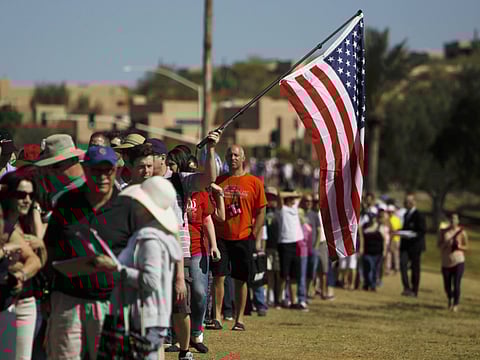
Donald Trump walked out to a packed, fevered crowd that aggressively ejected dissenters. He promised that, if he became president, he would build a wall along the Mexican border, and Mexico would pay for it. “You watch and that wall will go up like magic,” he said to raucous cheers in Tampa, Florida.
Outside in the sunshine, placard-waving demonstrators sang, “Build a wall, build it high, let’s put Donald Trump inside!” and “T-R-U-M-P, that’s how you spell bigotry!”
The Republican frontrunner’s predominantly white supporters glared, made obscene gestures or yelled back, “Build the wall!” and “Trump, Trump, Trump!”
Then one young Latino woman spoke in a clear, determined voice, quoting the Statue of Liberty: “Give me your tired, your poor ...” Another chimed in: “Your huddled masses yearning to breathe free.”
It was Monday and America was the country of Hamilton and Trump; the culture gap had never seemed so wide. There were the liberals who spoke for inclusivity, felt wistful for the Obama years and were fearful or panicked by what might come next. Then there were thousands of the angry, the frustrated and the thwarted, putting their faith in a showman plutocrat who promises to protect the borders and make America great again.
“Hamilton” tells the story of Alexander Hamilton, an 18th-century immigrant who became one of the founding fathers of the US. Through an ingenious blend of rap, pop and jazz, it charts his rise from illegitimate birth in poverty in the Caribbean to becoming George Washington’s aide-de-camp and the first secretary of the treasury — and his spectacular death at the hands of vice-president Aaron Burr in a duel.
Introducing the special White House performance, Obama said: “In the character of Hamilton — a striving immigrant who escaped poverty, made his way to the New World, climbed to the top by sheer force of will and pluck and determination — Lin-Manuel saw something of his own family, and every immigrant family.”
The musical has become something of an obsession among the New York and Washington corridor’s literati. More people talk about it than have actually seen it, although the soundtrack has become a surprise schoolyard hit. Entrepreneur and philanthropist Bill Gates and former vice-president Dick Cheney are big fans.
Last September it caught the eye of the “New Yorker” magazine, which published an essay headlined, “Why Donald Trump and Jeb Bush should see Hamilton”. At that stage, it noted, Hillary Clinton was the only presidential candidate known to have done so. “With its youthful, almost entirely non-Caucasian cast, and its celebration of the possibilities inherent in building a new nation, the poetry of ‘Hamilton’ is a reminder of the gleaming sense of hope that the election of 2008 engendered,” the magazine said.
Luis Miranda, 61, a Democratic party consultant, also finds it “symbolic” that his son’s work has run parallel with the Obama presidency. “Here we were [at the poetry jam in 2009] and the enthusiasm and euphoria that represented for the entire country and for minority communities in particular,” he said. “And then here we are, the last year of the administration, presenting a full musical of the story of this country told by a Puerto Rican and portrayed by a multi-ethnic and multiracial cast with [portraits of] Martha Washington and George Washington on each side of the room and President Obama sitting in the audience. It’s mind-boggling, it’s mind-blowing.”
The “New Yorker” essay presciently highlighted two lines from the show that have come to resonate during a helter-skelter election season. Hamilton is told, “Ya best g’wan run back where ya come from,” but he makes the case: “Immigrants, we get the job done.”
Trump kicked off his campaign last June with a charge that Mexico is sending its criminals and rapists to the US, “and some, I assume, are good people”. His promise to build the wall is a perennial crowd-pleaser and he has also vowed to round up and deport 11 million undocumented immigrants. Claiming to speak for the silent majority, he relishes denouncing a culture of “political correctness”.
In Tampa, Trump’s rally had plenty of theatrics — he was introduced by former Alaska governor Sarah Palin — but also its usual undercurrent of menace and violence. When an African American woman stood on her chair and ripped up a Trump placard, she was unceremoniously bundled out of the room. Another woman confronted her, remonstrating furiously.
Standing in line before the event, Anthony Arnold, 45, a publisher, said: “Most of the time Trump is speaking from factual evidence. All the political correctness says you can’t offend anybody. But when you say this or that group commits the crime, they shouldn’t be offended. It’s data.”
Margaret Braun, 73, a retired teacher in a wheelchair who had travelled two hours to be at the rally, said: “He’s not racist. He has strength on the economy and is not affiliated with the establishment.”
Trump supporters are numerous, defiant and devout. They point to wage stagnation, outsourced jobs and hollowed-out communities, and a need for change. At another rally in Boca Raton, Florida, Debbie Finley said: “I’m a recruiter and I see a lot of visa applications. I think he will make all of that better and help the people back to work. How can he have such beautiful children and not be a great guy?”
Teresa Kinan, 56, a caretaker who moved to the US from Portugal two decades ago, added: “Hillary Clinton really is evil. I love Donald Trump because somebody has to do something for this country and nobody else will do it. If people don’t like him, they should go home.”
Trump won the Florida primary with nearly 46 per cent of the vote. Marco Rubio, the Republican establishment’s last hope, finished second on 27 per cent in his home state and dropped out of the race. Mitt Romney, the Republican nominee defeated by Obama four years ago, has since written on Facebook: “Trumpism has become associated with racism, misogyny, bigotry, xenophobia, vulgarity and, most recently, threats and violence. I am repulsed by each and every one of these.”
Back at the White House, Lin-Manuel Miranda performed a freestyle rap with the first black president: the symbolism of modern, diverse, inclusive, creative, idealistic America could hardly have been more vivid. So how can it be, liberals ask, that the elegant Obamas might soon be packing their bags to make way for the brash, orange-haired billionaire whose helicopter is greeted by the theme music of the movie “Air Force One” booming from loudspeakers? (The chopper is announced as “Trump Force One”.)
For some, it is not a mystery in a society riven by inequality and discontent. Anthony Giardina, author of “The City of Conversation”, a play that explores three decades of Washington politics, said: “All you have to do is ... get out of the pockets of affluence. You get a feeling of what it might be like for someone who feels the country has been taken away from them. They expected a certain kind of life and what they see celebrated is another. Someone comes along and speaks to them and of course it has appeal.”
This theme was also explored by Miranda, whose consultancy work has included the election of Hillary Clinton and Chuck Schumer to the US senate. He said: “I believe that there is a chunk of America that is very angry. In my opinion it’s because we are not creating the middle class that has been created over the past hundred years, and we no longer see that our children can do better than us, and that’s very frustrating. You work all your life, and you were given the promise — because you saw it with your parents — that they are going to be better off than you, and that is just not happening.
“I totally understand why people are angry but I assure you that it is not the lady who’s cleaning toilets at the Marriott that’s causing that. To be angry with the lady cleaning toilets at the Marriott and make her responsible for our inability as a country to create a middle class over the past 35 years is unjust and is blaming the victim.”
Trump and Trumpism represent a denial of America’s shifting demographics, Miranda believes, as white working-class males lose their dominance. “It’s just sad that a segment of the Republican party is still there. For them, the ‘good old days’ were when there was no diversity. Those days are gone. I wish I had more hair on the front of my head but that hair is gone, it’s not coming back, it’s not going to grow. So for me it’s like a puzzle: you want to go back to a country that cannot exist anymore, rather than help build the one that brings the energy, the talent, the intelligence of the many new people who are here.
“That, for me, is the relevance of ‘Hamilton’, because the other thing that it does is present our founding fathers as normal dudes, as people who were brilliant but that they were petty also, and insulted each other and fought with each other but, in the end, put the good of the country first.”
Not everything about Alexander Hamilton and Donald Trump is like chalk and cheese. Each was the son of a Scot and lived in New York. Both were outsiders taking on political elites. In the show, Thomas Jefferson denigrates Hamilton: “Smells like new money, dresses like fake royalty.” Trump’s gilded mansion in Florida, Mar-a-Lago, has been described as a kitsch version of Versailles.
But the similarities, historical or artistic, pretty much end there. Amy Austin, president of theatreWashington, said: “Trump’s ability to stir emotions around the wall and Mexicans is the opposite of ‘Hamilton’, which has this hopeful message that immigrants can do anything. That’s what America is. ‘Hamilton’ is so aspirational. Trump doesn’t have anything aspirational for the whole country.”
Austin said her sons were born in Guatemala and are worried by Trump, but she has faith that his version of America will not prevail in November. “When Barack Obama was elected, there was such an amount of optimism and hope and a sense that the country was moving forward. I believe the country still holds its principles dear and Trump doesn’t stand for many of those principles.”
Indeed, the split in America is not necessarily six of one, half a dozen of the other. Frank Rich, writer-at-large at “New York” magazine, said of Trump’s support: “There’s a certain hysteria, including among some of the liberals in America, that this represents the majority of the country. If you look at any kind of polling, it just doesn’t.”
As for Trump’s bizarre showmanship, Rich, a former theatre critic, offered a review unlikely to prompt a run at the box office. “Compared to Nuremberg rallies, second rate, third tier,” he said. “He’s more the lounge act than the main attraction.”
–Guardian News & Media Ltd


