Fury Shakes the caucuses, boosting Cruz while slowing Clinton
Results have confirmed that despite widening fissures, voters are united in an impatience of what they see as a rigged system
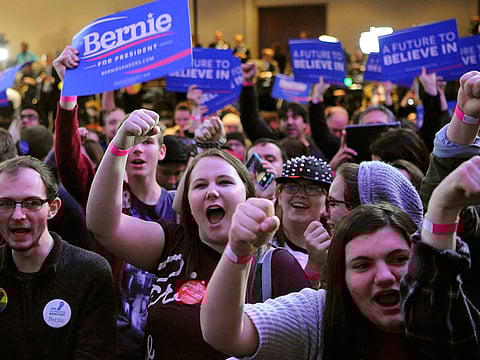
Des Moines, Iowa: Fury carried Ted Cruz to victory. And it halted Hillary Clinton from truly claiming one.
Caucus night in Iowa was a portrait of red-hot America, so disaffected that it turned to a pugilistic evangelical Republican who calls for demolition of a system saturated with corruption. And it sent a forceful message to Democratic leaders that it was unwilling to put aside its resentment of Wall Street and corporate America to crown a lifelong party insider who has amassed millions in speaking fees from the big banks.
Monday night’s results have confirmed that despite the widening cultural and political fissures that have divided right and left, voters are united in an impatience, even a revulsion, of what they see as a rigged system that no longer works for them.
For Republicans, the enemy is an overreaching government, strangling their freedoms and pocketbooks. For Democrats, it is an unfair economy, shrinking their paychecks and aspirations.
“This is the most anxious electorate we’ve seen in a very long time,” said David Gergen, an adviser to four presidents of both parties.
Cruz’s triumph Monday, combined with Sen. Bernie Sanders’ effective tie with Clinton, demonstrated how bipartisan the bitterness has become. “It’s striking,” Gergen said, “that the winner of the Republican side represents the far right and the moral winner for the Democrats comes from the far left. It’s a clear vote of no confidence in the economic order.”
In many ways, the focus of the 2016 campaign has turned to easing the palpable frustrations of a large portion of white working-class people who believe that the country no longer works for them.
Now, both parties are reacting, sometimes clumsily, to the indignation and insecurities of those voters, buffeted by financial stagnation, globalisation, and technological and demographic change.
From the start, an uncomfortable question has hovered over this race: in a country where, increasingly, everybody is a statistical minority, who exactly speaks for the white working class?
Clinton has stumbled as she has sought to champion such voters, as if putting on a pair of populist clothes that do not quite fit. Despite advantages of financial muscle and establishment organisation, she failed to convince enough of the insecure electorate that she was truly on their side.
On Monday night, a disappointed-looking Clinton raised her voice to a near yell as she tried to demonstrate her own conviction. But she offered oddly little direct assuagement to the unsettled working class that still craves her assurance.
That task fell instead, as it has throughout the campaign, to Sanders, Clinton’s ultraliberal rival, whose denunciations of greedy plutocrats and an unfair economy are at the Centre of his message. “Given the enormous crisis facing our country,” he said here after voting had concluded, “it is just too late for establishment politicians and establishment economics.”
On the Republican side, Cruz has sought to cast himself as the saviour of the disaffected working class, denouncing a “Washington cartel” that vows radical reform on their behalf but then makes treacherous concessions in the name of cooperation and comity. And his expressions of religiosity have allowed him to bond with working-class voters who might otherwise be wary of his Ivy League pedigree and Washington career. But his credibility as anti-corporate crusader is in doubt: His wife is an executive at Goldman Sachs and he relied on a hefty loan from the bank to pay for the campaign that propelled him into the US Senate.
But on Monday, Cruz was just persuasive enough, overtaking his colourful red-cap-wearing rival, Donald J. Trump, whose entire candidacy was built around class rage and a promise to bring wealth and success back to the downtrodden. Surveys of voters who turned out for the Iowa caucuses showed that 40 per cent of Republicans described themselves as angry. And they split their vote between Cruz and Trump.
In his victory speech, Cruz characterised this win as a victory for the overlooked and undervalued — those “who shouldered the burden of seven years of Washington deals run amok.”
Fittingly, Clinton and Cruz are worlds apart on almost every issue.
She is for abortion rights; he is firmly opposed to them. She wants to expand health care; he wants to blow up the Affordable Care Act. She wants to raise taxes on the rich; he wants to impose a flat tax that would lower them. She is an eager supporter of gay marriage; he views it’s legalisation as in infringement on religious liberty.
But both confront the same furious national mood and the challenge of turning alienation and rage into organised support and Election Day votes over the coming months — without going too far. Of course, Iowa is not representative of the entire country. Its quirks and attitudes may not be replicated everywhere. But it is difficult to overstate how avidly a large segments of Americans now wish to see the depth of their outrage and their hunger for systematic reform embodied in their presidential candidates.
“It’s totally understandable,” said Steve Schmidt, a longtime Republican strategist who advised John McCain’s 2008 presidential campaign. “Across the depth and breadth of American society,” he said, “nothing seems to be working.”


