From Carter to Trump: Why Washington keeps getting Iran wrong
Why diplomacy, sanctions and military force have failed to reshape Tehran’s behaviour
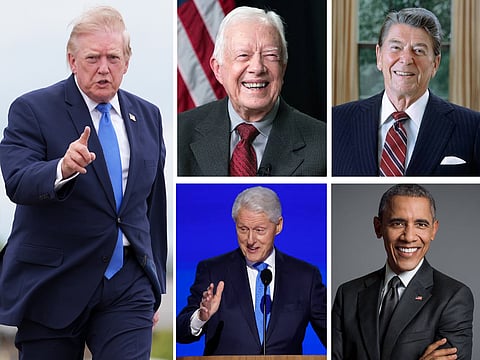
Dubai: Donald Trump is hardly the first American president to discover that Iran is one of Washington’s most difficult adversaries.
As his administration struggles to secure an agreement to reopen the Strait of Hormuz while warning Tehran against defying US demands, historians and former diplomats say Trump has joined a long line of presidents who have failed to fully understand how Iran’s leadership thinks and negotiates.
According to a New York Times analysis, every US president since Iran’s 1979 Islamic Revolution has wrestled with the same challenge: Dealing with a political system where ultimate authority rests not with elected officials but with a powerful religious leadership whose ideology often leaves little room for compromise with Washington.
Trump himself has publicly acknowledged his frustration.
“All they do is make me angry,” he told reporters last week, after accusing Iran of being “unbelievably duplicitous” in negotiations.
His administration believes a deal to reopen the Strait of Hormuz may be within reach. Yet Tehran continues insisting on collecting shipping fees that Trump has repeatedly rejected, prolonging uncertainty in one of the world’s most strategically important waterways.
A familiar American problem
Iran specialists interviewed by the New York Times argue that Trump’s frustrations are part of a pattern stretching back more than four decades.
Kenneth Pollack, a former CIA analyst and National Security Council official who has studied Iran for decades, believes Trump embodies Washington’s contradictory approach.
“In many ways, Trump represents the epitome of America’s frustrations with Iran,” Pollack said.
“He has been both the most desirous of making a deal with Iran, and the one who used the most force against it. He has found that neither got him what he wanted.”
Carter: The first lesson
President Jimmy Carter believed he had negotiated an agreement in 1980 that would secure the release of the 52 Americans held hostage in Tehran.
Instead, Iran’s supreme leader Ayatollah Ruhollah Khomeini rejected the proposal, blindsiding both American officials and his own negotiators.
Carter later described the collapse as “a bitter disappointment.” A rescue mission failed, and the hostages were released only on his final day in office.
Reagan: The Iran-Contra scandal
President Ronald Reagan later authorised secret arms sales after intermediaries claimed moderate Iranian leaders would emerge once Ayatollah Khomeini died.
Instead, the initiative became the Iran-Contra scandal, while the promised moderates never materialised. The CIA later concluded the intermediary who promoted the plan had been fraudulent.
Clinton: Reformists blocked
When reformist President Mohammad Khatami came to power in 1997, President Bill Clinton responded with conciliatory gestures, including restoring some Iranian imports and acknowledging past American actions in Iran.
But Supreme Leader Ali Khamenei rejected broader reconciliation, ensuring that hard-line factions retained control over relations with Washington.
Obama: A breakthrough that stopped short
Barack Obama achieved what none of his predecessors had managed by securing the 2015 nuclear agreement, which limited Iran’s nuclear programme in exchange for sanctions relief.
Yet even that landmark deal failed to transform the relationship. Iran accepted limits on its nuclear activities but resisted broader political rapprochement, while Trump’s withdrawal from the accord in 2018 eventually helped unravel it.
Why Iran keeps outmanoeuvring Washington
The New York Times says many specialists believe successive US administrations have repeatedly underestimated the ideological foundations of the Islamic Republic.
Suzanne Maloney, vice-president of the Brookings Institution, said American policymakers had consistently failed to appreciate “the ideological commitment and deeply institutionalised structure of power in the Islamic Republic.”
Veteran Middle East negotiator Dennis Ross offered an even starker assessment.
“The Iranians seem to understand us better than we understand them.”
Ross argued that Tehran has learned to use America’s urgency against it.
“They tend to read our sense of urgency as a form of leverage. We always seem in a hurry to get things done. They operate under the premise that time serves their interests more than ours.”
A lesson still being learned
Trump entered the conflict believing military pressure could quickly force Iran into sweeping concessions. Instead, Tehran has continued negotiating over issues such as the Strait of Hormuz and its nuclear programme while rejecting many of Washington’s broader demands.
If history is any guide, the New York Times concludes, Trump’s frustrations are not unique. Rather, they are the latest chapter in a decades-long struggle by successive American presidents to understand — and influence — one of Washington’s most resilient geopolitical rivals.


