Abu Dhabi showcases intelligent, integrated medical emergency response system at World Congress of Military Medicine
Unified Medical Operations Command Centre highlights Abu Dhabi's approach
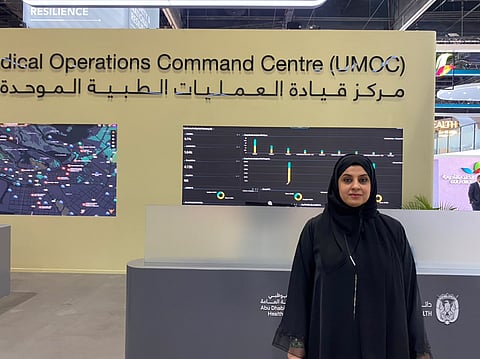
Abu Dhabi: The Department of Health – Abu Dhabi (DoH) showcased the emirate's Unified Medical Operations Command Centre (UMOC) at the exhibition accompanying the 46th World Congress of Military Medicine, held from 9 to 13 November 2026 at ADNEC Centre Abu Dhabi.
The showcase highlighted Abu Dhabi's approach to building an intelligent, connected and resilient healthcare system that strengthens preparedness, supports coordinated medical responses and enhances the ability of healthcare stakeholders to respond to emerging health challenges.
At the heart of this approach is a commitment to moving beyond responding to emergencies towards strengthening readiness before they occur. By bringing together healthcare expertise, digital technologies and collaboration across relevant stakeholders, Abu Dhabi continues to advance a more integrated approach to protecting population health.
Speaking to Gulf News on the sidelines of the congress, Dr Salama Jamal Bin Rafeea Al Tamimi, Acting Director of the Centre of Emergency Preparedness and Response at the Abu Dhabi Public Health Centre (ADPHC), highlighted the importance of integrated coordination in strengthening the healthcare system's ability to prepare for and respond to emergencies.
"Our approach to emergency preparedness is built on a simple principle: the strength of our response depends on how well we prepare and work together before an emergency happens. By connecting expertise, information and healthcare capabilities, we are building a more coordinated and resilient system that puts people's health and safety first," Dr Bin Rafeea said.
One connected healthcare system
Led by the Department of Health – Abu Dhabi, UMOC supports integrated medical emergency preparedness and healthcare coordination across the emirate, working closely with relevant emergency response and healthcare stakeholders.
The centre brings together three essential elements of medical emergency preparedness: pre-hospital emergency services, healthcare facilities and essential medical support functions.
Through coordination with emergency medical service providers and healthcare facilities, UMOC supports a shared understanding of healthcare readiness and facilitates communication among stakeholders involved in medical emergency response.
The centre also supports visibility of relevant healthcare resources and capabilities, helping inform decisions related to medical coordination and the appropriate use of available healthcare capacity during emergencies.
This integrated approach helps strengthen coordination across different stages of emergency medical care, from the initial response through to hospital-based treatment, while supporting the continuity of essential healthcare services during periods of increased demand.
"What makes this approach important is that we are looking at the healthcare system as one connected network rather than a collection of individual services. When healthcare providers and emergency response teams have a shared understanding of the situation, they are better positioned to coordinate their efforts and support patients when every moment matters," Dr Bin Rafeea explained.
Using intelligence and technology to strengthen preparedness
Technology plays an important role in Abu Dhabi's approach to strengthening healthcare readiness and supporting informed decision-making.
UMOC brings together operational information, digital technologies and data-driven insights to enhance situational awareness and support medical coordination across participating healthcare and emergency response stakeholders.
These capabilities help relevant teams maintain a clearer understanding of healthcare readiness, identify potential pressures on medical services and support timely coordination when emergencies arise.
The approach reflects Abu Dhabi's broader vision for an Intelligent Health System, where technology, data and healthcare expertise work together to strengthen prevention, preparedness and the delivery of care.
Rather than viewing emergency response as a series of isolated activities, Abu Dhabi is advancing an integrated model that connects preparedness, coordination and healthcare delivery.
By strengthening the flow of relevant operational information and supporting collaboration among stakeholders, the system helps healthcare professionals make more informed decisions and facilitates timely access to appropriate medical care.
Building readiness before emergencies happen
Dr Bin Rafeea emphasised that healthcare preparedness is a continuous responsibility, particularly as health systems around the world face increasingly complex challenges, including infectious disease outbreaks, extreme weather events and major emergencies.
Abu Dhabi's approach places importance on strengthening readiness through continuous planning, collaboration and the development of coordinated response mechanisms.
Building on experience gained from previous emergency response activities, the emirate continues to enhance the processes, capabilities and partnerships that contribute to healthcare resilience.
UMOC supports this approach by bringing together relevant stakeholders and strengthening the coordination mechanisms that help the healthcare system prepare for changing circumstances.
"Preparedness is not something we activate only when an emergency occurs. It is a continuous process of planning, coordination, learning and improvement. Every experience gives us an opportunity to strengthen our readiness and ensure that our healthcare system is better prepared for future challenges," Dr Bin Rafeea said.
Importantly, preparedness extends beyond the immediate response to an emergency. It also involves supporting essential healthcare services, strengthening recovery capabilities and applying lessons learned to improve future readiness.
This continuous cycle of preparedness, response, recovery and improvement contributes to a healthcare system that is better equipped to manage emerging challenges while maintaining its focus on the needs of the population.
Strengthening civilian–military medical collaboration
Abu Dhabi's participation in the World Congress of Military Medicine also highlights the importance of cooperation between civilian healthcare authorities and military medical stakeholders in strengthening health resilience.
Complex emergencies often require coordinated efforts across multiple sectors, making collaboration, joint preparedness and knowledge exchange essential elements of an effective medical response.
Military medical services bring valuable experience in managing complex medical situations, including trauma care and emergency medical support, complementing the expertise and capabilities of civilian healthcare systems.
"Health resilience is a shared responsibility. Civilian and military medical services bring different experiences and strengths, and there is significant value in learning from one another. By strengthening cooperation and exchanging knowledge, we can continue to enhance our collective preparedness and our ability to respond to complex health challenges," Dr Bin Rafeea highlighted.
Such collaboration contributes to a broader approach to resilience, where different stakeholders can draw on their respective strengths to support healthcare preparedness and emergency medical response.
The congress provides an important platform for advancing these discussions and exploring opportunities to strengthen cooperation across the wider medical community.
Sharing Abu Dhabi's experience with the world
The World Congress of Military Medicine offers Abu Dhabi an opportunity to share its experience in advancing an integrated, intelligence-driven approach to healthcare preparedness while learning from international practices and expertise.
Through participation in global platforms, Abu Dhabi continues to strengthen knowledge exchange, explore innovative approaches and build partnerships that contribute to the development of resilient healthcare systems.
The emirate's approach brings together leadership, healthcare infrastructure, skilled professionals, technology and institutional collaboration within a broader vision for an Intelligent Health System.
For Abu Dhabi, healthcare resilience is not only about responding effectively when emergencies occur. It is also about building the capabilities, partnerships and readiness needed to anticipate challenges, adapt to changing circumstances and sustain essential healthcare services.
By connecting expertise, information and healthcare capabilities, Abu Dhabi continues to strengthen an integrated system focused on protecting lives, supporting healthcare professionals and ensuring that the population can access appropriate care when it is needed most.


