Three ways to see Romania’s medieval legends and unconquered wilderness
The Eastern European nation is the last refuge of bears, horse-drawn carts and unspoiled nature
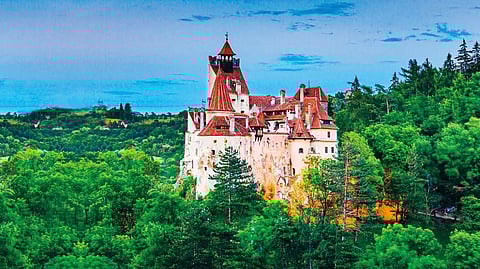
Haunted castles, check. Bear encounters, check. Ice caves, check. A land of mysteries fed by a fascinating history and ancient beliefs, Romania is the hidden gem of Europe for adventure seekers and travellers looking to get way off the beaten tourist path.
The most distant observers know it just for its vampires, gypsies and orphanages. Others have heard of its sport personalities - Nadia Comaneci, Ilie Nastase and Gheorghe Hagi - or its famous artists - composer George Enescu or sculptor Constantin Brancusi. Many who visit Romania rarely travel outside Bucharest, the capital city luring tourists with its picturesque old town, James Bond-esque casinos and endless restaurants guilty of belt-snapping sarmale (stuffed, pickled cabbage leaves) or amandine (rich, glazed chocolate cakes).
Those who do venture outside the capital, usually take the two hours train - or car - ride north to the medieval town of Brasov. This is the gateway to the famous (or infamous, if you think of Dracula) Transylvania. The Gothic style Black Church in the heart of Brasov’s old town, the ski resorts of nearby Poiana Brasov and Sinaia, and Bran Castle, which most know as Dracula’s Castle, are the most-visited places, and for good reason. Prince Charles loved the area so much he bought property here.
But there’s far more to see beyond the tourist trail: There is abundant bird life in the final resting place of Europe’s longest river, the Danube Delta; and steam trains that used to transport coal or wood logs, passing through steep mountain gorges or alongside village houses. Living tradition abounds, from Sibiu’s narrow cobblestone streets and spooky roof windows that look like half-closed eyes to “Capra” (the Goat), a traditional costume dance performed by two people dressed as a goat and accompanied by drummers, which has its roots in pre-Christian beliefs and is performed on the streets of every village and city on New Year’s Eve. Architecturally, too, Romania is a world of discoveries from Bucharest’s impressive Parisian-style mansions turned into five-star hotels to the 12th century painted churches of the Moldova region (not to be confused with the neighbouring country of the same name), ingeniously depicting Bible stories on their inner and outer walls,.
There are year-round festivals, water parks and mountain hidden castles, but if you have to pick just three sites, here are three unique ones.
SAPANTA’S MERRY CEMETERY
“Rest in peace - but I do not
Saulic Ion lies in this plot
In the grounds of Belmezau
I a shepherd was, you know
A bad Hungarian had come
And shot my head through with his gun
He hacked my body clean asunder
Thus I was buried six feet under.”
The rhyming epitaph, along with a painting depicting the deadly crime are on a bright blue grave cross in Romania’s most famous and world unique cemetery, the Merry Cemetery of Sapanta.
A remote village in Maramures, one of Romania’s most beautiful regions, revered for its wood carvers, the country’s oldest and tallest wood churches, idyllic valleys and unspoiled centuries old traditions, Sapanta is a small village where people still travel by horse and cart and spin wool from their own sheep into carpets, blankets and clothes.
Sapanta’s blue cross cemetery was the creation of Ion Stan Patras. He was a simple man who learned his trade through hardship after his father died when was Ion still a child and his mother fell ill.
In his teens, he started carving wood crosses. Although they looked far from traditional gravestones, they were successful. The cheerful colours and words made the passing away of someone dear less sad. They reflected Ion’s belief that death should be given a bright and fun makeover.
The nearly 1,000 wooden crosses surrounding the Sapanta church are an explosion of bright colours. They all have a blue background, which symbolises the sky to which the soul rises after death. Most are painted with the portrait of the deceased and text on both sides. The inscriptions are in the form of epitaphs, written in the first-person and are often ironical or humorous when depicting the vices and weaknesses of the buried.
Dating from 1935, the cemetery was ignored by Romania’s communist regime. Eventually, it was “discovered” by a group of French travelers passing through Sapanta. Impressed by the lively colours and funny words, the French named it the Merry Cemetery. Soon after it was listed as a heritage site by Unesco. In 1971, as a result of the French publicity, Ion was invited to show his work in a Paris exhibition. It brought him a top prize and a big sum of money. Back home, the communist government confiscated the money. Patras asked, though, for an asphalt road to be built between his house and the village centre. The authorities agreed.
This road still exists today, leading tourists to Patras Memorial House and the workshop where his followers continue his work. Since 1977 Ion Stan Patras has been resting under his own blue cross, for which he wrote his own epitaph.
The Merry Cemetery is open daily from 8am-6pm. Entrance is RON 5/person (Dh4.50). The best time to visit is on a Sunday before noon, when most of the village folk gather for the church service, dressed up in traditional attire. To visit the cemetery and the memorial house can take anything from half an hour to a couple of hours.
How to...
Get there: Sapanta is just 4km from Romania’s northern border with Ukraine. The nearest city is Sighetu Marmatiei, 19km away. To reach Sighetu Marmatiei take the overnight train from Bucharest. It’s a 13-hour journey, but the train’s sleeping cabin will make the journey fun and comfortable. Once you arrive in Sighetu Marmatiei (around 7am), the best option is to get a taxi to Sapanta’s Merry Cemetery (make sure the driver switches on the meter) or better still, rent a car (prices start from Dh85/day).
Where to...
Sleep and eat: There are dozens of guesthouses and even small hotels around Sapanta; most are family homes offering a few rooms for rent. Some include breakfast or the use of a kitchen. Restaurants serve hearty meals; a popular choice is Pensiunea Ileana, a traditional Romania guesthouse, across the road from the Merry Cemetery. It has free car parking and Wi-Fi, an outdoor terrace for guests and three rooms with private bathrooms (double and family rooms). Breakfast is included. Pensiunea Ileana’s restaurant is also a great option for lunch and dinner.
THE JURASSIC CAVE
So far, over 12,000 caves have been discovered in Romania, all full of legends and environmental riches. There is the Bear Cave, named after the many bear fossils found there, as old as 15,000 years. There is also the 52km Cave of the Wind, the longest in Romania, known for its fierce air currents. And then there is Pestera Scarisoara (the Scarisoara Cave), Romania’s largest and oldest ice cave, formed of limestone dating from the Jurassic age, about 150 million years ago.
Located in the Apuseni National Park, deep in the forests of the western Carpathian Mountains, Scarisoara Cave is perched at 1,165m altitude, spreads across 720m and goes 105m deep.
It was first mentioned in 1863 by the Austrian geographer Arnold Schmidl, who made some observations and the first map of the cave, and later on it was explored by the Romanian scientist Emil Racovita, who studied the cave in the early 1920s.
What makes it special is its ice mass, Scarisoara being home to Europe’s second largest underground glacier and one of the oldest too, at 4,000 years. The ice block reaches 20m thickness in places.
At the edge of a mountain forest, a narrow path and steep metal stairs lead the way into the cave. Even here, at the edge of the cave, it is always winter, and in the peak of the summer, when outdoors it may be 30 degrees C, there is snow inside and temperatures never go beyond 1 degree C.
At the bottom of the stairs, a 17m high portal allows access into the first chamber of the cave, the Great Hall. The floor of the Great Hall is the top of the massive glacier, and inside, a nearly 18m tall ice cliff overlooks the Pool of Ice.
From the Great Hall, passages lead to several other chambers. The Church, “decorated” with over 100 ice stalagmites, is where tourist access ends. The other rooms, the Great Reservation, the Coman Gallery and the Little Reservation, all located under the Great Hall, are reserved for scientific research.
Over the last 10,000 years, snow and rain dripped into the depths of Scarisoara, where they froze into thin layers of ice containing chemical evidence of past winter temperature changes. Until now, reconstructions of Earth’s climate record have relied largely on summer conditions, but for the first time scientists are now able to study winter climate changes all the way to Holocene period, using the ice from Scarisoara Cave.
The cave is open daily from 9am-6pm, and it takes about half an hour to visit. There are a couple of other caves and tourist attractions in the region. Entrance to Scarisoara Cave is Dh10/adult and Dh5/ child under 12 years old. Reaching the cave involves some walking, so appropriate shoes and warm clothing (it’s cold down there) are advised.
How to...
Get there: Although there are buses to the nearest village, from where it’s a couple of hours’ trek, the easiest way is by car. Rent one from Alba Iulia, the nearest major city. From here head 122km north-west towards Campeni and Garda Seaca, a two-hour journey through small villages with scenic mountain views. From Garda village there are two options: A 10km hike, marked with a red cross or keep driving up to catunul (remote mountain village) Ghetari, where the road ends. An easy, 15-minute walk through the woodland will get you to the cave’s entrance.
Where to...
Sleep and eat: The three-star Four Seasons hotel in the Vartop village is not a part of the luxury chain, but does a swimming pool and free Wi-Fi, but a real local gem when it comes to accommodation is Pensiunea Ghetarul Scarisoara near the cave. This is not just any guesthouse. Located at 1,100m altitude, the 15-room hostelry was built by a local family on their farmland high up in the mountains. Guests share the nearly five hectare courtyard with the farm’s cows, chickens, cats and dogs, and there is a restaurant serving local cuisine prepared with fresh, local ingredients. It is one of the few in the region that has breakfast included in the accommodation price, which starts from Dh90/night.
THE LAST INHABITED CITADEL
Saxons arrived in Transylvania from what is now western Germany in the mid-12th century at the request of King Geza II, who wanted to counter the influence of tribes pressing from the east. The Saxons prospered, guarding their traditions, farming and building impressive fortified churches and citadels. One of them is Sighisoara, one of Romania’s most beautiful cities.
A picturesque town with steep cobblestone streets and charming red terracotta-roofed houses, the medieval citadel is the last one in the world still inhabited today. In the past nine centuries, little has changed here.
The origins of Sighisoara city go back to the Roman times. During the first century AD, the Dacians (the native inhabitants of present day Romania), built a fortification here called Sandava. In the 12th century, the Transylvanian Saxons built a new citadel on the same spot, named Schassburg, which was further strengthened and extended in the 15th century.
The name of Sighisoara was first noted in a written document issued by Vlad Dracul, Vlad the Impaler’s father, in 1431. Bram Stoker’s fictional character Dracula was inspired by Vlad the Impaler, who was born in Sighisoara and was ruler of these lands from 1456 to 1462. His childhood home can still be visited today.
Prosperous economy allowed for an impressive defense system: 14 towers were constructed, each built and protected by a different craft guild. The last to survive the test of time, and the most striking of them all, is the 14th century Clock Tower, which controlled the main gate of the nearly one kilometre long defensive wall and stored the city’s treasures.
Following a fire in 1676 (when the town’s gunpowder deposits exploded) the roof of the tower was restored to its present Baroque shape, and in1894 the colourful tiles were added. The four small corner turrets (also seen in other Transylvanian towns) symbolize the fact that the town had judicial autonomy and the “right of sword”, which was the right to convict criminals to death.
The Clock Tower also hosts a history museum, one of the oldest in the country, established in 1899. From its 64 meters high rooftop, there are stunning views of the medieval citadel, its cobbled streets, burgher houses and ornate churches.
The Clock Tower and the history museum are open daily, except Mondays. Admission fee is Dh15.
One of Romania’s most picturesque cities, Sighisoara is located right in the heart of the country, 297km north of Bucharest. It’s connected with all major cities by train and road. One of the best times to visit is the last weekend in July, when the annual Sighisoara Medieval Festivals takes place. Street art, theatre, live concerts, medieval costume parades and dancing, traditional crafts and great food are taking over the citadel.
Where to...
Sleep: 300m from the Clock tower, in a historic building is Casa Savri. Its Saxon architecture, solid wood furniture and modern amenities make it one of the most popular hotels in town. It has a coffee shop, but no restaurant serving lunch or dinner. However, there is an outdoor barbecue area for guests and it also offers bicycle rentals.
A more international option is the Double Tree by Hilton Hotel Sighisoara, just across from the Tarnava Mare River and 200m from the medieval city. The hotel has a restaurant, a spa, indoor pool and gym. Prices start from around Dh320 per night.
Eat: For an elegant lunch or dinner try the Joseph T. Restaurant in the Central Park Hotel. It serves international, Eastern European and Romanian cuisines, anything from foie gras to seafood pasta and stakes. Expect to pay around Dh150 for a three-course meal.
Casa Ferdinand is a favourite with both locals and tourists. It serves traditional Romanian dishes, but also Saxon and Hungarian-inspired ones, from goulash soup to hunter’s stew, but what is most famous for are its papanasi, a traditional Romanian dessert based on steamed dough, cream and forest fruit or marmalade.


