Heritage in the lap of nature
The former Laos capital, with traces of a French past, is a chill-out zone
Kahm began his story in such a way that you had no idea if the ending would be happy or sad. You just hoped for the best and feared the worst. We were standing outside the Xieng Thong Temple (built in 1560), our bicycles propped against a flaking wall. For many years, Kahm, our guide, and his wife, had been desperate for a child. Finally, she became pregnant but, after six months, complications set in and she was told the only option was major surgery.
She would lose the baby but her life would be spared. Without the operation, mother and unborn child would both die.
"We came here to the secret chapel and the monks let us go inside," Kahm said. "We spoke to the Buddha and also left handwritten notes at his feet. Then we waited."
Then his eyes welled up and he said: "Five years ago, my wife gave birth to our daughter and the doctors have no explanation for it."
My eyes were welling up too — but, then, the sprinklers had been going on and off throughout a wonderful week in Luang Prabang, the undoubted star of 21st-century Laos.
Designated a Unesco World Heritage Site in 1995, Luang Prabang has 33 temples and 111 historic Lao-French buildings (the French presence lasted from 1893 to 1954).
What makes the former Laos capital irresistible is that it's extraordinarily accessible.
There are really only three main roads and the town is framed by the Mekong River on one side and the Khan River on the other.
In between, there are little lanes, where restaurants, cookery schools, guesthouses, bars, paper factories, rice-cake makers and artisans of all kinds beaver away while monks holding Sun-sheltering umbrellas file purposefully past.
The opening of Amantaka, a hotel, has upped the luxury, laid-back ante. It occupies what used to be the town's hospital and we could not find a single thing to fault.
Luang Prabang is big on excursions. Choose wisely. We loved our dragon-boat ride up the Mekong River. We went as far as the Pak Ou caves, discovered in the 16th century, when they were most likely centres for spirit worship. Today, they are filled with idols of Buddhas and, frankly, are overrated.
On the return leg, as the Sun was setting over the lush hills, we stopped at a small village where women were still toiling at their looms, selling beautiful scarves for £2 (Dh11).
Back in town, the National Museum, housed in the former Royal Palace, is highly recommended. And you can hardly be in Luang Prabang without making the trek up to Wat Choum Si (there are 328 steps), which rewards you with commanding 360-degree views.
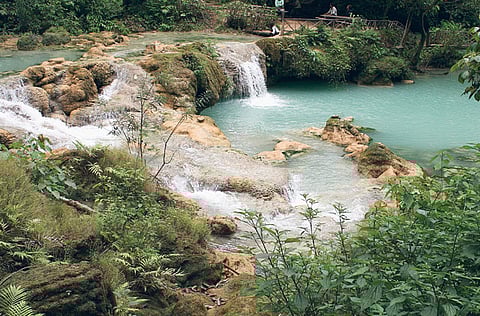
We passed on elephant riding in favour of a trip to Tat Kuang Si, a beautiful spot 40 minutes from town. Here, you will find waterfalls tumbling over white limestone into multilevelled turquoise pools.
There's also a remarkable Asiatic black-bear sanctuary on the way to the falls, run by a British couple.
All the bears have been rescued from the bad guys, who kept them in tiny cages and had bile removed from their gall bladders to make traditional Chinese medicine.
Lao cuisine is a blend of Chinese and Thai, with emphasis on local herbs.
Most days, we ate lunch at a stall by the side of the road for £1 (Dh6) — spicy noodles with chicken and mushroom. L'Elephant, near the Mekong River, is arguably the smartest place for dinner, with a mainly French menu.
How long Luang Prabang can be so engaging, so life-affirming, is hard to say. But the message is clear: Go sooner rather than later. This is travel of a different kind.


