Pax Silica: What the new AI tech bloc means for the UAE, global economy
UAE enters a US-led AI alliance linking chips, data centres, minerals, global energy power
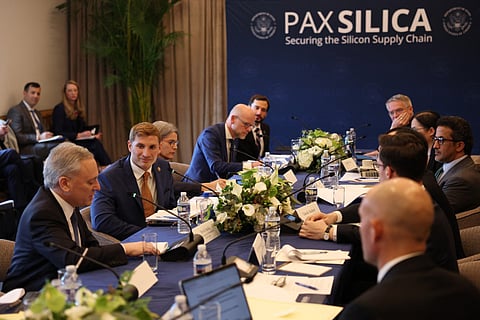
Dubai: The US launched a new tech alliance to shape how the AI economy is built called the Pax Silica Initiative, also known as the Silicon Declaration. The project began late last month, in December 2025, and sits at the heart of Washington’s new technology strategy.
Pax Silica focuses on securing the supply chains behind advanced AI. It targets four pillars: compute, semiconductors, critical minerals, and energy. US officials describe it as “silicon statecraft,” aimed at building a trusted tech ecosystem.
As of January 19, 2026, nine countries have formally signed the declaration. They are the US, the UK, the Netherlands, Israel, Qatar, the UAE, Japan, South Korea, Singapore, and Australia. The coalition has expanded quickly since its first summit in Washington.
Who has joined, why it matters
The bloc now spans North America, Europe, the Middle East, and the Asia-Pacific. It brings together chip designers, equipment hubs, energy producers, and capital-rich states. This mix gives the group control over many of the inputs behind modern AI systems.
Qatar joined the initiative on January 12, 2026. The UAE followed on January 15, 2026. Their entry marked a major expansion into the Gulf.
US policymakers see Gulf states as critical to the future of AI infrastructure. Large data centres need stable energy and long-term financing. The UAE and Qatar offer both through energy reserves and sovereign wealth.
India, access, the “moving gap”
India was absent from the first summit in December 2025. In January, the US ambassador to India, Sergio Gor, formally invited New Delhi to join. Officials expect India to sign in February 2026, positioning it as a large alternative manufacturing base.
Pax Silica also reinforces a US policy called the “18-month moving gap.” The aim is to keep a permanent technology lead over rivals. Members gain preferred access to advanced chips, frontier AI systems, and high-end manufacturing tools.
Non-members face tighter export controls. Access to the full AI stack, from Nvidia chips to advanced lithography, stays largely inside the bloc. This turns membership into both an economic and strategic advantage.
How it will shape global trade
Not every participant holds full status. The nine signatories have signed the main operational document for economic security. Taiwan, the European Union, Canada, and the OECD have attended summits as observers or special guests.
Taiwan’s role remains limited because of geopolitical sensitivity around its semiconductor dominance. The tiered structure lets the bloc share coordination while restricting sensitive technology. It also gives Washington flexibility in how access is granted.
For global trade, Pax Silica effectively creates a new tech-aligned zone. Members plan to coordinate joint investments, including mega-projects like the proposed $500 billion 'Stargate' data centre programme. They also aim to build mineral refining capacity outside Chinese control.
The bloc will align export rules on advanced hardware and frontier AI models. The goal is to prevent technology leakage to countries of concern. For the UAE, membership places it inside the planning of global AI infrastructure, not just as a buyer, but as an energy, capital, and technology partner.