New Apple CEO John Ternus takes over on Sept. 1 ahead of iPhone 18 launch: What to know
New Apple chief John Ternus debuts amid foldable iPhone and AI race
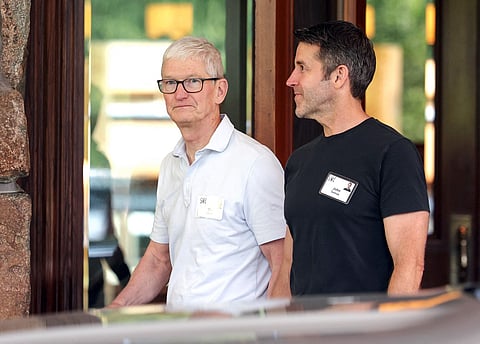
On Tuesday (September 1, 2026), John Ternus takes over as CEO of Apple, ending Tim Cook's 15-year run at the top.
Cook becomes Apple's executive chairman. Apple says the succession was the result of long-term planning and was unanimously approved by the board.
The timing could hardly be more dramatic. Eight days after becoming CEO, Ternus is expected to stand on an Apple stage for his first major product event.
The potential headline product: the much-talked about first foldable iPhone.
Who is John Ternus?
Ternus is almost the opposite of the stereotypical Silicon Valley CEO.
He is an engineer, not a marketing executive. He joined Apple in 2001, eventually becoming one of the company's most senior hardware leaders.
He has overseen major parts of Apple's hardware engineering, including the Mac, iPad, iPhone and Apple Watch.
US tech media describes him as a key figure in Apple's hardware development and says he played a central role in the revival of products such as the Mac.
He became Apple's senior vice president of Hardware Engineering in 2021.
That makes the succession significant: Apple is moving from an operations-and-supply-chain CEO to a product-and-engineering CEO.
Tim Cook's great strength was making Apple's enormous machine run: manufacturing, logistics, China, suppliers, services and financial performance. Ternus inherits that package.


But he also inherits a very different technology industry.
What we know so far:
Bloomberg’s Mark Gurman reported that Ternus is about to debut the following:
Apple’s first foldable iPhone
A smart home device with facial recognition
A tabletop robot
AirPods with cameras
Smart glasses
A 20th anniversary iPhone with new glass-centric design
A home security system.
“He also needs to reinvigorate Apple’s design team," Gurman stated, "determine the future of the VisionPro, figure out the long-running memory shortage, oversee a lawsuit against OpenAI related to trade secrets and fight to keep engineers who are fleeing to OpenAI and other rivals. Most importantly, Ternus needs to oversee an AI comeback and decide how much of the technology should be built in-house by Apple.”
Apple's AI challenge
This is the big one. Apple was an early mass-market AI company in one sense — Siri arrived in 2011 — but the generative-AI revolution has exposed how far the company has fallen behind rivals.
Apple has faced delays with its more ambitious Siri upgrades, while Google, OpenAI, Microsoft and others have moved rapidly into generative AI and AI agents.
Tech analysts see AI growth and Apple's China supply chain as two of Ternus' biggest challenges. One analyst described Ternus as a hardware expert who now has to scale up Apple's AI strategy.
This creates a particularly difficult challenge. Apple's historical advantage has been tight integration of hardware, software and services.
If the intelligence powering Siri and other AI features increasingly comes from outside partners, Apple risks losing part of that advantage.
Ternus therefore has to answer a fundamental question:
Can Apple build an AI ecosystem as compelling as the iPhone ecosystem?
Apple's next trillion-dollar product?
The iPhone remains Apple's revenue engine. But the question hanging over Ternus is brutally simple: What's next?
Analysts have long argued that Apple needs to diversify beyond the iPhone. The Guardian noted that Ternus will be under pressure both to improve Apple's AI position and diversify the company away from its dependence on the iPhone.
The company has experimented with the Vision Pro, services, wearables and other categories. But none has yet produced an iPhone-scale breakthrough.
This makes the foldable iPhone, when it does come out, matters so much. It isn't merely a change in form factor. It is Ternus' first opportunity to demonstrate that Apple can still create a new premium product category rather than simply refine an existing one.
Manufacturing challenge
Cook made China a manufacturing powerhouse for Apple — and also made Apple deeply exposed to China. That creates a difficult balancing act for Ternus.
Apple needs Chinese manufacturing, Chinese suppliers and Chinese consumers. At the same time, US-China tensions, export restrictions, tariffs and Beijing's push for domestic technology create geopolitical risks.
Reuters has identified Apple's China supply chain as one of the major issues facing Ternus. The problem is not simply moving factories from China to India, Vietnam or elsewhere.
Apple's supply chain is an extraordinarily complicated ecosystem of suppliers, tooling, skilled workers and component manufacturers.
Ternus cannot simply “leave China.” He has to make Apple less vulnerable to China without making Apple's products dramatically more expensive or less efficient.
Tariffs and the global supply chain snags
Cook was exceptionally good at navigating tariffs and supply-chain shocks.
Ternus now inherits that geopolitical minefield. Apple's latest earnings remained strong, but tariff-related issues have already affected its financial picture. Axios reported that Apple's latest quarter benefited from tariff refunds.
That means Ternus isn't just running a technology company.
He is effectively managing a global geopolitical supply chain alongside rare-earth materials, semiconductors, tariffs and export controls.
Each can affect Apple's margins and product availability.
Can Apple still surprise people?
This may be Ternus' most important cultural challenge. Apple has become enormously successful at refining products. But the company's mythology was built on something else: surprise.
This goes from the Mac, to the iPod, the iPhone, iPad, AirPods and the Apple Watch.
Will Ternus be able to lead Apple to make the tech giant look exciting again?
And then comes September 9
Here's where the succession becomes almost cinematic.
Ternus officially becomes CEO on September 1.
Apple has scheduled its major September product event for September 9.
Apple is expected to unveil its next iPhone generation and potentially its first foldable iPhone at the event.
Recent reports say the event is expected to centre on the iPhone 18 Pro and iPhone 18 Pro Max, alongside the long-rumoured foldable model.
The biggest launch: the foldable iPhone
If leakers and current reports are correct, Apple's first foldable iPhone is the product to watch. Tech media suggest a premium device that folds down to roughly 5.5 inches and opens into a screen around 7.8 inches, approaching the size and proportions of an iPad mini.
The significance goes far beyond another iPhone model. Samsung has spent years developing the foldable-phone category.
Apple has watched and waited: Now it appears ready to enter the market at the premium end.
And because this is Apple, the real question isn't whether it can make a foldable phone. It is whether Apple can make foldables mainstream.
Will Apple help the foldable-phone market grow, as overall smartphone shipments decline?
That makes the foldable potentially the most important Apple hardware launch since the Vision Pro — and arguably more commercially consequential.
Launch timing
Ternus could not have asked for a better introduction. Imagine the sequence:
September 1: Tim Cook steps aside.
As John Ternus becomes CEO on September 1, and Apple unveils its next generation of iPhones on September 9, unveiling a completely new iPhone form factor, that gives Ternus something Cook did not have when he became CEO in 2011. Cook inherited the iPhone 4S era and the enormous Jobs legacy. Ternus inherits an Apple that needs to prove it can still invent the future.
Now, a key challenge to Ternus is to convince consumers that Apple still has something genuinely new to say. The foldable iPhone may be his first answer.
But it won't be the final one. On September 9, the world gets its first real clue about what kind of Apple he intends to build.


