Dubai’s 1 Billion Summit: Will AI influencers take over social media?
A panel at Dubai’s 1 Billion Summit explores whether AI influence can ever replace humans

Dubai: A dystopian reality question, but in our ever evolving AI world, as artificial intelligence continues to reshape digital culture, one question keeps coming up: will AI influencers eventually take over social media?
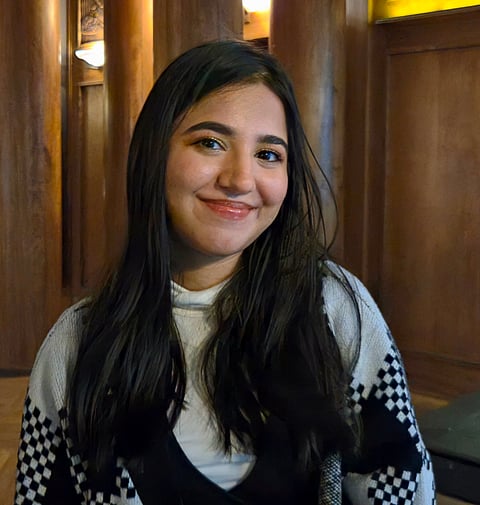
A panel debate at the 1 Billion Summit between Egyptian content creator Farah El Kordy and Dhairya Patel, who represents virtual influencer Lil Miquela, moderated by Sarah Sabbagh, explored a future that's far more complex than simple replacement.
The human side: connection through imperfection
For Farah El Kordy, influence starts and ends with lived experience. "When it comes to humans, we connect to growth and imperfection," she explained, pointing out that authenticity is built through time, effort, and actually being present emotionally.
Unlike virtual avatars, human creators show up tired, evolve publicly, and experience burnout. That vulnerability isn't a weakness. It's actually what builds trust with audiences.
Farah also questioned whether emotional connection can truly be copied. "Authenticity is what gets attention," she noted, adding that whilst AI might look good visually, it lacks the emotional friction that defines real human interaction.
To her, the challenge for AI influencers is depth. "For me, AI influencers are just a bit boring. Everyone can have an AI. It's going to become easier over time," she said.
She also rejected the idea of replacement completely. "I don't think the future is human versus AI. It's human and AI," she stressed, pointing out that culture ultimately moves around people, not platforms or tools.
The AI perspective: it's a team effort
Representing Lil Miquela, Dhairya Patel challenged the assumption that AI influencers lack authenticity. "There is a big misconception," he explained. "She is not real biologically, but she is real in the sense that there is a team of humans behind her."
According to Patel, virtual influencers are less about automation and more about collaboration. "It's more like filmmaking," he said, describing a process involving writers, stylists, and storytellers who put real human emotions into a virtual character. "She becomes a publisher of human stories."
From a brand perspective, Patel highlighted another advantage: stability. "She doesn't burn out," he noted. Virtual influencers don't face the exhaustion or personal crises that often affect human creators. "That's brand-safe, and brands like that."
Still, Patel acknowledged growing doubts. "The fear is real," he admitted, pointing to audience reservations with AI. But he sees wider access as an opportunity, not a threat. "Access creates noise, but it also raises the bar. Culture doesn't die, it evolves."
So will AI take over?
Both speakers actually arrived at the same conclusion: Takeover is the wrong word to use.
Farah made it clear she values the human experience too much to give it up. "I enjoy warning people, sharing stories, and connecting with them," she said, adding that whilst she might consider AI tools in the future, she won't remove herself from the process.
Patel agreed from a different angle. "At the end of the day, it comes down to intent," he said. "Whether biology or artificial, what matters is what we're trying to communicate."
The bigger picture
The debate showed that AI influencers aren't here to erase human creators. They're here to challenge them to evolve.
Humans bring empathy, unpredictability, and lived context. You can't programme the feeling of having a bad day and still showing up for your audience. You can't fake genuine excitement when something good happens.
AI brings scale, consistency, and collaborative storytelling. Virtual influencers maintain perfect posting schedules, never get sick, and always look exactly right. For brands, that reliability is valuable.
The future of social media influence won't belong exclusively to either humans or AI. It will belong to those who understand how to balance technology with humanity and use both to tell stories that people still recognise themselves in.
What audiences actually want
At the end of the day, audiences want content that resonates with them. Whether that comes from a person or a virtual character matters less than whether it speaks to something real in their lives.
The challenge for AI influencers isn't proving they can post consistently or look perfect. It's proving they can tell stories that feel genuine and create connections that last.
The challenge for human creators isn't competing with AI perfection. It's remembering that their imperfections and authentic voices are actually their biggest strengths.
Perhaps the question shouldn't be whether AI influencers will take over social media. Perhaps it should be whether we're ready for a future where the line between human and AI-created content becomes increasingly blurred.
As Farah pointed out, everyone will soon have access to AI tools. When that happens, what makes content stand out won't be the technology behind it. It will be the intention, creativity, and human insight that shapes it.
The future isn't about choosing between human creators and AI influencers. It's about understanding what each brings and finding ways to make them work together without losing what makes influence meaningful.
Areeba Hashmi is a trainee at Gulf News.