Running in a park — a lonely bid for Albanian glory
Gega’s world is miles and miles from how the stars — footballers and big-name athletes — prepare for matches
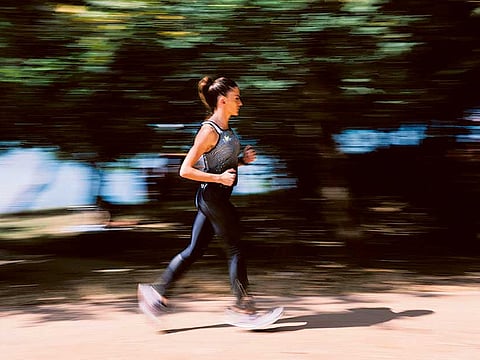
Tirana: She runs next to leisurely joggers in a Tirana park — with no athletics track in the Albanian capital, Luiza Gega has no choice but to train alone and wherever she can.
But the tiny 27 year old, a picture of pure muscle and energy, is building up to the 3,000m steeplechase at the Rio Olympics next month, where she will be a proud flag-bearer.
Albania has never won an Olympic medal, and such is the desperation for national sporting success its footballers were honoured by the country’s political elite after a 1-0 victory against Romania at Euro 2016 in France.
In contrast, when Gega finished sixth at the 1,500m at the World Indoor Championships in 2014, all she got was silence, complained her coach Taulant Stermasi. The former football player finances his sports activities through his real-estate business.
“To get money from the state one has to be in the five best ... she finished sixth. How high are Albanian footballers ranked?” he asked bitterly.
The minister in charge of sports met the footballers, but she never saw Gega, Stermasi said.
“I wanted to tell her, ‘If you think Gega doesn’t deserve the money, OK, but just tell her.’
“She’s the best athlete ever in Albania.”
Stavri Bello, Albania’s Olympic Committee secretary general, summed up the challenge Gega faces for recognition: “Politics wants the image and will follow the sport that gives the image.
“Football, that’s a heavy industry.”
Bulldozers at stadium
Gega, who is in action at the ongoing European Athletics Championships, had long trained at the dilapidated Qemal Stafa stadium, Albania’s largest.
Constructed in 1946, runners complained the surface hurt their legs.
But it had the only athletics track in Tirana, a city of around one million people.
Then in April, just four months before the Rio Olympics, Gega learned that it would be demolished to enable construction of the 22,300-seat National Arena stadium.
Prime Minister Edi Rama declared optimistically that it would be “one of the most beautiful [stadiums] in Europe.”
But for Gega there was a major catch — there will be no athletics tracks.
And she never imagined that the bulldozers would arrive so quickly, before the Olympics.
“I’ve been training at this stadium for years,” she sighed.
Gega headed to Korca, about 180 kilometres southeast of Tirana.
The town, 900 metres above sea level, has one of only two running tracks left in Albania.
Stermasi brought hurdles there for the steeple event and made repairs to a leaking water jump.
Little help
Gega, holder of national records from 800 to 10,000 metres, was born in the port of Durres.
The daughter of a cook and an agronomist, she would win school races but only started to run seriously at the age of 14.
Thirteen years later, on August 5, she will be among the first athletes to enter the Rio Olympic Stadium and will be carrying the Albanian flag for a small team likely to comprise a couple of swimmers, an athlete and a weightlifter.
Gega will travel to Rio without a physiotherapist, a nutritionist or a masseur — unthinkable for the bigger names in athletics, or many of her competitors.
At her coach’s expense, she has been undergoing strength-training in local gyms, next to fitness and bodybuilding enthusiasts. And of course running in parks.
Money is scarce.
An International Olympic Committee (IOC) cheque of $1,000 (Dh3,672) a month enabled her to go for seven weeks to Kenya in January.
But it was impossible to raise the funds to go this summer to Font-Romeu, the popular French mountain resort hosting athletes before major competitions.
The only other help Gega gets financially is $3,000 annually from her equipment supplier, her coach said.
Gega admitted that her homeland, one of the poorest nations in Europe, is a “country that has a lot of difficulties.”
But the authorities — who have promised to deliver an Olympic stadium, without giving a date — paid “€1 million (Dh4 million) to footballers for scoring one goal,” claimed Stermasi, referring to the Romania win.
“With proper training Gega would be in medal contention,” he added wistfully.


