The secret mental skill that helps Messi, Haaland and Kane spot chances other footballers never see
Sports psychologists explain the hidden mental skills shaping football's biggest moments
Dubai: Nobody expected Cabo Verde to hold Spain to a 0-0 draw in the opening week of the 2026 FIFA World Cup. Nobody expected Australia to beat Turkey either. And when Morocco held five-time champions Brazil, it raised the same question it always does at a World Cup: what actually decides whether a team wins or loses?
Talent matters. Fitness matters. Coaching matters. But according to one sports psychologist, there is a whole other game happening on the pitch that most of us never see, and it is happening entirely inside the players' heads.
The psychologist who studies football brains
Dr Eric Zillmer is a neuropsychologist at Drexel University in Philadelphia. He grew up playing football in Germany and now runs the university's Global Sport Leadership Solutions Lab, where he studies how elite athletes perform under pressure. In a recent analysis published during the World Cup, he outlined a set of psychological principles he believes are shaping results at the tournament, drawing on existing sports science and his own observations of how the best players and teams operate on the pitch.
Here is what he identified.
Great strikers do not just react: They process
We celebrate goals for what we see: the volley, the header, the curling finish. But the actual goal starts much earlier than that, and most of it is invisible.
Think about what a striker's brain is doing in the two or three seconds before a shot. They are tracking the ball, watching the goalkeeper, reading the movement of defenders, spotting where teammates are running, and calculating where the space is, all while sprinting and being physically challenged.
Dr Zillmer calls this "attentional fitness." It basically means the ability to juggle multiple streams of information at the same time without losing focus. The best strikers do not freeze when the moment comes. They stay locked in.
Players like England's Harry Kane, France's Kylian Mbappe and Norway's Erling Haaland all have this. When we say a player has "ice-cold composure" or "nerves of steel," what we actually mean is that their brain is managing pressure more efficiently than everyone else's. And the interesting part is that it is a skill, not a personality trait. It can be trained.
Messi is not watching the ball, and that is the point
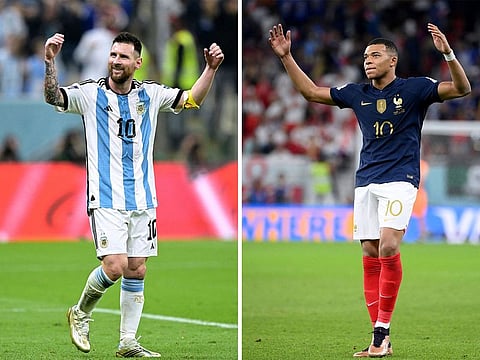
This might be the most fascinating detail in Dr Zillmer's research. When scientists tracked where Lionel Messi looks during a match, they found something that goes against everything coaches have said for decades. His eyes are frequently off the ball.
He is not zoning out. He is scanning. Psychologists call it "controlled mind-wandering," and brain imaging research shows that in those moments, the brain is not resting. It is processing the wider picture: where teammates are, where the gaps are, what is about to open up.
Messi takes in the whole pitch like a map. Then, the second a chance appears, he snaps into total focus and acts. That switch, from broad awareness to razor-sharp concentration, happens almost instantly. Most people cannot do it. Messi does it constantly, and it is a big reason why, even at 38, he still reads the game better than almost anyone.
Underdogs win by getting inside your head
One of the more interesting ideas Dr Zillmer talks about is "disruption." It is why teams like Cabo Verde can neutralise a side as talented as Spain.
Disruption means deliberately breaking the other team's rhythm. That could be aggressive pressing that forces mistakes, well-timed tactical fouls that kill attacking momentum, set pieces designed to create confusion, or simply winding up opposition players.
The key is that disruption is a mindset, not just a game plan. A team does not need to be more talented than its opponent. It just needs to be better at making the opponent uncomfortable. When that happens, skill gaps shrink. We have already seen it work multiple times in the group stage.
The best playmakers think like problem-solvers
Watch a player like Croatia's Luka Modric or Belgium's Kevin De Bruyne and you will notice they play passes that no one else on the pitch would have even considered. It looks like instinct, but Dr Zillmer says it is actually a form of creative thinking that can be developed through training.
Psychologists call it "divergent thinking," which is the ability to come up with several possible solutions to a single problem instead of just going with the obvious one. In football terms, that means seeing four or five passing options when everyone else sees one, and picking the one nobody expects.
Modern football demands more of this than ever. The game has moved away from rigid formations and towards fluid, high-pressing systems where players need to adapt constantly. That requires mental flexibility, not just physical speed.
US head coach Mauricio Pochettino summed it up neatly in the build-up to the tournament when he told his players to "play like children." It sounds simple, but the psychology is sound. Children experiment. They try things. They are not afraid to fail. That kind of freedom is exactly what allows creativity to show up in high-pressure moments.
The invisible edge
Sarah Carvell, a sports psychologist at the University of Gloucestershire, has made a similar argument. She believes the teams that prioritise mental preparation alongside physical and tactical training are the ones most likely to go deep in this tournament.
"Success on the world stage may depend not only on talent, but on the ability to withstand and adapt to the invisible pressures of the modern game," she wrote ahead of the World Cup.
So the next time you watch Haaland bury a chance he had no right to convert, or Messi find a pass that should not have been possible, or a team ranked 40 places below their opponents hold them to a draw, remember that what you are seeing is not just football. The goal was scored in the brain long before the ball crossed the line.