Road to 2027 ODI World Cup: Can Virat Kohli, Rohit Sharma afford to fail?
Star veterans fail to perform in the opening ODI against England at Edgbaston
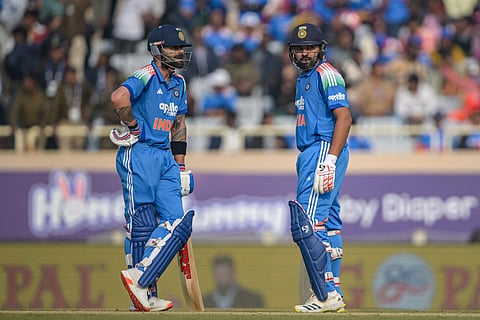
The spotlight never really leaves Virat Kohli and Rohit Sharma. Long before India’s ODI series against England got under way, the conversation once again revolved around the veteran duo. Every time they walk out to bat, their form, fitness and future dominate headlines. Despite carrying India’s batting for nearly two decades and amassing more than 35,000 international runs between them, one poor outing is often enough to trigger familiar questions.
Can they still be trusted for the 2027 ODI World Cup?
Those questions resurfaced on Tuesday during the opening ODI at Edgbaston. While India bounced back impressively from their T20I whitewash to register a convincing victory and take a 1-0 lead in the three-match series, the biggest talking point remained the failures of Kohli and Rohit.
Opening alongside Shubman Gill, Rohit managed just 11 off 21 deliveries before offering a simple catch to Harry Brook at mid-off off the bowling of Sam Curran. Kohli lasted only six balls, scoring five runs before Jofra Archer trapped him leg before wicket. The former India captain shuffled across attempting to flick a straight delivery, was struck in front and chose not to review the on-field decision.
For most batters, such dismissals would simply be written off as part of the game. For Kohli and Rohit, they immediately reignited the debate over whether India should continue backing them with the 2027 World Cup less than 16 months away.
Rotation policy
Recent reports have suggested the BCCI is considering a rotation policy in ODI cricket to manage workloads while simultaneously assessing the bench strength. It is a sensible approach for a team entering a transition phase, but it has also intensified scrutiny on the senior players.
The reality, however, is that Kohli and Rohit are judged by standards no other cricketers are expected to meet.
A string of low scores from a younger player is viewed as part of the learning process. When Kohli or Rohit fails, retirement debates begin, television panels light up and social media erupts. That is the burden of being among the greatest players the game has produced.
Over the past decade, both men have elevated expectations to extraordinary levels. Ironically, they are no longer measured against their contemporaries but against the best versions of themselves.
India have already begun preparations for the 2027 ODI World Cup, and captain Shubman Gill has made it clear that both veterans remain central to those plans.
“Rohit Sharma and Virat Kohli have been the backbone of the Indian batting lineup for the past decade, and both remain an integral part of the team. The experience and skill they bring are obviously very valuable. We have seen what they have done over the past decade in different conditions,” Gill said.
His assessment reflects the thinking within the Indian camp.
Neither Kohli nor Rohit needs to feature in every bilateral assignment. Managing their workload while giving opportunities to younger players is a practical strategy. But when India enters a major ICC tournament, experience becomes as valuable as talent.
Handling pressure
World Cups are rarely won on ability alone. They are won by players capable of handling pressure, adapting to changing situations and delivering in defining moments. Few players in world cricket possess those qualities more consistently than Kohli and Rohit.
Kohli’s ODI record over the past few years continues to rank among the best in the format, while Rohit’s ability to dominate the Powerplay remains a weapon that few teams can match. Judging either player on the basis of one or two failures ignores the realities of elite sport.
That does not mean either should be selected purely on reputation. Performance must always remain the ultimate selection criterion. If either suffers a prolonged decline over an extended period, selectors will inevitably have to make difficult decisions.
But there is a significant difference between demanding accountability and overreacting to every failure.
India still have plenty of ODI cricket before the World Cup in 2027. There will be lean patches, disappointing series and days when even the best players struggle. That alone should not become evidence that their careers are nearing the end.
The transition to the next generation is already under way. Gill, Yashasvi Jaiswal, Ruturaj Gaikwad, Tilak Varma and the exciting Vaibhav Suryavanshi represent India’s future.
History, however, shows that successful transitions are built on balance rather than abrupt change.
Fair judgement
Perhaps the greatest compliment Indian cricket can pay Kohli and Rohit is to judge them fairly rather than exceptionally.
The expectation should not be that they score a century every week. It should simply be that they remain among India’s best options when the World Cup arrives.
If they continue to perform, they deserve their place. If they no longer justify selection, Indian cricket will naturally move forward.
Until then, every low score should not be treated as a retirement announcement. Because even legends are allowed to fail.


