Why 2025 was transformative year for the UAE’s non-oil foreign trade
Despite global tariffs and transit disruption, the UAE set historic trade milestones
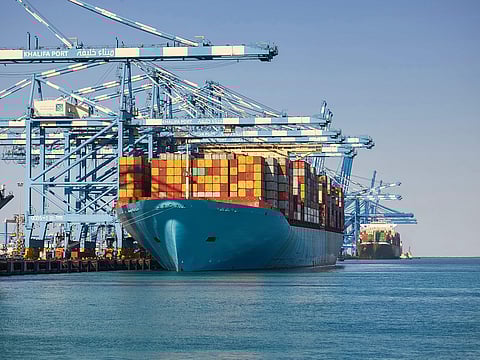
Trade isn’t always the most newsworthy topic. The movement of goods and services between nations is such an accepted – and necessary – component of the global economy that it only makes the headlines when it suddenly ceases, or at least slows to the point when consumers, retailers and manufacturers are adversely affected.
This has been the case only a handful of times in the last 30 years. The Asian financial crisis of the late 1990s, the global financial crisis a decade later and, from 2020, the supply-chain disruptions of Covid all caused global trade to decline by at least 10 per cent, with the resulting bare shelves and unfulfilled order books serving as a reminder that modern life relies on the resources, products and agricultural produce that come from somewhere else.
While 2025 hasn’t quite reached that level of fracture, it’s been another year where trade has made headlines for the wrong reasons, with tariffs and trade disputes erupting between key markets and impacting some of the primary levers of the economy. According to the World Trade Organisation (WTO), the value of imports affected by new tariffs between October 2024 to October 2025 reached $2.64 trillion, a fourfold increase on the same period a year earlier – the highest recorded in more than 15 years of WTO monitoring.
Transit difficulty
In parallel, the difficulties of transit through both the Suez and Panama canals – albeit for differing reasons – has caused ocean-going cargo to select longer, costlier routes and further impede the global trading system. For trading nations such as the United Arab Emirates, which has made the flow of goods into and out of our ports a pillar of economic strength, it was hardly the most promising of macroeconomic environments.
Yet, by almost every metric, 2025 has been the most successful ever year for UAE foreign trade. We haven’t so much sidestepped the roadblocks as soared above them, using a combination of policy, partnership and private-sector ambition to set new records in every non-oil trade category and confirm our place at the heart of global commerce.
Record non-oil foreign trade
In 2025, the value of the United Arab Emirates’ non-oil foreign trade reached Dh3.8 trillion. This not only represents an increase of nearly 27 per cent over 2024, it puts us within touching distance of the Dh4 trillion target we set for 2031 – fully six years ahead of schedule. Underlining our momentum, non-oil foreign trade in both Q3 and Q4 exceeded Dh1 trillion, the first and second times this quarterly milestone has been reached in our history.
Perhaps most significantly, the UAE’s non-oil exports reached Dh814 billion in 2025, a growth rate of 45.5 per cent over 2024 – and around three-and-a-half times the UAE achieved in 2019. Non-oil exports now account for 21.6 percent of total non-oil trade, the highest share ever recorded and the clearest sign of the productivity and competitiveness of our industrial sector.
Comprehensive Economic Partnership Agreement
Driving many of these gains is our Comprehensive Economic Partnership Agreement programme, which has been securing trade deals with key economies across the world since 2022. In 2025, our CEPAs with Australia, Malaysia, New Zealand, Jordan, Serbia, Costa Rica, Chile and Mauritius entered into force, increasing the number of global customers our exporters can access on a preferential basis and securing key supply chains between the UAE and South America and the Asia-Pacific region.
We have also continued to expand our CEPA network. In 2025, we cemented our ties to the key regions of Eastern Europe and Eurasia, signing deals with Ukraine, Azerbaijan, and the nations of the Eurasian Economic Union – Russia, Belarus, Kazakhstan, Kyrgyzstan, and Armenia – as well as resource-rich Africa, where CEPAs with Angola, Congo-Brazzaville, Central African Republic, Kenya and Nigeria will provide a range of opportunities in critical sectors such as agriculture, renewable energy, mining and logistics.
Rejuvenated trading landscape
Indeed, what began as a year of challenge has, due to new trade blocs and networks such as ours, ended with a rejuvenated trading landscape. Figures published by the United Nations Conference on Trade and Development (UNCTAD) in December confirm that, despite geopolitical tensions and rising costs, global trade will have reached an all-time high of $35 trillion by the year’s close, driven primarily by intra-regional trade in Asia and growing demand from Africa. South–South trade, which includes the Middle East, has expanded by 8 per cent.
This is the new direction of travel for trade – and for the global economy as a whole. Powered by the vision of President His Highness Sheikh Mohamed bin Zayed Al Nahyan, the United Arab Emirates will be a central force behind it.
Global trade leadership
For the UAE, trade isn’t simply cargo. It’s connectivity. It’s the global partnerships that deliver opportunity for our manufacturers, our service providers and our investors. Trade accelerates industrial output, sharpens our competitive edge, drives innovation and supports economic diversification – not just for the UAE but for ambitious, emerging economies across the world.
It is precisely because we recognise the power of trade to catalyse growth that we continue to pursue and promote multilateral solutions to today’s supply-chain challenges. In September, the UAE was a founding member of the Future Investment and Trade Partnership (FIT-P), an informal and agile group of nations determined to develop progressive trade policies and processes to support development, facilitate investment and create high-quality jobs. Our first meeting in November in Singapore agreed an agenda that will prioritise technological adoption and free-trade advocacy.
Ministry of Foreign Trade
Finally, 2025 was the year in which His Highness Sheikh Mohammed bin Rashid Al Maktoum, Vice-President and Prime Minister of the UAE, and Ruler of Dubai, announced the establishment of the Ministry of Foreign Trade. Our mission will be to develop new trade corridors with markets driving tomorrow’s growth and transform today’s volatility into long-term certainty and stability.
The new ministry underlines trade’s centrality to national growth – and its role as a diplomatic bridge to like-minded, expansion-focused nations. While trade volumes and CEPA deals remain our core performance indicators, we know that GDP is the ultimate barometer for success.
If the last 54 years have taught us anything, it’s that trade isn’t one component of economic performance, it’s the driving force behind it – and 2025 provided another timely reminder.
Dr Thani bin Ahmed Al Zeyoudi is the UAE Minister of Foreign Trade


