How public art bridges heritage and future in our cities
As cities grow more connected, public art helps preserve identity and a sense of place
In cities across the world, the effects of globalisation are producing an unexpected paradox. As urban centres become more connected and outward-looking, they risk losing the very qualities that once made them distinct. Skylines may rise, infrastructures may strengthen, but without a sense of identity, cities can quickly feel interchangeable. This is exactly where public art comes in. Not as a form of cultural embellishment, but as a means of grounding a city in its heritage while leading its evolution.
Public art, especially when site-specific and interactive, acts as a kind of compass that orients residents and visitors not through geography alone, but through meaning and imagination. It reminds people of their surroundings and encourages them to rediscover the landscapes and histories that shape collective identity. At a time when cities must constantly negotiate between tradition and progress, public art provides the language to hold both.
But its power goes deeper than visual impact. Public art creates continuity. It reveals the layers of a city from its ancient geographies to its contemporary ambitions, and makes those very stories accessible to all. Public art can transform a park, a coastline, or a public square into a site of connection, simply by engaging with the environment rather than decorating it. It prompts people to pause, feel and reflect. This is particularly important in cityscapes, where speed often overtakes awareness.
In the United Arab Emirates, this relationship between art, place, and identity has gained remarkable momentum. The landscapes of Abu Dhabi and Al Ain, from their coastal archipelagos and mangroves to oases sustained by centuries-old aflaj systems, hold narratives that continue to shape how communities understand the world. When artists respond to such contexts, our cities become places where heritage and future meet in meaningful dialogue. The past is not just preserved, but reinterpreted to inform how we move forward.
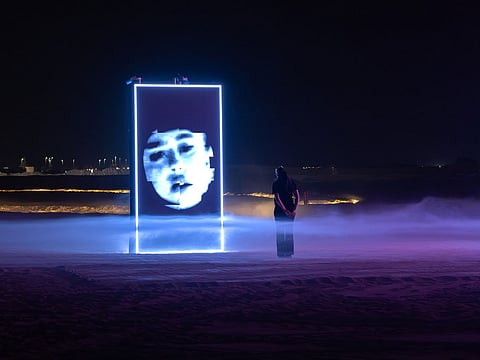
This is the impetus behind Manar Abu Dhabi, a Public Art Abu Dhabi initiative that has returned this year for its second edition and expands for the first time to Al Ain. Under the theme The Light Compass, artists from the UAE and across the world are exploring the Gulf’s ancestral relationship with light. How light once guided seafarers across open waters and desert travellers across shifting terrain, and how it continues to shape the sensory language of the region. Light, in this sense, becomes a metaphor for understanding where we came from, how we move through the present, and how we imagine what lies ahead.
In Al Ain, newly commissioned installations illuminate cultural sites and oases inscribed on the UNESCO World Heritage List. They bring to life the interplay between water, light, land, and human ingenuity. These works offer residents a fresh encounter with landscapes they may know intimately, while inviting visitors to understand their significance beyond aesthetics.
In Abu Dhabi, large-scale installations on Jubail Island and Souq Al Mina reinterpret the emirate’s coastal and urban identities. They demonstrate how public art can respond to contrasting environments while remaining grounded in shared cultural sensibilities. Across both cities, the artworks create pathways, both literal and figurative, that encourage people to move differently, notice carefully, and imagine openly.
This is precisely what public art must accomplish in a globalised world. It must serve as cultural direction helping cities articulate who they are and what matters to them. Heritage cannot remain static, nor can the future be built without it. Public art bridges this divide by transforming environments into experiences, and experiences into understanding.
As cities evolve, the challenge is not to simply flourish, but to grow with intent. Public art offers that clarity. It provides a framework for a modern-day identity that is inclusive, accessible, and continuously renewed. And in doing so, it ensures that as cities look outward, they remain deeply rooted in the stories that shaped them.
In Abu Dhabi and Al Ain, public art is illuminating not just landscapes, but the paths between past and future. It becomes a guiding light for cities and the people who call them home.
Alia Zaal Lootah is Curator, Manar Abu Dhabi


