MS Dhoni’s biggest loss to CSK may come off the pitch
The IPL legend leaves behind a commercial legacy that will be difficult to replace
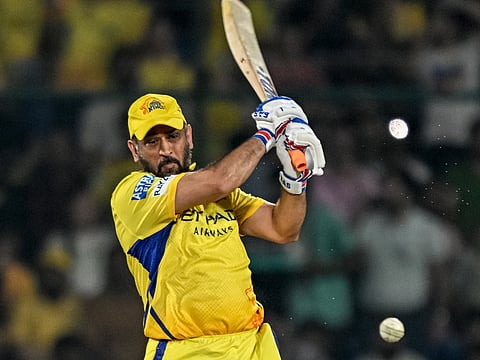
Dubai: MS Dhoni’s retirement from the Indian Premier League marks the end of an era for Chennai Super Kings (CSK). For nearly two decades, the former India captain was more than just the man leading the team on the field. He was its biggest attraction, its most recognisable face and arguably its most valuable commercial asset.
While his absence will undoubtedly leave a void in the dressing room, CSK could feel the bigger impact away from the cricket field. The franchise is losing a personality who helped turn it into one of the most recognisable and commercially successful teams in the IPL.
Dhoni’s contribution to Chennai’s success cannot be questioned. He led the franchise to five IPL titles - in 2010, 2011, 2018, 2021 and 2023 - making them joint-record champions alongside Mumbai Indians. He also guided them to two Champions League T20 titles in 2010 and 2014.
However, his importance to CSK extended well beyond those trophies.
When Chennai Super Kings picked Dhoni for $1.5 million at the inaugural IPL auction in 2008, they could hardly have imagined the commercial phenomenon their investment would become. The relationship between the player and the franchise grew so strong that, for a considerable section of supporters, following CSK was almost synonymous with following Dhoni.
His No. 7 jersey became a familiar sight across India, while his appearances at Chepauk regularly generated an atmosphere that few other cricketers could replicate. Even opposition grounds turned yellow whenever Chennai travelled, underlining the scale of his following.
Commercial value
That popularity translated into commercial value.
According to Sportico’s first IPL franchise valuation study in 2026, CSK is valued at $1.75 billion (Dh6.42 billion), making it the third most valuable franchise in the competition, behind Mumbai Indians and Royal Challengers Bengaluru. While that valuation reflects the overall strength of the IPL business model, central media rights and the franchise’s commercial operations, Dhoni has been a major part of the identity that helped CSK reach those heights.
There is also evidence of how closely his popularity has been associated with the franchise’s brand. Houlihan Lokey’s IPL Valuation Study 2026 valued CSK’s brand at $244 million, up from $235 million in 2025. Its 2024 report had also identified Dhoni as the biggest contributor to the franchise’s success and highlighted his influence on the team’s sponsorship appeal.
The commercial numbers tell another part of the story. CSK Cricket Limited’s consolidated annual report for 2024-25 recorded revenue from operations of approximately Rs6.73 billion (around $81 million). Sponsorship income stood at Rs1.16 billion, while merchandise sales generated Rs19 million. These are substantial revenue streams, and Dhoni’s popularity has been an important ingredient in making the franchise attractive to sponsors and supporters.
It is important to note that CSK does not publicly disclose how much of its sponsorship or ticketing income can be directly attributed to Dhoni. Nevertheless, the commercial connection is difficult to overlook.
Access to audience
Sponsors are not simply buying space on a team’s jersey; they are buying access to its audience. Dhoni brought an enormous audience with him.
Ticket sales are another important consideration. Whenever Dhoni was expected to play at Chepauk, the anticipation was different. Supporters wanted to see him walk out to bat, even if it was only for a few deliveries. His appearances also attracted attention at away venues, demonstrating that his commercial appeal was not restricted to Chennai.
His playing contribution, meanwhile, had gradually diminished in his final seasons.
Dhoni moved away from the captaincy in 2024, handing over the responsibility to Ruturaj Gaikwad. He increasingly operated as a lower-order batter, with his appearances at the crease becoming shorter. Knee problems also affected his ability to bat higher up the order. In IPL 2025, he scored 196 runs in 14 matches, while a calf injury kept him out of the entire 2026 season.
The franchise had, therefore, already experienced what it was like to play without him on the field. Interestingly, CSK’s brand value still increased by 3.8 per cent in 2026, according to Houlihan Lokey. That suggests the franchise has developed commercial strength beyond one individual, although Dhoni’s continued association with the team helped preserve that connection.
Mentor’s role
His retirement from playing, announced on November 17, is a different proposition. He will move into a mentor’s role from IPL 2027, allowing CSK to retain some of his influence and visibility. But having Dhoni in the dugout is not quite the same as having him walk out to bat.
There is a difference between supporters buying tickets to watch their team and buying tickets because they want to see a particular player. Dhoni often provided both reasons.
CSK now face the challenge of ensuring that the next generation of players can create the same emotional connection with supporters. Gaikwad, Shivam Dube and other emerging faces will have to help carry that responsibility. Winning trophies will remain important, but building marketable personalities and maintaining the franchise’s connection with its fan base will be equally crucial.
Dhoni leaves behind an extraordinary cricketing legacy. Five IPL trophies, two Champions League titles and years of leadership are achievements that will be difficult to replicate.
But his biggest contribution to Chennai Super Kings might not be measured in runs, wickets or trophies. It could be measured in the number of people who bought a ticket, purchased a No. 7 jersey, watched a match or followed the franchise because of him.
That is why CSK will miss Dhoni more off the pitch than on it. Replacing his contribution with the bat might have been inevitable. Replacing his commercial pull and emotional connection with supporters will be considerably harder.


