Lebanon held hostage: The cost of Hezbollah’s dominance
A 'state within a state' leaves the nation paying for proxy wars
There is little doubt that the influence of Hezbollah in Lebanon, or more precisely, Iranian influence, represents one of the most dangerous consequences of Iran’s expansion beyond its borders. Since the 1979 Iranian Revolution, Tehran has persistently sought to export instability and conflict through what is known as a proxy warfare strategy, embodied in what it calls the “Axis of Resistance,” with Hezbollah serving as its spearhead since its establishment in 1982.
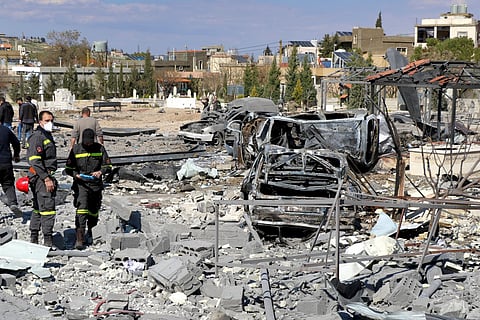
Lebanon has continued to pay the price for Hezbollah’s presence, culminating in the current war, into which the group has drawn itself in defence of the Wilayat Al-Faqih system, to which it is ideologically, politically, financially, and organisationally aligned. After more than three weeks of fighting, the toll in Lebanon alone has exceeded 1,500 fatalities, with thousands more injured, widespread destruction across multiple regions, particularly in the south, and over one million displaced persons. This staggering figure, however, appears to have little impact on Hezbollah’s leadership, as the fate of these civilians, forced from their homes and living in dire conditions, does not factor into its decision-making. In effect, these are Lebanese citizens whose destiny is being determined by a group that claims their name, but not necessarily their identity or national belonging.
Prolonged conflict
Hezbollah continues to insist on prolonging the conflict with Israel, largely heeding only directives communicated through its channels with remaining elements of the Islamic Revolutionary Guard Corps. It neither listens to nor meaningfully engages with Lebanese political leaders, operating independently of the state and without consultation, even though it claims to represent and defend Lebanon. Instead, it pursues what it describes as imposing a “new equation” in any potential negotiations with Israel, regardless of the broader national consequences.
In fact, the role played by Hezbollah on the Lebanese scene, and the crises it generates, represent one of the most complex geopolitical challenges to analyse. It is untenable for the fate of a state to remain hostage to the ongoing score-settling between two other states, bearing the costs of their tensions, conflicts, and wars. Yet this is precisely Lebanon’s reality: a country effectively held hostage by Hezbollah to the deep-rooted confrontation between Iran and Israel, despite having no direct stake in this destructive conflict. Lebanon and its people are in no position to bear even a fraction of its economic and strategic costs. Any acceptance of this reality risks gambling with the very future of the Lebanese state, not merely at the institutional level, but in terms of its continued existence on the map.
‘State within a state’
Equally, it is no longer viable to remain silent or patient in the face of a “state within a state” controlling the destiny of an entire country. Over the years, Hezbollah has evolved into the decisive authority over Lebanon’s security and stability. It renders any meaningful discussion of Lebanon’s future scenarios largely futile, as the group retains the capacity to overturn any political equation at will, particularly upon receiving signals from Tehran to escalate along the Israeli border.
The facts are clear: Hezbollah has been part of Lebanon’s political system since 1992 and remains a central actor in successive governments. It has built a comprehensive institutional infrastructure, spanning healthcare, education, finance, military, security, and ideological domains, operating beyond the oversight or control of any Lebanese government. This is, in the literal sense, a “state within a state,” not an exaggeration. For every official Lebanese institution, there exists a parallel counterpart within Hezbollah’s system. More strikingly, the group’s capabilities often surpass those of the Lebanese state itself, particularly in the military sphere. Under such conditions, discussions about redeploying or positioning the Lebanese army appear largely symbolic, as the presence of a parallel force with superior military capacity makes effective implementation on the ground highly improbable.
Structural crisis
This phenomenon reflects a broader affliction across the Middle East, where ideologically driven militias have, in some cases, dismantled the very foundations of the nation-state and, in others, continue to operate alongside or above national armies. It is a profound structural crisis that has long been met with silence or avoidance, treated as a deferred issue beyond consensus or resolution. Today, the peoples and states of the region are reaping the consequences of that prolonged silence.
Lebanon’s dilemma is unlike others. Any president or government in the country finds itself in a deeply complex position in the presence of a militia that operates outside the state’s constitution and legal framework, yet remains an integral part of its formal political structure. This entity makes unilateral decisions to engage in proxy wars and military ventures on behalf of external actors, while the Lebanese state and its people bear the heavy costs. At the same time, successive governments face mounting international and regional pressure to restrain the group, control its actions, disarm it, and dismantle its military infrastructure, but the Lebanese state is unable to achieve these goals under the current internal balance of power. This is particularly the case given Lebanon’s consensual political system, which effectively grants the group the ability to block any government decision that conflicts with its strategic, security, and military agenda.
Fragile coexistence
In this context, what may be described as a fragile coexistence between the state and Hezbollah has become unsustainable. This nominal arrangement no longer guarantees stability or continuity, as it may have done in previous years. Confronting reality has become imperative for all stakeholders, within Lebanon and among its regional and international partners alike. It is no longer possible to continue operating under the same rules that have clearly failed to ensure the survival of Lebanon and its people; indeed, these very rules have become part of the problem, opening the door to recurring instability and conflict within the country. Achieving genuine sovereignty now requires, at a minimum, the removal of Hezbollah from the military equation. The question of how to achieve this necessitates significant coordination, cooperation, and support from Arab states, Lebanon’s international partners, and all those committed to upholding the principles of international law, particularly respect for state sovereignty and independent national decision-making as foundations of stability and security.
If Lebanon is to avoid remaining a perpetual victim of militias and the expansionist policies of Iran’s ruling establishment, addressing its crisis cannot rely solely on developments in Tehran or on the expectation of a collapse of the Iranian regime, which would lead to the decline of Hezbollah and other regional proxies. Rather, it requires urgent action from within Lebanon itself, driven by the Lebanese people and supported regionally and internationally, to forge a new future for their country, free from external proxies that operate according to foreign agendas and destructive directives.
Rawdha Abdulla AlMarzooqi is the Head of Marketing and Exhibitions and official Arabic Spokesperson, TRENDS Research & Advisory