Hiroshima’s lesson still matters in a nuclear age
On Atomic Bomb Memorial Day, Japan urges renewed commitment to non-proliferation
Recent attention regarding the ongoing military conflict between the United States and Iran has often focused on the issue of navigation through the Strait of Hormuz. However, the issue of Iran’s nuclear weapons poses a threat not only to the Gulf region but also to the international community. It is an issue that should be of serious concern to all.
As conflicts and confrontations intensify in various parts of the world, it has become increasingly difficult for the international community to reach consensus on nuclear non-proliferation. The Review Conference of the Parties to the Treaty on the Non-Proliferation of Nuclear Weapons (NPT), held in spring of this year, was an important meeting — the first in nearly four years — to bring together a broad range of nuclear-weapon states and non-nuclear-weapon states. However, against the backdrop of an ever more severe international security environment, the conference was unable to adopt a final outcome document by consensus. Just as a small tear, if left unattended, gradually widens, there is concern that the international nuclear non-proliferation regime could further lose its effectiveness as differences in national positions widen and confrontations among states deepen. To prevent such a scenario, it is crucial that every country considers nuclear non-proliferation as its own responsibility and take the actions required.
Japan has made diplomatic efforts, in close cooperation with the countries concerned, toward the resolution of Iran’s nuclear issue. It is our sincere hope that further negotiations between the United States and Iran will lead to an agreement on the nuclear issue as soon as possible.
Atomic Bomb Memorial Day
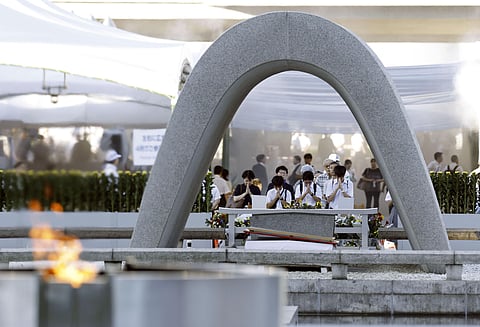
On 6 August 1945, an atomic bomb was dropped on Hiroshima. Three days later, on 9 August, another atomic bomb was dropped on Nagasaki. In Japan, these dates are widely observed as “Atomic Bomb Memorial Day”, and Peace Memorial Ceremonies are held annually in both cities. They provide us with an opportunity to remember what happened in the past and to renew our determination never to repeat the horrific tragedy caused by nuclear weapons.
It is estimated that approximately 210,000 people lost their lives in Hiroshima and Nagasaki by the end of 1945. Many more have continued to suffer from the effects of radiation exposure ever since. It is difficult for those who have not experienced such devastation to fully comprehend the catastrophic humanitarian consequences of nuclear weapons. As the Hibakusha, the atomic bomb survivors, grow older, passing on the realities of the atomic bombings to future generations has become a pressing challenge.
In this context, it is encouraging to see young people in Japan have become more engaged in nuclear issues by listening to the testimonies of the Hibakusha, sharing their experiences with others, and advocating the importance of nuclear disarmament and non-proliferation. In recent years, the Hiroshima Peace Memorial Museum and the Nagasaki Atomic Bomb Museum have also welcomed a growing number of visitors from overseas. Today, approximately 1.12 million international visitors each year visit these museums to learn about the realities of the atomic bombings. Needless to say, greater public awareness of the issue of nuclear weapons is of vital importance in maintaining international momentum toward the realisation of a world without nuclear weapons. I sincerely hope that many people from the United Arab Emirates will also have the opportunity to visit Hiroshima and Nagasaki and witness these realities for themselves.
Nuclear disarmament and non-proliferation
As the only country ever to have suffered atomic bombings during war, Japan has long positioned nuclear disarmament and non-proliferation as one of its highest policy priorities and has exercised leadership in the international community in this field. To build momentum toward the realisation of a world without nuclear weapons, Japan, together with like-minded countries, launched the Non-Proliferation and Disarmament Initiative (NPDI), a cross-regional grouping of non-nuclear-weapon states. I highly commend the UAE for its participation in and valuable contribution to this Initiative.
While efforts to advance nuclear disarmament and non-proliferation remain indispensable, promoting the peaceful uses of nuclear energy under the strict safeguards of the International Atomic Energy Agency (IAEA) brings significant benefits from the perspectives of achieving a decarbonised society and enhancing the well-being of people. Japan and the United Arab Emirates are also cooperating closely in this field. For example, Japanese companies have contributed to facilities associated with the Barakah Nuclear Energy Plant. In addition, Japanese heavy-ion radiotherapy technology has been introduced at Cleveland Clinic Abu Dhabi, while Japanese universities are cooperating in the training of medical professionals. These examples demonstrate how cooperation between Japan and the UAE in the peaceful uses of nuclear energy is making a tangible contribution to the lives of people in this country.
As Ambassador of Japan to the UAE, I am delighted to see Japan’s advanced technologies and products contributing to the country’s electricity supply and healthcare. I sincerely hope that our cooperation in these areas will be further strengthened in the years ahead.
Ken Okaniwa is Ambassador of Japan to the UAE


