Sharjah-based scientist devises the bio-brick
Award-winning scientist Dosier has looked to nature to help protect the environment
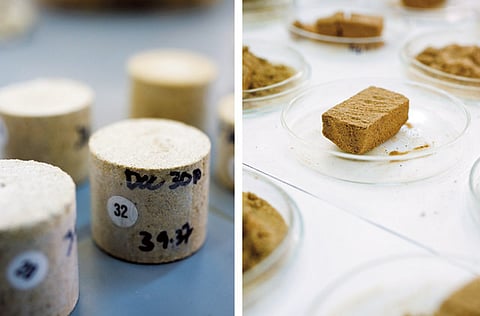
As a young girl growing up in Alabama, Ginger Krieg Dosier was fascinated by the numerous seashells that washed up on the sandy beach where she played. Asides from the soft, fleshy, fabulous creatures that inhabited their core, or the pretty colours, patterns and geometric markings that covered their exquisite exterior, what intrigued her most was how the shells were created.
- Who: Ginger Krieg Dosier
- What: Producing bricks that are eco-friendly
- Where: American University of Sharjah, College of Architecture, Art and Design
Stiff and strong, yet lightweight, these advanced nanostructure armour systems, she learnt, were composed of calcium carbonate which, when hardened, form into a tough shell. Her interest did not stop with seashells alone. She was enamoured by corals as well and their composition (again, calcium carbonate).
Little did she know then that years later, her wide-eyed awe of one of nature's most amazing phenomenons would inspire her to embark on a journey of experimentation and research, and lead her to ‘grow' a truly innovative product - a bio-brick made after harvesting cultured bacteria and mixing it with a combination of sand and urea.
It is not merely the idea of mimicking complex structures found in nature that is the most promising aspect of this new discovery. The true appeal of this 33-year-old assistant professor of architecture's sustainable creation lies in its potential to globally revolutionise the way buildings are constructed - turning one of the most energy-intensive processes in construction into an eco-friendly endeavour.
A pivotal part
Ginger, who has been teaching at the American University of Sharjah, College of Architecture, Art and Design, since 2007, considers a brick to be "the lowest common denominator" in architectural materials. Used in construction for more than 5,000 years, brick manufacturing is a pivotal part of the global construction industry.
The process of brick-making includes preparing the clay and shaping, drying and hardening it by baking it in a kiln at 2,000C. This results in emissions of pollutants into the environment. As well as being a major source of air pollution and a leading source of greenhouse gases, the brick industry also consumes millions of tonnes of good quality agricultural soil every year.
With 1.23 trillion bricks manufactured globally per annum and considering that each clay brick in a coal-powered kiln emits 1.3 pounds of carbon dioxide into the air, the brick industry is viewed as a serious menace to the environment.
What is fascinating about Dosier's new bio-brick is that it replaces firing with simple mixing and chemical reactions in a process that uses no heat at all. It can be done onsite without modern infrastructure, and yet, it is as strong as conventional bricks, endowed with similar properties in strength and durability. If these bio-manufactured bricks were to, therefore, replace each new brick on the planet, it would reduce carbon dioxide emissions by at least 800 million tonnes a year.
This concept of biologically "grown" bricks that are durable, sustainably manufactured, and easily produced from readily available materials earned Ginger in May last year, the New York-based Metropolis Magazine's 2010 Next Generation Design Competition, an annual contest that promotes activism, social involvement, and entrepreneurship in young designers.
The process
The process behind the innovative new brick is known as microbial-induced calcite precipitation, or MICP, and utilises microbes on sand to "glue" the grains together using a chain of chemical reactions.
Dosier's exploration into the essence of materials in design began just before she enrolled in graduate school. "[There] I became interested in the properties of materials: the chemical processes involved [in the manufacture of things], how you can alter their composition to change the way they grow and/or die."
After earning a Masters of Architecture in 2005 from Cranbrook Academy of Art, Dosier experimented with salt and calcium carbonate to make temporary architectural materials. She documented her studies in a thesis titled Material Choreography.
The experiments with salt led her to create a handrail composed of a salt mix that also served as a hand sanitiser. However, the handrail did not last long and soon disintegrated. However, she didn't want to leave the salt to permeate into the environment and began to look into employing additives to neutralise the negative effects of salt in the soil.
"This [made me wonder] whether we could grow materials as opposed to dissolving them," she says. "After graduation, I had lots of different samples that I had made out of calcium carbonate, and as I had always been fascinated by how seashells and coral were created in ambient temperatures in an aqueous environment in the presence of several minerals, I began to question if we could make construction materials mimicking processes from nature. How can we harness nature to produce sustainable building materials? The idea was to grow architectural materials with micro-organisms and use them as a manufacturing source."
She started knocking on doors at North Carolina State University where she served as Visiting Assistant Professor in 2005.
"I talked to microbiologist José Bruno-Bárcena about bacteria. I wanted to know if there were any bacteria that could aid in the formation of calcium carbonate. We began having long discussions about how this process could be made into architectural materials - that was six years ago. I began auditing courses in the material sciences poring over books and familiarising myself with growing materials for industrial uses."
Since then, it has been "testing, testing, and more testing," she says.
"In 2005, I was trying to go full scale first; trying to make an actual-size brick but there are so many nuances to the research one little variable can throw everything off. That's been one of the biggest challenges - trying to isolate these variables. I realised in the beginning I had to keep it simple and small."
However, at first, her "almost 98 per cent failure rate" did not actually cause her to wind down research.
"Instead, these failures tell you what happens if you don't add one element or mix too much of another. Initially, the mistakes were discouraging but you embrace each failure as you know you are inching closer and closer to your goal."
Another mentor, architecture professor at NCSU James Patrick Rand, encouraged her to scale down her thinking to smaller and more practical applications and Dosier focused on the brick chiefly because it was manageable. "There is also a lot of poetry behind bricks," she adds.
"It is the oldest form of construction but is also designed to fit in the hand. There is a ubiquitous language that goes into the brick itself. Also, a brick lends itself to multiple uses such as paving, precast panels, and side elements."
Despite focusing on a material that is the core of masonry construction, Dosier had no intention of aiming to redefine the construction system.
"If you look at masonry and the brick itself, it is evident with the bio-brick, the craft of construction does not have to change - rather the method of biomanufacturing reduces the need for high natural fuel sources. I am looking at the ability to insert a sustainable material that is grown in a biological process into the construction industry without introducing an entirely foreign process of construction."
Replacing the brick
Currently, countries around the world use different types of materials to make the brick. The goal, says Dosier, "would be to look at the bio-brick as a replacement for the standard brick. It doesn't matter which part of the world it is, the brick is ubiquitous and global, and can be used worldwide. Bio-bricks look the same, are of the same dimension and performance, and they are just the same in terms of their inherent properties such as strength and durability. The bio-brick can be made as soft as sandstone or as hard as marble - it can fit any requirement or be used for any type of infrastructure."
While her first creation took 11 days to grow, currently the bio-bricks take only about four to six days to form. However, Dosier admits that further testing is required to check the bio-brick's performance in severe weather conditions - can it handle freeze-thaw cycles, how does it test against water absorption, thermal capacity and so on.
"Technically, it should work," she says, "but industry requires testing a few of them together and my aim now is to build a two-metre wall by June to facilitate the process."
While the new brick presents countless design possibilities, the chief hurdle in large-scale production would be the inherent slow chemical process compared to the kiln method. She also admits that the product contains waste ammonium which, if it reaches groundwater would be harmful.
"If we were to capture the emissions before they transform into noxious gases, it would solve the pollution problem," she says.
"Currently, I am recycling and filtering the waste back into the system as a ‘closed-loop' - where everything is recycled back into the system. I am working with environmental engineers to streamline this process."
There are still a lot of questions to be addressed, she adds.
"I am running as fast as I can. My personal goal is to prepare for commercialisation within one or two years."
Her aspiration, of course, is to actually put the bricks to use. "I am yearning to put my architectural skills into practice and eventually design and build homes or other structures with these bricks."
Winning the 2010 Next Generation Design Competition award last year, she says, has been a great boost to her research efforts. "The Award opened a lot of doors for me. I've been contacted by Nasa [for material use in space application purposes]; several individuals and politicians in the US keen on looking at sustainable technology for their regions; many individuals from Haiti are hoping these bricks will meet their affordable housing needs and architects, too, have shown their eagerness in using the bio-bricks in their projects. Several scientists from across the globe have also contacted me, offering valuable advice on how to proceed. I am therefore extremely grateful for the award, and have the utmost confidence in the ability of the brick to be a replacement to high-embodied energy materials."
The bio-brick can bring about immense benefits for developing countries across Asia and Africa particularly, in housing and infrastructure development, she says, "but to see the bricks put to use is the ultimate goal."
Fact: The carbon footprint of brick-making alone amounts to more than that produced by the world's entire aviation fleet.
Sign up for the Daily Briefing
Get the latest news and updates straight to your inbox

