Michel Parmigiani: Creating timeless masterpieces
Michel Parmigiani has not only created the first full-fledged clock based on the Islamic calendar, he's also the last hope for restoring many precious antiques that may be lost to the world.
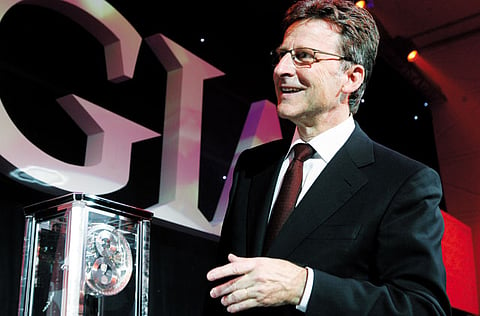
It's a brand you may not have heard of. Parmigiani Fleurier is not your average Swiss watch company. The eponymous brand of Michel Parmigiani, a noted horologist and restorer of vintage timepieces as well as other precious mechanical objects, it's one of those that even people who have watches from blue-blood companies often haven't heard of. "We cater to a very select and exclusive clientele, those who look further than the obvious big brands," says Jean-Marc Jacot, CEO of Parmigiani Fleurier. Kind of like an exclusive club that even the elite can only aspire to get into.
One for the lunar calendar
That club just became more exclusive, as well as elusive, with the launch of Parmigiani's newest creation, a mechanical Islamic perpetual calendar clock, in Abu Dhabi last month. It could be the rarest of luxury artefacts in the world, costing around $2.58 million (Dh9.5 million). Not surprising as it is the only one of its kind. The clock is housed in a cabinet and base made of solid silver, with decorative details in quartz and black obsidian. It weighs 17kg and has a power reserve of 30 days indicated by a ruby index that moves horizontally along the bottom of the cabinet.
However, it was not the claim to exclusivity that prompted Parmigiani to create his latest masterpiece. It was something as simple as a childhood fascination with calendars. "Calendars are always something that have fascinated me very much, because for me they have always held a special meaning," says Parmigiani, in his halting English, prompted at each faltering step by his interpreter.
"They are the heart of the civilisations. If you analyse calendars you can better understand the civilisations. Human beings have always been facing moon issues or sun issues, and have always been intrigued by the influence and the impact of these natural elements."
Finding inspiration from a piece of history
What really gave him the impetus to experiment with the Islamic calendar in a clock was the time he spent restoring "a piece of art from the Renaissance period, a pocket watch that dated back to 1600 and belonged to a ruler of the Ottoman empire," says Parmigiani. The mechanical part of the stopwatch had been completely destroyed. "But it was a simple calendar that had to be adjusted every year. It didn't take into account the mathematical algorithm, say, for a cycle of 30 years."
The challenge was to create a mechanism that was adapted to the Islamic calendar. The Islamic calendar has fewer days than the Gregorian calendar, 354 days instead of 365, and 11 leap years in the moon's 30-year cycle, with each leap year adding a day to the year.
The problem was the lack of accuracy when banking on the moon to tell the time. "With the sun, rotations can be measured with precision," says Parmigiani. "The lunar year is shorter, and the cycles of the moon irregular. This instrument uses a mechanism that takes lunar variations of normal and leap years into consideration over a 30-year cycle.
Fine-tuning the calculation
"People use different algorithms to calculate the moon's phases depending on the location, but my clock adapts to different algorithms," says Parmigiani. "I have chosen the most common algorithm that has been approved by the observatory of Paris. The Babylonians were already using this algorithm in 6BC. The Egyptians later adapted this and their astronomical knowledge is based on these tables."
Parmigiani says he solved this problem through the mechanism he created for the clock. "This clock can be adjusted to local latitude and geography, anywhere from Qatar to Riyadh, to the phase of the moon, and will stay accurate once adjusted," Parmigiani says.
The reason is that the calendar is not based on the observation of the moon and the skies and stars, but scientific tabulation and algorithms. "You can set the clock to the time at the location you are at. You can be in Riyadh or in Qatar, it can be adapted to the moon phase observation of this location. Later you may travel to Sydney but this piece of art will always show you the exact time and date according to the sky at the location. This clock determines the position of the moon with precision without an actual sighting."
Restoring masterpieces
The passion with which he struggles to make himself understood in a language that is clearly alien to him is indicative of his fascination with master craftsmen of the past and the masterpieces they created. Beginning in the late Seventies, leading Swiss collectors and later Ephrem Jobin, the first curator of Château des Monts (the famous watch museum in Switzerland), retained Parmigiani to restore their important pieces. Parmigiani went on to collaborate with the Patek Philippe Museum in Geneva, the Museum of Decorative Arts in Paris, Milan's Castello Sforzesco, and the Palazzo Falson in Malta, among others. At the end of Jobin's career he entrusted Parmigiani with the restoration of the Maurice-Yves Sandoz collection. This gave Parmigiani daily access to historical treasures, and provided the chance to meet Pierre Landolt, chairman of the Sandoz Family Foundation, whose trust marked the beginnings of a watchmaking adventure and ultimately to the creation of the Parmigiani brand in 1996.
According to Parmigiani, restoration is a multi-step process: a series of encounters with the object, and with its past. "Before you can set a finger on a piece, you have to immerse yourself in the know-how of the period when the piece was created," says Parmigiani. A completely faithful restoration requires mastering a range of skills relating both to the decorative exterior and to the complex mechanical workings of the piece. Restoring the visible outer aspects may involve several arts, including goldsmithing, enamelling, chisel engraving, stone setting, gilding, and glass working, so you have to have sufficient knowledge, he says.
Driven by passion
The total conviction with which he details his work is extraordinary. "What makes me restore such ancient objects which many may say are of no use anymore is that it helps you understand history," says Parmigiani. "By working with it you retrace history. Sometimes timepieces are three to four centuries old. It is very important. For example, this wonderful timepiece that belonged to the Ottoman empire I had a chance to restore allowed me to understand what had already been achieved centuries ago. I have always been intrigued by the mechanical achievements of the past. They challenge me to go further, to continue to be a part of the history."
But restoration has its limitations, agrees Parmigiani. "Restoration allows you to understand the past and to give it life again, but it does not allow you to express yourself, to be creative," he says. "On the other hand, to create something new, like the new Islamic calendar clock is really an expression of the knowledge and also a tribute to the art of the past.
"So, this is my way of paying tribute to the past centuries of watchmaking."
At the top but grounded
However, in the world of watchmaking, Parmigiani is known as an artist par excellence. Consider that a 30-year-old Patek Phillippe watch would have to be sent to Parmigiani Fleurier for any kind of repair. Parmigiani refuses to be drawn into a bit of self-promotion, though he does concede with a smile: "Yes, we can officially say we have restored an old timepiece of Patek Phillippe. I have been restoring timepieces for ages, and you can see showcased in our restoration department the biggest brands and among them the one that you named."
Investing in the future
Parmigiani believes in passing on his knowledge to his workers. Not for him the exclusivity that comes from guarding his craftsmanship. "Certainly, one of our aims is to train new young people who are talented in horology," he says. "For example, also my daughter has collaborated in the restoration in this particular timepiece. We have to take care of the future, which is why we train new people every year."
Even though Parmigiani Fleurier employs more than 600 employees, they are said to make only 10,000 watches in a year. The rest of the man hours are spent in restoring ancient pieces, as well as making parts for other brands.
"Ours is a vertically integrated company and this has been done in less than 15 years," explains Parmigiani. "Today we have a capacity to produce more than what we are producing for Parmigiani.
"We have the capacity to produce up to 20,000 watches in a day, but only produce 5,000 of our own pieces annually. In a year you can say we produce around 10,000 watches if you also consider all the parts that we produce for other brands. We wanted to go step by step to build the brand in a very selective way, with very selective distribution. But we are absolutely certain we don't want to go above 10,000. At that number we can keep the quality under tight control. If you go beyond that you lose control on quality."
It is this exclusivity of the brand that got them the commission in 2004 to make the Bugatti Type 370 Centenary watch (to celebrate Bugatti's 100th anniversary in 2009). It required five years of research to set its movement transversely, designed to match the world of motoring.
Is part of the reason he encourages new talent his recognition of the fact that many a great art has died because craftsmen don't pass on their knowledge? "Exactly!" he exclaims. "I am absolutely aware that in the past years, in the Eighties and Nineties, there has been too much knowledge that just disappeared because of this. It is not only one of my targets, but a very important part of my life's work to preserve this knowledge and train new people to develop it as a continuation of this patrimony."
Biggest achievement... yet
For now, he considers the Hegirian calendar clock his biggest achievement. "I have created even bigger masterpieces that were complicated, but with already existing know-how," he says. "But this one I would say is definitely the biggest masterpiece I have ever done because I had to build it from scratch. The basis was there, but finally it's a total innovation. It is something that has not been done before."
In future he'd like to go back to his old love - calendars. "I am really interested in calendars because it really reflects the civilisations," he says, smiling like a delighted child.
"My dream is to one day achieve a masterpiece of a watch that includes several calendars in time. It may sound impossible, but it's just a question of time, research and investment, because all the different cultures have different calendars but finally we end up with the same centre of three planets, the sun, the moon and the earth. These are the three common elements all the calendars have in common. So I aim to try to find a way to have the several calendars in one masterpiece. This is the dream of my life. This would be the final achievement of my life in the horological world and I would consider that to be the watch of peace."
The Hegirian calendar
From the start of the Hegirian Muslim calendar in AD622, when Prophet Mohammad (PBUH) moved from Madina to Makkah, until today, corresponding to the Hegirian year 1431, Muslim communities have been divided over the starting date of each month and, by extension, the dates of important religious holidays, says Hasan Hariri of the Dubai Astronomy Group.
While a standard Gregorian calendar is based on the movement of the sun, an Islamic calendar depends on a visual sighting of a hilal, or waxing crescent moon, on the 29th or 30th day of each lunar month. As a result, dates on a Muslim calendar can be moved by a day or so, depending on the first actual sighting of the moon by an accepted authority.
"Though people assume it is difficult to incorporate the Islamic calendar in a clock, I feel it is only because nobody has been interested in trying," opines Hariri. "We have ignored the Hegirian calendar, and hence the lack of a watch based on it."
Master's touch
According to Michel Parmigiani, restoration of an antique piece would depend on a piece's state of conservation. "Oxidation often prevents the movement from working properly," he says. "So, a meticulous process of rust removal and polishing has to be carried out. The Perrin Frères signed watch is a good example. The bells, posts, mobile stars, pinions, springs and index adjuster all had to undergo complete rust removal treatment."
On the Fabergé Peacock Egg, Parmigiani's restoration enabled the automaton to work harmoniously once more: the peacock moves on its two legs, and fans out its tail feathers as it goes round. Retouching the enamel also brought back a forgotten shine.
On occasion, prior unprofessional restoration efforts cause more damage than the ravages of time. In the case of the La Cueillette des cerises pocket watch, prior work included soft-soldering several components, causing irreversible oxidation of the steel.
Sometimes modern technology assists the restorers. The Yousoupoff Egg, an enamelled clock with rotating ring made in the workshops of Carl Fabergé, provides an example. Parmigiani used 3-D computer renderings to recreate several broken components that were still present in its mechanism. "It's beautiful, and the whole hand decoration of this unique piece is absolutely unique," says Parmigiani. "Yeah, I completely restored it. It belongs to the Sandoz Family Foundation Collection."
In the sporting arena, Parmigiani Fleurier teamed up with Italian luxury yacht builder Pershing to create the Pershing 002. More than just a smaller case size of 42mm (the men's is 45mm), the women's models have feminine flourishes that distinguish them. With or without the gemstones on the bezel, the Pershing abounds in delightful details like the blue mother-of-pearl dial, the starfish second hand with engraved tentacles and the centre seconds in the form of an octopus.
- Shiva Kumar Thekkepat is features writer, Friday


