Massive Attack: Pioneers of Sound
A tribute to British band Massive Attack's seminal debut album Blue Lines
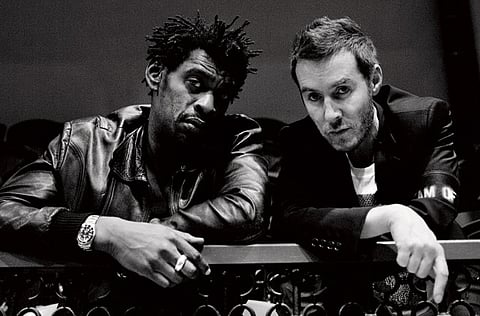
Precious few albums — even the great ones — are able to sound fresh two decades after their release, with electronic dance music arguably more susceptible to the corrosive power of time than any other genre. But Massive Attack's pioneering LP Blue Lines, which celebrates, believe it or not, its 20th anniversary next month (anyone who was a teenager in the early Nineties will feel positively decrepit at this news), has seen its importance swell with every passing year.
On its release in April 1991, the music press, lacking a convenient pigeonhole in which to slot it, struggled to categorise Blue Lines. Taking strands of American hip hop and weaving them into a British tapestry that embraced everything from dub to rare groove, Massive Attack was something of an anomaly in a dance music scene dominated, at the time, by the 4/4 beat of house.
Music critic Simon Reynolds said the album marked a change in electronic dance music, "a shift towards a more interior, meditational sound", and this was corroborated by Massive Attack band member Grant Marshall (aka Daddy G) who said: "What we were trying to do is create dance music for the head, rather than the feet." The band's Robert del Naja added: "What was most important [to the music] was the pace… the weight of the bass and the mood."
Urban, darkly downtempo and often accompanied by distorted, melancholy lyrics, it was a sound that was later coined trip-hop, a sound characterised by bands such as Portishead, Tricky (like Massive Attack, both from the United Kingdom's Bristol area) and Morcheeba. But whereas these acts failed to achieve any momentum, Massive Attack has thrived and outlived the very genre it spawned, releasing a slew of albums that have flirted with other musical styles and featured myriad guest vocalists who have helped expand their audience.
Blue Lines almost didn't get made at all. The three members of the band - Marshall, del Naja and Adrian Vowles, (who left the band in 1998 due to creative differences) were part of a sprawling Bristol collective called The Wild Bunch, a group of DJs, break-dancers and graffiti artists who put on events around the UK in the late 1980s. When the trio broke away to form their own band they needed prompting from an already established singer to actually enter the studio and create something.
"We were lazy… It was Neneh Cherry who kicked our butts and got us into the studio," Marshall admitted in 2004. "We recorded a lot at her house, in her baby's room. It stank for months and eventually we found a dirty nappy behind a radiator."
The album's executive producer Cameron McVey has also talked of the initial problems facing the band as they painstakingly put together their debut album.
"We made most of it in mine and Neneh's house in London, with babies, the office, the children and all of Massive Attack hanging out of every available nook and cranny! We had debt collectors banging on the door every day looking for money, it was a crazy time. It took a year in all to record Blue Lines."
Listen to the album's stand-out track, Unfinished Sympathy, with its moving vocal from Shara Nelson and haunting strings and it's easy to see why the production dragged on.
While every electronic act may have used a sampling machine ad nauseam in the early Nineties, when Massive Attack availed themselves of another artist's work they somehow made it better, as if they were stealing back a piece of music that was originally theirs. Unfinished Sympathy relied on a percussion loop from an obscure cover of a Paul Simon song — and few people even noticed.
Unfinished Sympathy undoubtedly hogged the limelight — helped by one of the most memorable music videos of all time — but there were other instant classics: the rumbling Safe From Harm, the poundingly upbeat Hymn of the Big Wheel and the album's title track were all innovative pieces of music that somehow broke the rules and set a whole list of new ones. Each track is distinct, and yet Blue Lines is a complete vision. The album never sounds like a compilation.
And even now the plaudits keep on coming. Blue Lines perennially crops up in Best Albums of All Time lists and in 2009 the band deservedly received an Ivor Novello award for Outstanding Contribution to British Music.
In a Music of the Millennium poll it was named 21st greatest album of all time. Rolling Stone magazine has it sandwiched between ZZ Top's Eliminator and Roxy Music's For Your Pleasure in its Top 500 Albums list.
Astoundingly, Blue Lines barely registered outside of the UK when it was first released. It was a commercial slow-burner, too ahead of its time to shift copies in large numbers. It took an inferior cover version of Unfinished Sympathy by Tina Turner for most Americans and the French to get acquainted with the album. But it has more than compensated for its sluggish start, creating a potent legacy. Without Blue Lines we would arguably have no Morcheeba, no Guerillaz, no Thievery Corporation.
Think of how many movie soundtracks would sound completely different.
Blue Lines is a unique - sometimes challenging, always pleasurable — listening experience which should be in every person's music collection, and if your own tune-box has this gaping omission, go out and buy it. Buy it right now. Better 20 years late than never.
Careers launched by Blue Lines
Tricky
Crackly-voiced Bristol rapper Tricky (Adrian Thaws), one of the original Wild Bunch collective, went on to release Mercury Music Prize-nominated album Maxinquaye and date eccentric Icelandic warbler, Bjork. His latest album, Mixed Race, was released last year.
Shara Nelson
The vocalist on four of the tracks from Blue Lines, Londoner Nelson is best remembered for her appearance in the video for Unfinished Sympathy. She went on to release two solo albums in the Nineties (one of which, What Silence Knows, was nominated for a Mercury Music Prize) and she has a new album out this year.
Geoff Barrow
Geoff Barrow founded breakbeat outfit Portishead, who won the 1995 Mercury Music Prize with its acclaimed album, Dummy. Their last album, Third, was released in 2008 but they're still regulars on the festival circuit. He was the music supervisor for graffiti artist Banksy's documentary, Exit Through the Gift Shop.


