Making the connection
Matthew Sanford reclaimed his lost years and paralysed limbs by establishing an effective mind-body connection through yoga
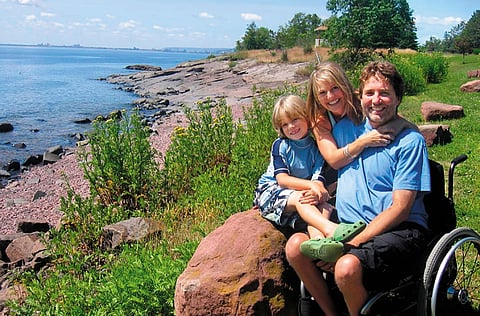
What Paraplegic yoga teacher in the US who helps other disabled people with adaptive yoga classes.
Where Minnesota, USA
Who Matthew Sanford, yoga teacher, public speaker, critically acclaimed author and leading voice in the integrative health movement.
Why He wants to bring about a change in rehabilitative therapy for paraplegics and people with physical disabilities by spreading the awareness that it is possible to reclaim one's whole body even after a disability, by using mind power to train it.
The video link that Matthew Sanford emailed me gives an inkling about the man.
It begins with a shot of a studio where Sanford is teaching yoga to a class full of students. It then zooms in on him and we hear his soothing voice encouraging students to concentrate on their body as they sit in a yogic pose, hands outstretched and eyes closed. Although he is in a wheelchair, he is agile, the chair becoming almost an extension of his body. He wheels up to a physically-challenged student and tells him that he needs to correct his posture. The student then uses his hands to lift his leg high up. With a little help from Sandford the student's leg is now perpendicular to the ground.
The grin on the student's face says it all. To him it is nothing short of a miracle that he can lift his limbs, albeit with support. What he has done was possible only through the motivation and exercise techniques that Sanford has been teaching at his institute in the US.
Sanford himself can do some pretty amazing things. Help him onto a yoga mat, and the 44-year-old who hasn't walked since he was 13 will achieve poses that trouble even the strongest able-bodied practitioners."Living vibrantly through one's whole body is a powerful part of living, whether one is paralysed or not," says Sanford. "There is a whole realm of healing potential within the mind and body relationship that does not require a reversal of condition," says Sanford, throwing light on his interpretation of healing that, according to him, is an art we have today relegated to the realm of science.
At his studio, Sandford encourages students to rediscover the mind and body connection to restart the process of healing.
His message is not about how he is able, despite being physically challenged. It's about how we all can live more fully in our bodies with a stronger mind-body connection. And no, he did not overcome anything, he says.
"We're always taught to ‘overcome' disability," Sanford says. "But you can't overcome your body. I didn't become a yoga teacher because I overcame anything. I'm a yoga teacher because I live an altered mind-body relationship.''
So who is Matthew Sanford? How is he making a difference in the lives of people? And how did he end up in a wheelchair? For the answers, we need to go back in time a little.
The early years
Matthew Sanford was 13 when a harrowing accident changed his life. Like any boy, he enjoyed being outdoors, playing soccer, climbing trees, running around with his friends… He always had a smile on his face - a reason why he was nicknamed Jolly.
One day, while Sanford and his family were on a holiday, they met with a devastating car accident which claimed the life of his father and elder sister. His mother and brother escaped with injuries while Sanford ended up with a broken neck and back. For three days, the young boy lay in a coma. Eventually, when he came out of it, he found that he was paralysed from his waist down.
Sanford was taught by his care-givers to concentrate on his upper body and strengthen it through exercises. Initially, any sensation he felt in his paralysed limbs was dismissed as a ‘phantom' sensation and he was taught to live like an amputee. Not one to give up, he was determined to do as many things as an able-bodied person could do. "I felt it was my birthright to be able to feel my whole body,'' he says. "For 12 years after the accident, I was going through the motions of my life and, by outward appearances, I was succeeding,'' he says in an email interview with Friday.
"For instance, I graduated from college with the highest honours and was a fellow in graduate school.'' But there was a sense of emptiness in his life. "The world felt bleak. I felt bleak. One day I realised that I truly and deeply missed my body. I was a fun-loving and very athletic little boy. What I had become was a floating upper torso that was profoundly disconnected from my paralysed body. I wanted to feel more alive, more vibrant.''
Keen to set right his life, "I decided to take up yoga'', he says. "That's when I started to explore the subtle world of sensation that existed within my paralysis.''
Yoga, the healer
At the age of 25, he approached a Bikram Yoga teacher, Jo Zukovich, who was to change his life in a major way. A caring instructor, Zukovich took him to a local martial arts studio and helped him get out of his wheelchair to sit on the floor.
And then something simple yet life-changing happened. With Zukovich's help, Sanford spread his legs wide. "It was really emotional," Sanford says. "It was really powerful. I had tears, but I didn't know why. Then I realised: I hadn't had my legs wide for 12 years.''
Zukovich encouraged Sanford to look at his body in a new way and to strengthen his mind so he could use it to train his body well.
It did not take long for the effects of yoga to begin showing on his body and mind. "For the first time after [my accident], I could feel the energy flow through my whole body. Through yoga, I encountered a richness and texture within part of me that I never thought possible. It helped me feel whole again. My paralysed body pulses with life and sensation and has much to teach me about the experience of living."
That was 19 years ago. Sanford's life has since been transformed through the practice of yoga. Not only did he come to terms with his own condition but decided he wanted to help others who may be suffering from conditions similar to his. He did not want them to spend years in darkness as he had and was keen to give them the chance of feeling whole once again.
"If you give of yourself, not only do you get something back but you create something new. It deepens the fabric of living when you give,"he says.
Together, Zukovich and Sanford founded the San Diego Yoga Studio. When Sanford's life had changed forever and he felt more integrated with his body, he decided to teach adaptive yoga to the physically challenged as well as to people who were older and who felt that they were beyond yoga. In 2007 he established Mind Body Solutions, a non-profit organisation in his hometown, Minnesota.
"When I started teaching yoga to people living with disabilities and they experienced a transformation similar to what I did, I realised that I was truly on to something. I also knew that what I was experiencing was not just true for people living with disability. It was true for the experience of consciousness in general."
He now teaches at yoga conferences around the US. He has won awards for his pioneering ideas in medicine. In Minnesota, he teaches regular yoga classes as well as adaptive classes for disabled people.
He also speaks at conventions because his message about mind-body connections applies to not just people with challenges but to everyone.
Sanford says we should all pay more attention to living fully in our bodies and recognising the subtle sensations there. Why? "Because they will improve the quality of your life," he says. "It will improve your connection to your life. Your relationships change. Your stress will go down. Our culture is in a hurry, and we don't take time to integrate subtle aspects of who we are through these practices."
He says some yoga exercises can help a patient with a physical disability listen to the ‘silence' of the affected area and establish a connection. "Yoga has also helped me realise and confirm a different kind of strength that resides not in what we can control and directly feel, but in the parts of us that we cannot directly control and feel.
"There is profound strength in the silence within us. The work of a practitioner of yoga is to make his or her actions congruent with the strength that resides within that silence. When this happens, a lightness and freedom occurs that deepens your sense of living. For me, it helped my paralysed body feel more alive.
"This insight, that my life is dedicated to sharing, is experiential in nature. This means that the students do not have to believe in me. They only need to believe in and appreciate their own experience. When this happens, their face lights up and we share a secret that cannot be broken.''
Sanford lives with his wife Jennifer who also handles the media and communication aspect of his work and his young son. He spends his professional life teaching yoga, speaking at workshops, seminars or giving radio talks.
"On a good day, I help my son off to school. I practise yoga. I have a few good thoughts. I drink enough water and I add value wherever I can, whether with respect to the non-profit I founded - www.mindbodysolutions.org - my teaching, my public speaking or my writing. I manage to do what I do because I take one day at a time and trust in the general direction of my life."
Waking up
Sanford has written the story of his life Waking: A Memoir of Trauma and Transcendence, a memoir that chronicles the journey of his life.
"Everyone has experienced tough moments, losses... Hopefully, my story will help others explore the story of their own lives."
Sanford has revolutionised the thinking of physical therapists and anyone working with post-trauma and physical injury patients.
He dreams of a day when the mind-body connection that he and many others have felt is truly given the recognition it deserves. "My dream is that mind-body integration is recognised as more than a personal health strategy.
"I believe it is a movement that is the key to long-term human survival. I have never seen someone truly become more aware of his or her body without also becoming more compassionate."
The mind body connection
Science is beginning to catch up to what Sanford says he knows firsthand about the power of the mind-body connection. Last summer, he underwent an MRI of his brain for a study at Rutgers University. The team of doctors mapped his brain as they squeezed his ankles. The images showed that his sensory cortex lit up in the same way it would in a non-paralysed person. For Sanford, this test proved what he had already discovered - his lower body might be considered dead, but there is still, somehow, life there. "It's a level of sensation that I know exists," Sanford says. "And it's missing in our rehabilitation practices." Through his non-profit Mind Body Solutions, Sanford hopes to spread more information about the mind-body connection to the health-care industry. He thinks that if workers are trained to understand the subtle, powerful nature of that relationship, they can pass the information on to those they try to rehabilitate.
Widely recognised for his efforts Matthew Sanford has received a string of prestigious awards for his selfless work. He was awarded the Karma Yogi honour by the Yoga Journal, the Judd Jacobson Award, Kare-Tv's Eleven who care award and the Volvo for life award. He is also scheduled to receive the prestigious Pioneer in Integrative Medicine Award from the Institute of Health and Healing in San Francisco. He follows in the footsteps of Mehmet Oz, Deepak Chopra and Andrew Weil in receiving this honour.
With inputs from McClatchy-Tribune Information Services


