Living with multiple sclerosis in the UAE: ‘You learn to not let uncertainty control you’
Rayan Daboul shares her emotional journey of accepting her MS diagnosis
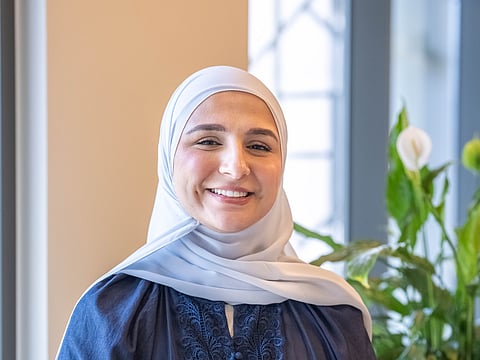
Rayan Daboul was in denial, after her multiple sclerosis (MS) diagnosis.
As she tells us, “At first, I thought everything was going to be okay, without really doing much research. I didn’t want to face the reality of it, so I took it lightly, but that was really just denial.”
It took her a while to process, what was happening. "Even then, I was always convinced that it had happened for a reason.”
Making sense of it alone
In the weeks after her diagnosis, Rayan wished she had known what to expect, emotionally as well as physically.
“I wish someone had explained to me the different stages I might go through emotionally, instead of having to figure everything out about MS on my own,” she says. “The internet can be very scary, especially when you are already overwhelmed.”
What helped, in the end, was professional guidance and time. “Having the right guidance from healthcare professionals, and giving yourself time, can really help make sense of the confusion.”
Learning her own body
Uncertainty is now part of everyday life, but Rayan has learnt not to let it rule her. As she says, with time, you adapt, and eventually, you learn to deal with it, as it comes. "You start understanding your own body better, like knowing when something might be more serious or when you need to slow down. You can’t predict everything, but you learn not to let that uncertainty control you.”
Taking a reset
Some days are heavier than others, and she has learnt to recognise when she needs a break. And so, she tries to change her environment: Travelling, disconnecting for a while, or just having a period, where she doesn't put too much pressure on herself. It's a detox for her mind, as she says.
She has looked after her wellbeing in other ways, too. “I’ve tried therapy, explored hobbies that I’ve always wanted to try, and learnt to surround myself with people who genuinely understand and support me."
Moreover, she tries to keep the environment small and peaceful, when she needs to, to avoid overstimulation and conflict. "For me, looking after my emotional wellbeing is about giving myself space to reset while still doing the things that make me feel like myself.”
The symptoms no one sees
Some of the hardest moments come when other people can’t see what she is going through.
“There are days when I don’t answer questions or explain what I’m feeling, because explaining yourself over and over can be exhausting. There are symptoms and experiences that people simply cannot see. Some people will understand and some won’t, and I’ve learnt to accept that.”
That is why she believes in talking openly and in finding others who know the experience first-hand. Having a community of people living with MS can make a huge difference, because they understand things that don’t always need to be explained.”
That sense of recognition is one of the aims of the MS Support Group Program run by the National MS Society (NMSS). Sara Almheiri, Senior Programs and Community Outreach Specialist at NMSS, says the programme was developed in response to needs raised by the MS community, including demand for mental health support alongside physical symptom management. The sessions offer a professional, supportive space to connect and take part in expert-guided discussions.
Living more fully
The diagnosis has changed how Rayan thinks about her time. “It made me want to live more fully and not waste time,” she says. She hasn’t found a way to predict what lies ahead, and the difficult days haven’t disappeared. However, she has made room for uncertainty while continuing to pursue the things that make life her own.
“I believe everything happens for a reason, and that God knows I have the strength to handle what comes my way.”
Acceptance is a process
Tanya Dharamsheh, a counselling psychologist at The LightHouse Arabia, says there is no single way to respond to a diagnosis.
“There isn’t one emotional response to an MS diagnosis, just as there isn’t one experience of living with MS,” she says. Relief, fear, anger, disbelief and grief for an imagined life can all coexist, and none of them follows a predictable timeline. People may even grieve possibilities they fear losing while the future is still unknown.
Dharamsheh is wary of telling newly diagnosed people to 'accept' their condition. “Acceptance does not mean liking what is happening or giving up. It is about gradually making room for the reality that is here, including the difficult emotions that come with it. Adjustment is a process, and it is rarely linear.”
Living with uncertainty
Uncertainty is exhausting, and draining. It be one of the most psychologically demanding aspects of MS, too as Dharamsheh says. “A new sensation can understandably trigger the thought, ‘Is this MS? Is something changing?’”
The goal isn’t to become comfortable with that, she adds. Some uncertainty is genuinely difficult, and some concerns about the future are realistic. The psychological work is learning that uncertainty and a meaningful life can exist alongside one another. "You can be frightened about what might happen and still ground yourself by asking: ‘What do I know today? What matters to me today? Where do I still have choice?’”
Rethinking resilience
Dharamsheh is also careful with the word 'resilience,' which can imply that anyone who is struggling simply needs more of it. Fatigue, pain and cognitive changes can affect everything from work to parenting and friendships.
When someone is struggling with that, she says, “it doesn’t necessarily mean they aren’t coping. Sometimes it means they are carrying a great deal. Resilience isn’t about pushing through or staying positive. Sometimes resilience actually means doing less. It can mean pacing, asking for help, setting boundaries or changing the way we do something.”
There can also be grief. We often think about grief in relation to bereavement, but we can grieve changes to our health, our independence, our sense of certainty, or the future we had imagined for ourselves. Sometimes that grief is about something that has already changed; sometimes it is about what we fear we may lose...

Invisible symptoms
Someone can appear completely well while using enormous physical and psychological energy simply to get through the day. That creates a second burden: “The person isn’t only managing their symptoms; they may also be managing other people’s interpretation of those symptoms.”
Even a well-meant 'You look so well' can leave someone feeling unseen. Her advice is simple: you don’t need to fully understand someone’s symptoms to believe them.
For families and friends
“When we love someone, our instinct is often to help, protect or fix,” says Dharamsheh. “But helping can sometimes unintentionally become taking over. If someone is already experiencing changes in their independence, having others decide what they can and cannot manage can add another layer of loss.”
Instead, she suggests asking a simple question: “Would it help if I did that, or would you prefer to do it yourself?” Abilities can also vary from day to day, so managing something once doesn’t mean someone always will. Rather than trying to recreate life exactly as it was, she encourages families to ask what a meaningful life looks like now.
Above all, she reminds them that MS is only one part of the person they love.
“Not every conversation needs to be about MS. The person is still a partner, parent, friend, colleague: someone with humour, interests, values, ambitions and an identity that extends far beyond their diagnosis.”


