Little miracles
Meet a woman who proves that change can begin with the efforts of an individual.
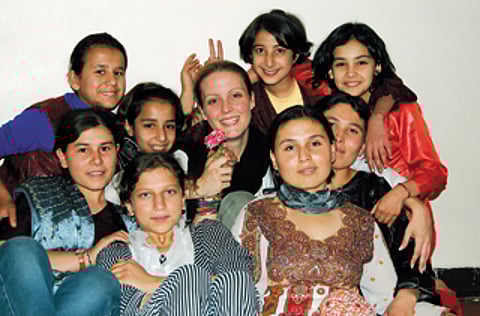
What Aid for orphans in Afghanistan
Where Afghanistan and Dubai
Why Fund raising and documentary project to offer relief to Afghan orphans and raise awareness surrounding their plight
How Turn to the next page to see how one woman is bringing hope to orphans in Afghanistan and increasing awareness through her charity drives and filmmaking.
In 2002, conflict claimed the lives of many men in a village in the Bamiyan province of Afghanistan. In one family, three sisters lost their father and consequently were sent to different orphanages. One of them, Sussan, was sent to Mehan Orphanage.
A very quiet girl, Sussan prefers sitting by herself while the rest of the world flits about her. She's introverted and doesn't say much. Although people try communicating with her, the 15-year-old's responses remain limited.
Natalie Carney visited Kabul for the first time on a whim.
"I wanted to get out of Dubai and experience a complete change of environment. I've always been attracted to locations off the beaten track, so Afghanistan was a destination that appealed to me," says Carney.
While getting out of the city was the original motivator, Carney had no idea at the time where the road would take her.
"It was a friend who suggested that I visit an orphanage and maybe do some work with them,'' says Carney, "and I thought, ‘why not?'".
She started researching some orphanages on the internet and emailed a few of them with a proposal: to raise some donations which she would hand over to them during her five-day visit to Afghanistan.
However, the response she received from many of the them was far from encouraging. Most of them wrote back asking her to contact their parent organisation which was based either in the UK or the US. "I was shocked by their response and their lack of interest,'' says Carney.
Finally, she got in touch with the director of Mehan Orphanage who invited her to spend a day with the kids. "It was a much more personal response," says Carney. "[The director] was also completely open to my offer to organise donations, which they obviously needed.
"I didn't know what to expect from Afghanistan, let alone from the orphans,'' she admits. Being an only child and having no children of her own, Carney had never really interacted with children closely.
"But I realised that they are like children anywhere else in the world,'' says Carney. "I know that sounds clichéd and you might ask, ‘well, what did you expect?' I didn't know what to expect. I guess the illusion is that since it's a war-torn country, the children would be poorly cared for. The reality was far from it - at least not at this particular orphanage."
When Carney returned to Dubai after that first visit, she was met with tremendous interest from other people wanting to get involved - people who wanted to contribute in any way they could. Carney decided they should pool their efforts and come up with more donations to send.
Having found a company in Dubai (which prefers to remain anonymous) that was willing to fund the transportation of the donations to Afghanistan, the first aspect of the project was taken care of.
Carney's background in media helped her arrange for announcements to be broadcast on the radio with information regarding the drop-off points for the clothing donations. Within just a few hours of the first announcement, the first red bin was already overflowing.
The next step was the tedious task of collecting and sorting the stuff.
"Looking back, I should've stipulated what donations we were looking for," says Carney. "People shouldn't see donation bins as an excuse for getting rid of everything they don't want. One shoe, a pair of pants riddled with holes and so on, are not useful in any way!" A friend of Carney's offered her office space in Deira to the cause so that they had a sorting and storage room.
"It's really amazing what social media can do," says Carney. "I posted a note on Facebook requesting some help in the sorting and organising of the donations. The response I got was phenomenal."
The gloves were on
Over a six-month period, for hours at a time, the rubber gloves were on. Carney and her team of volunteers rooted through cockroach-infested bags, sorting through the contents of the donation bins.
"You won't believe the kinds of things we found in there," says Carney. "One of the most incredulous moments was when we pulled out a kid-sized flak jacket, which is a form of protective clothing designed to provide protection from shrapnel and the like. That was worrying. I did not even know that they made them for children."
New ideas
In the meantime, Carney had returned to Afghanistan twice. After her third visit, another idea sparked. Having done some TV work and a short course at the SAE Institute and owning her own recording camera, Carney began filming at the six orphanages she has got involved with (Mehan, Sitar 1, Sitar 2, Kufa, Mermon and Naseema in Jalalabad.) She then began talking to ministers and officials, and most of all, the children, in order to portray aspects of their lives as best she could. The film Forgotten Victims of Afghanistan began taking shape.
While in Afghanistan filming, the donations in Dubai had been shipped. The boxes were still sitting at Kabul Airport when it was time for Carney to leave. "It took tremendous effort to get those boxes of clothing released from customs," says Carney. "I wasn't there to see the delivery of the boxes in the end and I don't even know how much of it made its way safely into the right hands."
Eye-opening realities
Carney recalls having travelled to a little village north of the province of Nangarhar. Arriving, people came running up to her and the orphanage director [who she was with]. They were waving pictures of their children and begging them to take them.
"I admit that I was initially upset at these parents offering to give up their children so freely," says Carney. "But when you think about it, it's courageous that they're willing to give up their loved ones for a chance at their having a better future. It was an act of absolute love. They were desperate for their children to be accepted and taken into the orphanage because that's where they would be given an education; that's where they would be guaranteed food; that's where they were guaranteed a future."
These children come from such remote areas that they have no infrastructure, no health care and no education systems. Orphanages are, to their parents, the only way their child can be offered hope.
Staying in this particular village in Nangarhar, Carney remembers looking through the pictures of the children. One particular little boy named Hamid caught her eye. She decided to sponsor him.
"He is such a beautiful little boy," says Carney with obvious affection. "He writes me letters and sends me drawings. He doesn't have a birth certificate but we estimate that he's about 13 or 14 years old."
Moving forward
Back in Dubai, Carney wanted to keep the ball rolling.
"I'd learnt from the clothing donations project just how much tedium was involved in simply getting donations through customs, so I wanted to come up with a more practical way of helping. I have been working with a man named Kabul Wazir Mir, who is from Kabul. He has been incredible in motivating me. When I'm feeling run down and have no energy left, he's the one who stokes the fire. He came up with the idea for the 2010 calendar, which includes some beautiful pictures of these children, to raise money and awareness for their cause."
Carney also created a blog so she could post diary entries at the end of each day and include footage she'd filmed. She describes the responses as ‘simply incredible'.
"People who I had never met in my life, who were from nowhere near the Middle East - from all over the world - got in touch because they were interested in what was going on. I was so humbled by how these people really cared and were genuinely interested in helping. That was really touching for me.
"And of course there are all the people in Dubai who have been a huge part of this endeavour. There are so many fantastic resources here - professionally, personally and financially. If we can direct even 2 per cent of that into the right channels, so much might be achieved," she says, describing Dubai as the "perfect launch pad" for charity work.
Carney has a long-standing history with the Middle East having done a degree in Middle Eastern studies at Simon Fraser University in Canada. She's travelled extensively in the region, and considers Cairo in Egypt to be her second home. She intends to base herself there permanently this year to continue her work.
Fine tuning
Carney resigned from her job in radio to focus on her aid work and is doing all the filming and editing of the documentary herself, although she is getting help with post-production from NBC. "I find it's easier for me to do the editing because I know what's been filmed and I know what pieces I want pulled together," she says. "I know the editing software well enough to do this and will only get the experts to tighten it up after I've compiled the pieces. I will be going back to Kabul to do some more filming, so at the moment it's a continuous process.
"To do little projects like this full-time to raise awareness would be a dream come true, but I've got to pay the rent, so I'm merely taking a six-month sabbatical with my savings and doing some freelance work in between to keep the ship afloat. I'm utilising this time as best I can.
"The trouble in getting involved in this kind of project is that I feel riddled with guilt about the things I haven't done. When you get started, you just want to do more and more. The clothing donations were delivered in September last year, and I've done the calendar this year, but it's niggling at me that this is all that I've done. I know I might be too demanding of myself, but I feel like I can do more. And I know I will do more," she says.
Looking ahead
"It's always been a big question about what happens to the kids after 18," Carney says. "With the Afghan Child Education and Care Organisation (AFCECO), the main objective is to get them to go to university. But children from orphanages such as Kufa - which is not under any umbrella and therefore has little support - have less hope."
Carney explains that a lot of Afghan orphans end up back on the streets because there's no support structure in place to offer them an alternative. They are taught vocational training at the orphanages but only a few will be lucky enough to have those skills sustain them. "It's a very disturbing question for me," she says. "I wish I could find an answer to that and gear my next project to addressing it. It's a harsh reality that the efforts we put into helping these children are deemed futile when they reach adulthood and have no prospects."
Carney explains that while many argue that it's simply a case of focusing on education, housing and infrastructure, aid must go deeper than that. Things cannot move forward when the commitment is lacking at the core. "We need to address the nucleus," says Carney. What is the solution? It's a catch 22 - there really is no answer. And these innocent children are stuck in the middle of it all."
On one hand, Carney says she doesn't like talking about the problems of the country because she doesn't want people to get the wrong impression about Afghans.
"Afghanistan is a unique place and its people are beautiful. That's what keeps me going back; that's what keeps me hopeful," says Carney. "You'd think that after suffering so much despair they would be walking around with frowns on their faces but they're not. Their smiles are incredibly motivating for me. There is certainly tension in the air but their smiles shine beyond that."
Telling storiesForgotten Victims of Afghanistan begins with the narration of a 48-year-old American teacher whom Carney met at the first orphanage she visited.
"He got to a point of despondency as to what was happening around the world and he decided that he had to do more with his life," Carney recalls. "He went to stay with these children - living with them and teaching them. He wanted to represent a completely different side of his nation and similarly, do the same with the Afghans to the Americans. Mostly, he simply wanted to give these children love. So many of them have never known what it feels like to have someone care for them.
"The documentary is an exposé of the country told through these children's stories."
Carney emphasises that people need to see the human face of conflict so that they can relate. "I spoke with the Minister of Education in Nangarhar province who conveyed such a valid sentiment: Afghan orphans are the biggest problem in the country in that they are so susceptible to being manipulated. If we don't fix that there will be severe consequences for Afghanistan and the world."
***
Every day for lunch and dinner at the Mehan Orphanage, the girls sit down together on a mat to eat. During Carney's last meal on her most recent visit, Sussan unexpectedly sat herself down next to her. Sussan grabbed her hand and held it in both of hers. She didn't say anything.
As Carney gathered her things and packed the car to go, the girls came outside to say goodbye. Carney told them she would be back again soon.
Sussan stepped out from the group, wrapped her arms around her and said: ‘I know you'll be back soon,' followed by a whispered: ‘I love you' in her local dialect.
"As she clung to me for those last few moments, I knew what she said was absolutely true," says Carney.
"I would be back again… soon."
Who Natalie Carney, Canadian expatriate living in Dubai
Sponsor a child
There are different options for sponsoring a child. You can do a one-time payment or you can sponsor a child on a monthly basis. "These kids are in an environment in which hope is nurtured. They are striving to be presidents; they're striving to change their country. It's not just their basics like food and water and a place to sleep - they're getting much more than that," says Carney. Some sponsors encourage them to learn a new language. Some kids get to work with computers so they learn technology in order to adapt and evolve as the rest of the world does. "There are myriad ways in which we can enable change through various levels of sponsorship," she says. She recommends the Afghan Child Education and Care Organisation (AFCECO) as a good place to start. Visit www.afceco.org.
Carney offers some advice on sponsoring a child:
- Do your homework and ensure that the organisation you are going through is legit and that the money in being channelled in the right direction.
- Ask the organisation where the money is going.
- Find out what percentage of what you're sending is actually going to the child. "A lot of organisations all over the world - and I'm talking about NGOs here too - take a cut, so find out whether the organisation is really non-profit, or at the very least is not taking an unfair facilitative rate," Carney advises.
- Work with an organisation that is 100 per cent transparent about how they work.
Do you know of an individual, a group of people, a company or an organisation that is striving to make this world a better place? Every responsible, selfless act, however small or big, makes a difference. Write to Friday and tell us who these people are and what they do. We will bring you their stories in our weekly series, Making A Difference. You can email us at friday@gulfnews.com or to the pages editor at araj@gulfnews.com
Sign up for the Daily Briefing
Get the latest news and updates straight to your inbox

