In India, a campaign to win the right to work
A group of women in an Indian village challenged their community’s diktat barring them from working
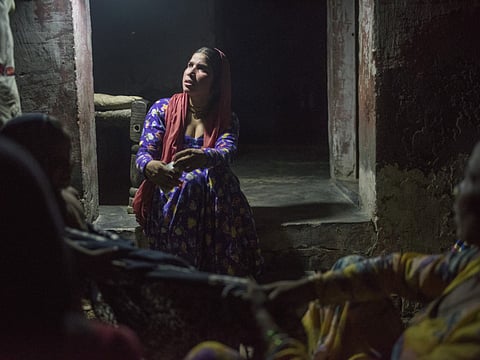
On a humid, sweaty, honking afternoon last summer, two women were making their way through the court complex in the north Indian city of Meerut, searching for the office of the subdivisional magistrate.
They walked past the purveyors of stamp papers and affidavits, typists clickety-clacking on stools, barristers-at-law in flapping gowns, pillars of wadded files bound in twine.
It is fair to say that these two did not belong. They had the swaying walk of village women — half-duck, half-ballerina — who have spent their lives balancing bundles of firewood on their heads. When they entered the office of a criminal defence lawyer, in the sweat-stained broom closet where he receives clients, they were at first so conscious of their low status that they tried to sit on the floor.
They were engaging his services because they wanted to work. They lived 160 kilometres away, in a small settlement where, for generations, begging had been the main source of income. A few weeks earlier, the male elders of their caste had decreed that village women working at nearby meat-processing factories should leave their jobs. The reason they gave was that women at home would be better protected from the sexual advances of outside men. A bigger issue lay beneath the surface: the women’s earnings had begun to undermine the old order.
It came as a surprise when seven of the women, who had come to rely on the daily wage of Rs200 (Dh11) refused to stop. The women would have to, the men said, blocking the lane with their bodies. They did not expect the women to go to the police.
It would have been impossible — this appeal to the distant, abstract power of the Indian state — if the women had not been so angry.
Geeta, the younger of the two, was born angry. Even as a child, if her siblings took her portion of food, she was apt to throw everyone’s dinner into the dirt. “A real [expletive]-woman,” one neighbour called her, eyes widening with admiration.
“Let their ladies sit and cook for them,” Geeta would hiss to her friend Premwati, as they walked together past their neighbours. “Our husbands are with us.”
Premwati was a more cautious sort. In the tradition of their caste, the Nats, a person challenging a community punishment could offer a defence at trial by picking up a red-hot piece of iron and walking five steps towards the temple. If her hands burnt, she was guilty, and would be placed in a hole in the ground until she confessed.
They had wandered into dangerous territory, she and Geeta. She knew that. When evening fell in the village of Peepli Khera, Premwati would crouch over her clay stove, rolling chapatis in and out of the embers, and survey the forces arrayed against them. Too poor to afford a house with a door, she lay at night under a thatched roof, listening for the footsteps of people she could not see.
Last summer, as they fought to remain in the workforce, Geeta and Premwati made up a small part of a big economic puzzle.
In India, around 27 per cent of women participate in the labour force, a lower figure than any other country in the G-20, except for Saudi Arabia. Standard models suggest that a lucky confluence of factors — economic expansion, rising education levels and plummeting fertility — would draw women swiftly into India’s economy.
Instead, the opposite is happening: From 2005 to 2012, women’s participation rates slid to 27 per cent from 37 per cent, largely because rural women were dropping out of the workforce. Of 189 countries studied by the International Labour Organization, India ranks 17th from the bottom.
This is terrible news for India, as it strains to become a competitive producer for world markets. Economists have put forward two theories to explain the decline. The first is that India’s boom has created jobs in segments that are generally not accessible to women, such as construction. The second has to do with culture: unless their choices are dictated by destitute poverty, Indian families seek the status that comes from keeping women at home.
The Nat families were just crossing that threshold, and many things were changing. Premwati and Geeta could feel the grip of the local moneylenders loosening; the taste of independence made them bold. In this way, over five months last spring and summer, the unstoppable force of economic need met the immovable object of social control.
The cost of remaining in the workforce, they discovered, was very high.
The bossiest woman in the village
At 10 o’clock on a morning in May, Geeta and Premwati wrapped fried bread in plastic bags and set off on foot towards the meat-processing factories. It was blindingly hot, and stray dogs and buffaloes lay in strips of shade on either side of the road.
To save the Rs5 fare for an auto-rickshaw, they walked the whole dusty distance, nearly an hour from their small community of Nats, who are Hindus, through the Muslim neighbourhoods that surround the factories. They kept their dupattas pulled all the way down over their faces, following the medieval tradition of purdah, or veiling, but men in skullcaps lingered in the doorways anyway, gawking.
“What is your name?” one of the men yelled, breaking the silence.
“Geeta,” came the reply, bell clear.
The two met as young wives, taken away from their home villages and deposited among strangers in Peepli Khera. Geeta, who had barely hit puberty, landed in the grip of a mother-in-law who believed that drinking tea made a girl greedy for extra helpings of food.
So Geeta would sneak over to see Premwati, who made buckets of tea, watery and sweet. Geeta was scrawny and mouthy. She tended to alienate women — maybe it was the way she called them fat buffaloes — but Premwati calmly allowed Geeta’s insults to bubble over her. Geeta returned this favour by stomping over and intervening whenever Premwati’s husband beat her.
“It has become a habit to take a beating,” Geeta said one day, scowling.
In this way, Geeta had carved out a role for herself as the bossiest woman in the village. No one beat her. “Her husband is like a chicken — if she tells him to get up, he will get up!” chuckled the chief in the town where she grew up.
As the women approached the factories that morning, they pulled their scarves over their faces against the smell, a stomach-turning odour that wafts off tallow-rendering vats and suggests rotting meat. Over the last five years, with the market for flash-frozen buffalo meat booming in Saudi Arabia, Egypt and China, India had quietly become the world’s largest meat exporter. The factories outside Meerut were expanding.
For this reason, about five years earlier, Geeta and her friends had been drawn into the labour force, supplementing their husbands’ seasonal earnings as wedding-band musicians. Inside the boundary walls of the factories, they broke rocks into rubble and carried cement mix in shallow pans, balanced on the crowns of their heads, to stonemasons building interior walls. Some washed meat pans; some assembled cartons; some carried bricks.
At night, returning home, they withdrew sweaty, folded bills from their blouses. A hollow-eyed woman named Pooja announced, with some surprise, that her husband and mother-in-law had stopped beating her. “When you earn money,” she said, “you are of some use to them.” As for Geeta, it became clear to her that the men swarming around the factory grounds were not making sexual advances.
“When you start working, your heart opens up,” she said. “Then you’re not scared anymore.”
At this point, the women began to make changes to their appearance. Geeta took note when the other workers recoiled from her, and began to wash twice a day, with soap. She bought two-metre lengths of cotton, the brighter the better, and paid tailors to stitch it into billowing pants.
Premwati, whose husband spent most days stretched out drunk on his rope cot, felt, for the first time in years, that she was standing on solid ground. With her earnings she married off three children. One last son needed settling. Then she could exhale.
Geeta’s plans were wilder, more improbable. Though she had never been taught letters or numbers, she worked her cellphone constantly, using a system of vigorous trial and error. In the financial cooperative that the village women had formed, pooling their resources and extending loans, she proved to be an excellent, if frightening, debt-collector. She began making payments into a life insurance policy with such a generous payout that she sometimes daydreamt, a little wistfully, about her husband’s untimely death.
She took advances on her salary, which were interest-free, rather than patronising the local moneylenders.
Then, last spring, she attracted attention by building a second house for herself, of rosy, freshly kilned brick, abutting the compound of Roshan, the village’s most powerful man.
Far from the modern world
When Roshan, the Nat chief in Peepli Khera, is ready to perform an exorcism, he starts out by asking a coy question: “Do you want to see the real drama?”
Then he trembles. His eyes roll back, he arches his tongue against his teeth like the deity Kali, who communicates to him through a string of wooden beads that he holds up to his ear, as if it were a cellphone. Nat families who are mistrustful of hospitals — that is, nearly all of them — come from kilometres away to see Roshan, who claims to be able to evict the jinns that have inhabited their bodies.
Asked how many of his patients survive, he barks laughter. “How do I know that? If they survive, they survive.”
In the half-light of evening, Roshan surveys the settlement, his chest thrown out. He has the high cheekbones of his nomadic ancestors, who made a living walking tightropes to entertain the Mogul courts. His lips are speckled and plump as cuts of liver. This is his dominion — about 65 kilometres northeast from Delhi as the crow flies, but far from the modern world.
Villagers live in a few dozen houses arranged around a whitewashed temple. A plaque notes that the temple was built by Roshan’s family, though no one needs to be reminded, and anyway, only two adults here know how to read. No one uses a surname or knows his or her age. One man, asked how old he thought he was, responded, “I don’t have any teeth left, and I am about to go.”
Roshan’s proudest moment occurred decades ago, when a police officer, sniffing for bribes, made the mistake of venturing into the square and grabbing his cousin by the neck. Roshan, then a young man, picked up an axe handle and hit the officer hard in the face. Since then, he likes to say, the police have not found occasion to come here. A boundary had been demarcated: this is a place beyond the reach of the state.
With the arrival of the factories, that boundary had begun to disappear. Roshan’s village was being swallowed by an expanding city. He forbade the women in his own family to work at the factories, but watched with distaste as his neighbours left in the morning. He looked back with nostalgia at the time when the Nats supported themselves by begging.
“Life was much better 20 years back,” he said. “It was a nice society. Now women are going out and meeting strange men.”
In the spring of last year, after Geeta built her new house, Roshan’s son Dharmender began observing her with interest. He noted her new outfits, the way she came home “with the crease in her clothes still visible”. He scanned her friends’ faces for traces of makeup. He shared his suspicion that they worked at an air-conditioned site.
Their work, he said, had a whiff of immorality.
“They have everything: clothes to wear. Enough to eat,” he said. “Why would they need to work? They still have husbands. It’s not just insulting to them, it’s insulting to the whole village.”
Money and respect
It was difficult to say where the rumour started. It concerned Geeta’s neighbour Pinki, who had fair skin and a little girl’s high, fluting voice. She was married with one child and worked at one of the new construction sites, breaking rocks with a hammer. Some reported that Pinki had been seen riding on a strange man’s motorcycle, others that a man from the construction site had shown up at her family home.
In May, Roshan vanished into the temple to present the matter to his most trusted authority: the deity Kali. After a long conversation over the magic necklace, he emerged saying that the goddess had shared a piece of disturbing news. Women in the village, he said, were engaged in prostitution.
“If Kali tells us this person is wrong,” he said, “this person is wrong.”
It was decided: the village’s women would stop working.
Geeta gathered a war council on the floor of her house. They were a party of seven, including Premwati, Pinki and another neighbour, Rekha. Geeta’s proposal was to ignore Roshan’s ban. If their female neighbours were willing to quit their jobs, it was only out of fear. The fear would fade, maybe in a month, maybe in two. In the meantime, she told her friends, they had the full support of the Indian government.
The government she had in mind was a Muslim politician named Jahiruddin Mewati, who had served as chief of the village of Peepli Khera until a few years earlier, and who was running again in autumn.
Mewati’s furred belly peeks out of the bottom of his dress shirt, and he has Tourette’s syndrome, so he emits a stream of grunts and tics. In the middle of a conversation, he slammed his hand with great force on the table, exclaiming, “I am on the side of the truth! I am not worried about votes! I am the true servant of the people, because injustice has been done!”
Mewati’s study of politics, especially the tactics of the British Raj, had persuaded him that there was much to be gained — specifically, votes — by inserting himself into local controversies. With all adult men and women counted, there are about 150 votes in the Nat community, nothing to sneeze at in a district where elections are won by a margin of 20 or 30. When Geeta appeared in his reception area, a collection of plastic chairs arranged under a tree, he smelled opportunity.
“Nobody can stop them from going to work,” he said staunchly. “We don’t have a Taliban here. It’s a democracy.”
Heartened, the women decided they would simply leave for work in the morning. Except, when they did, their neighbours were standing there, telling them to stop.
‘These people can beat me’
“On 18.05.2015 at 9:00 A.M. I was going for work,” reads the report filed at the police station in Kharkhauda, signed with Pinki’s thumbprint and written in the hand of their sponsor, Mewati.
“These people started saying that we were told not to go to the factory, because bad things are happening at the factory. These people became angry and started abusing me and they threatened to kill me. I request you to lodge my report and take legal action.”
She added, for good measure, “these people can beat me at any time.”
The station officer, Manoj Kumar Singh, took her complaint with a grain of salt. He had seen versions of this drama playing out in other hamlets where young women were leaving for work. The old, patriarchal order was dying in rural India, dying slowly, and releasing toxic bursts as it did.
“That may be the cause of this whole trouble, that they are losing control,” he shrugged. “These old practices are going away.”
When word got out that the women had gone to the police, Dharmender was the one sent to tell them how they would be punished. He stood in the lane and yelled it over the wall, using the old phrase “hookah-pani bandh”, a sanction that dates back to medieval times, when sharing a water-pipe packed with tobacco was the prerogative of adult men in rural India. From this point forward all seven women would be outcasts — symbolically denied the hookah, as well as “pani”, water, from a shared pump.
Geeta, Premwati and their friends tried to wrap their heads around it. As children they had heard of the rite of ostracism — it was used to frighten them into obedience — but they had never seen it imposed. At first they found ways to adjust, avoiding a confrontation with their neighbours by sticking to the lanes and handpumps that had been constructed with government money.
A few days passed before the finger of the punishment touched them. Geeta’s teenage niece greeted the girl next door and watched her glide by wordlessly, like a ghost. Rekha dialled the numbers of relatives, one after the other, and when she told them what had happened to her and spoke the phrase “hookah-pani”, they hung up.
Living as outcasts
Dharmender was astounded that the seven women persisted in going to work. The rest of the village’s women spent their days collecting firewood, and by mid-July, the piles had grown into towering, tangled masses that threatened to topple over. In the mornings, when Geeta and her friends left for the factories, men lined the roadway and jeered. “Are you going to star in a pornographic movie?” one of them called out.
The whole thing was strange, Dharmender said. The women had been offered a deal, allowing them back in the community if they confessed to “immoral acts” and paid a fine, but they had refused it. Ostracism was such a severe punishment that dissenters usually relented within 24 hours, paying whatever fine the elders demanded. Geeta and her friends had already lived as outcasts for three months. “Who,” he wondered aloud, “would be willing to suffer so much?”
The women, too, were in uncharted territory. Every two weeks, they made a trip to the magistrate’s court in Meerut to renew a restraining order that the police had recommended, which would impose a Rs50,000 fine on anyone who resorted to violence.
Their lawyer, Mohammad Yusuf Seddiqi, had rarely sat across his desk from such nervous clients. In his practice, it was not unusual to see state justice conflict with caste justice. One of his clients, who had appealed to court in order to obtain a divorce, had been assigned a punishment by his village council, to spit on the ground and then lick the spit.
Still, there was something unusual about these women, who signed each document with a thumbprint. Seddiqi watched them curiously.
“They know nothing about court procedure,” he said. “They never ask me questions. They just say one thing: ‘We are not wrong. We are not wrong. We are not wrong’.”
A return to begging
Around the hearths of the Nat women, the ones who had agreed to resign their jobs, pressure was building. They wanted to be loyal to the community elders but by September, stripped of the Rs200 a day that had been supporting their families, they were running out of money.
Geeta’s neighbour, an imposing woman known as Big Suman, surveyed the homesteads one by one with the experienced eye of a general. She had disapproved of Geeta’s rebellion, but she grumbled about having to give up her income. One morning, a moneylender stormed down the lane, bellowing, “Give me my money or I will take your bicycle!”
On one of her rounds, Big Suman spotted something peculiar: a widow with grown children was trudging back from the nearest town with a sack of flour balanced on her head. Big Suman did a double-take. She knew what begging looked like. This was an activity — “spreading your hands before strangers” — the Nats were trying to leave behind.
The widow’s story was what she expected. She had run out of flour two days earlier. The thought of going deeper into debt terrified her, so she did not want to approach Roshan, who would lend money but charge interest. She wept, and then she went to beg.
That morning, Big Suman decided the time had come to end it. She visited all the women who had resigned from the factories, stopping by at times when they would not be overheard by Roshan. They agreed that they would break into small groups, leaving when the men slept, and take their case to the one person who could clear the way for them to work again.
When Mewati, the Muslim politician from down the road, saw the crowd of women enter his courtyard, he perked up. Local elections were two months away and he was feeling lively, like a bear coming out of hibernation. Several days later, at 7.30 one morning in September, he bumped down the road in his decrepit Maruti Gypsy jeep, its suspension squeaking as it hit ruts in the road.
He moved with purpose. His shirt was clean and crisply ironed. He parked the Gypsy in front of Roshan’s homestead, and a series of Mewati’s male cousins unfolded themselves from the back seat, assuming positions in Roshan’s yard. The two headmen sat down on a rope cot, exchanging compliments.
“I am with you with all my heart,” Mewati said.
“I know you are,” Roshan said.
“Even if I die, I will support you,” Mewati said.
“I can die, but I cannot fight against you,” Roshan said.
Mewati assembled the villagers and informed them that the Indian Constitution guaranteed equality under the law. Women could not be prevented from working, and Geeta and her friends should be forgiven. Then he withdrew Rs3,000 in folded bills from his pocket, enough to cover the fine for Geeta’s disobedience, and handed it to Roshan.
“Take care of this mess,” he said.
The machinery of compromise cranked into motion. Roshan’s brother sprinkled sugar on the ground outside the temple, reversing the rite of ostracism. Geeta and her friends lined up and their neighbours embraced them gingerly, barely grazing one another with their arms. Geeta gathered the women to celebrate, and a shoe dangled on a pole above her house, in an ancient symbol of contempt for her accusers.
The matter was unfinished. Some tension flickered in the night. Dharmender, livid at his father’s lenience, grabbed Roshan by the shoulders and tried to shove him out of the town square.
“Your mind is not working,” he said.
‘A black mark has been drawn’
It was late at night, two nights later, that the police stationed at Kharkhauda received a report of violence from the village of Peepli Khera.
The officer on duty was sub-inspector Ankit Chauhan, a babyfaced 28-year-old. Striding down the centre lane into the settlement, heavy loops of khaki braid hanging from each shoulder, the subinspector noted that there were few men present, only a gaggle of women who had, he deduced, spent the last hours exchanging terms of abuse. He recalls examining “scratches and bruises”, nothing serious.
Finally, because he saw the necessity for some kind of action, he detained a short, excitable man, one of several who had been named in a complaint from Geeta, a female resident of the village.
He then gathered the villagers and reminded them that it was necessary to embrace modern life. Chauhan recorded this encounter as a constructive, civil one. Then, satisfied that he had performed his duty, he got back into his service vehicle and left the village.
Those who remained could hear the familiar sound as the police car bumped away down the rutted dirt road. Chup chup chup chup chup.
At night, the settlement is engulfed in darkness, oceans of darkness.
The electricity flickers on for a few hours a night, creating pools of light from single bulbs suspended inside each house. Beyond that, for kilometres around, there are only crickets, stars and sugar cane fields.
Jackals, grey and ghostly, dart in and out of the croplands.
When the sound of the police car had become faint enough, Dharmender and his brothers and his cousins and uncles came back out of the sugar cane field.
Premwati watched them advancing across the village square, some two dozen men closing in. When bricks began to fly, she and her friends ducked inside a house and braced their bodies against the door. Seated on the floor by the light of a candle, Premwati could see the faces of her neighbours, some pressed up against the grill on a window: those she loved, those in her family, those she had known since childhood.
“They have put a black mark on us,” she said. “It will stay as long as we live together.”
Pinki, whose 4-year-old daughter was trapped outside with the crowd, had begun to sob.
Inside the tiny house, Geeta’s friends watched as she dialled the cellphone again and again that night. But the government was not available. Mewati remained in his compound, about a kilometre away. He claimed later that his phone’s battery had died and he had been unable to receive calls.
Chauhan, for his part, was not in a hurry to return to this corner of his precinct twice in the same night. He found the reports of serious injury to be dubious. Where the Nats were concerned, he reasoned, injuries could be caused by any number of things.
“These people are all drunkards,” he said. “They are so drunk that even if you push one of those guys into a drain, he will fall down. These women try to exaggerate, they say, ‘This person attacked us, that person attacked us.’”
Seddiqi, their defence lawyer, saw no need to report the incident to the magistrate who had issued the restraining order. Sometimes, he said, it is better to allow a community to settle its own differences rather than initiate a laborious investigation. Anyway, he added, the police are very busy.
“This is a country with 1.4 billion people,” he said. “The police can’t stand behind every single person.”
The women were alone. When it became clear that Geeta’s friends were securely barricaded, Dharmender gathered a few men and made his way to the other end of the village.
Coursing through him, he explained later, was a certain kind of anger that he associated with being part of a mob. He had felt it before; it is gone after 15 minutes. But for that period, anger can make ordinary men strong enough to flip over a truck. Geeta had already called the police, and Dharmender saw no further reason to avoid violence.
Geeta’s husband, Sanjay, was in his undershirt at a neighbour’s house, watching a television serial, the children asleep under mosquito nets. When he looked up he saw that the door was blocked by bodies. He recalls the sight of his niece, slumped beside a drain, crying, and a heavy blow to the back of his head, and then nothing.
Dharmender felt pity as he beat Geeta’s husband: Sanjay was a poor boy, a decent boy. It was not his fault.
“If he was a bad person, we would feel OK that he had gotten hurt. But he’s a good guy,” Dharmender said. But the beating was necessary, he said, with a heavy sigh. “Until someone gets hurt, people don’t learn.”
The crowd dispersed some time later, leaving Sanjay unconscious in a pool of blood, with a deep cut on his arm, a slit snaking across a cheekbone, and a red knot on his forehead. His neighbours recalled seeing him lying unconscious on a woodpile. The police, when they finally arrived, recommended that he be taken to the hospital.
Sanjay would spend five days in a hospital bed. He had always been a small and quiet man, but when he returned to the village, he was somehow smaller and quieter. He took to slipping in and out in the half-light, trying to avoid crossing paths with the men who had beaten him.
“Anyone who has beaten you in the night can do it again,” he said.
Geeta, too, had lost her swagger. When people asked about Sanjay, she told them that he had fallen off the roof. She denied that she had been trapped in the house with the other women. She was no longer eager to boast about her campaign against the village council.
“They are powerful,” she said. “They are stronger. They beat us up like dogs.”
On the day Sanjay was discharged, Roshan was lounging with his male relatives on a rope cot outside the temple. The heat was soporific, and beside them, two buffaloes nosed through a pile of dung, quietly grunting.
All told, it had been an expensive night, Roshan said. To avoid criminal charges, he had had to pay Rs3,000 for Sanjay’s medical care and an additional Rs4,000 to ensure there would be no investigation. But it was worth it, they all agreed.
Even Roshan’s concession — allowing the women of the village to return to work in the factories — had turned out in his favour. Though the Nat women had headed out almost immediately, nearly all of the factories were now shuttered: China had closed its markets to Indian meat, and Brazil’s currency had declined so sharply that its meat was now cheaper than Indian buffalo.
So that was that. No one was hiring.
Roshan could not help preening a little. “See, in our community, a woman is a woman and a man is a man,” he said. “This is what it is here. Women have lower status and men have higher status.” If any more women propose to challenge that principle, he said, “we will quietly, politely tell them this is not a good thing.”
And that night, as the Sun slipped down over the sugar cane, Roshan and the others laughed and laughed.
–New York Times News Service


