'I refused to abort my surrogate baby'
Why a surrogate mother fought for the special needs baby she was carrying
Cradling my bump, I tried to focus on what the midwife was saying, but it was hard to hear the words over the thudding at my temples. “The baby has a cleft lip and palate,” she said. “It does not appear to have a stomach. She could have a cyst on her brain and there is some sort of heart defect that we need to investigate.”
It was an ominous list, one I hadn’t expected to hear at my 20-week scan. But I was shaking my head, refusing to give up on the baby girl growing and kicking inside me. Combined, the problems sounded insurmountable. But if I broke them down, took one at a time, then they didn’t sound that bad.
The only problem was convincing two other people that this was the right decision – the baby’s parents.
I’d been hired in October 2011 by Eve* and Simon* as a surrogate mother after Eve was advised against having a child because of health issues. I was a working mum of two daughters, aged one and three.
I can’t say the money, a $22,000 (Dh80,806) fee, wasn’t going to make a big difference to our lives because it would. I’d only recently split up with the father of my children, and though not in financial crisis, it would help us.
But that’s not the reason I agreed to have their baby. I liked being pregnant and I truly wanted to help a couple experience the joy of parenthood. Kissing my girls as they snuggled up in bed or reading to them were magical moments. If I could help a couple become a family, then why not? I’d known what it was like to face childlessness. I’d had two miscarriages before having my babies and remembered that ache and desperation to hold my own child in my arms.
That’s why I didn’t hesitate to become a surrogate for Eve and Simon. They seemed a lovely couple, who lived in New York with their three children, who were all IVF babies through an egg donor, and all born prematurely. Their doctor had told them Eve couldn’t risk another pregnancy, but they had two frozen embryos left that they wanted to use. An embryo had been transferred into me in October 2011. Ten days later a pregnancy test was positive.
This baby deserved a chance at life
Now, making the phone call to give them the news, fear twisted through me. It was a devastating list of problems, but I wanted them to know there was hope. “It will still be your baby,” I said gently. Eve was crying, but Simon immediately said he wanted me to have an abortion. Shocked, I refused. OK, it wasn’t my biological baby but I could feel her moving around, and kicking me. She deserved the chance of life – why should I get rid of her just because she wasn’t perfect? I didn’t understand them – this was their flesh and blood. How could they not love her already?
I’d refused to sign it, saying I would only have an abortion if there was something so severely wrong with the foetus that the baby would not survive or would die shortly after birth. The contract had come back with a clause saying the pregnancy could be terminated for cases of severe foetal abnormality, which would be determined by a 3D ultrasound, amniocentesis or other diagnostic tests.
We had been working to a tight time schedule because – as I understood it – the family’s contract for storing their remaining embryos was running out. Thinking that if I asked them to change the contract again I might lose my opportunity to become a surrogate mother, I’d decided to go ahead.
I never anticipated that anything would go wrong. I was under the impression that I would have a normal, happy pregnancy and birth. They would take the baby home and everything would be great. I won’t deny that I was a bit naive.
A week later the couple met me at Hartford Hospital near my home for another more detailed scan. Everyone was silent as the physician checked the baby, then confirmed everything the previous doctor had told me about the foetus’s condition.
I heard a sigh come from Eve and Simon standing behind me. My heart sank. Although the baby I was carrying was theirs I felt it had a spirit that was worth fighting for.
A couple of days later the surrogacy agency contacted me and I was told the family would give me $10,000 to terminate the pregnancy. But I had to schedule one quickly because in Connecticut the cut-off point to have an abortion was 24 weeks.
So in a moment of weakness I said I would only do it for $15,000. In my mind that was enough money that I could have the abortion, run away and start over where no one knew me and I could pretend this had never happened.
The family said they wouldn’t pay that amount and threatened to sue me for all of the money – $8,000 fee and medical fees – they had already paid me if I didn’t go ahead with the termination. Their lawyer wrote ordering me to have a termination. “You are obliged to terminate this pregnancy immediately,” the letter said. “You have squandered precious time.” I refused. Then the lawyers said that if I had the baby they wouldn’t seek custody of the child and she would become my sole responsibility.
I consulted a lawyer and, by the time they served me with a breach of contract lawsuit, he agreed to represent me pro bono. The couple kept changing their mind. They said even though they didn’t want to have her, I couldn’t either – they would insist she went into foster care.
It was a very emotional time. My mother and friends talked sense to me, asking: “Crystal, are you really going to live with yourself if you have an abortion?” The answer was, “No”.
I was trying to figure out what to do. Surrogacy law in Connecticut was uncertain but usually favourable to the biological parents not the surrogate. I was advised I could go to Michigan where the birth mother and not the genetic parents would be considered the legal guardian. But if I ran away and had the baby what would happen afterwards? How was I going to afford to live? In the end my lawyer told me it was perfectly legal for me to leave the state. Once the couple said they would not take custody of the baby, my attorney looked into what would happen to her.
My lawyer found that in Michigan surrogacy agreements are prohibited and I would have legal rights as the child’s mother under state law and could decide what was best for the baby. “I’ll go there,” I decided.
My mother agreed to pay for my medical bills and my rent in Michigan, so in April 2012, seven months pregnant, I packed up my stuff and drove with my daughters to Ann Arbor. The couple didn’t know I was leaving until my lawyer informed them on the day.
That’s the only way we communicated for the next few weeks, through lawyers, while I waited for the baby to be born. I decided to give her up for adoption. Reluctantly, I had to face the fact that, as much as I wanted to, I couldn’t afford to keep her. My lawyer and I were trying to get the couple’s cooperation with the adoption plan. We were never clear about their intentions though.
They filed a lawsuit in Connecticut asking for their names to be put on the baby’s birth certificate. They also filed an order saying they wanted to be the legal guardians but had to admit that Eve wasn’t the baby’s genetic mother as they’d used an anonymous egg donor.
Watching my bump get bigger I focused on the baby, hoping she was healthy enough to survive the birth. I checked into hospital at about 6am in Michigan on June 24 after I began experiencing pains late the previous night.
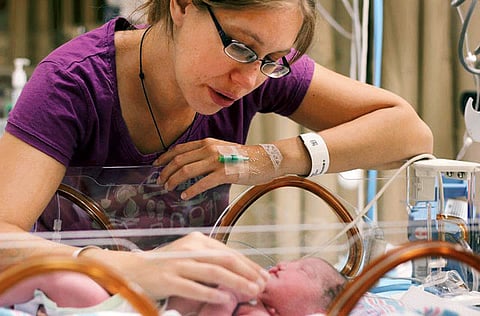
Baby S was born at 6.51am on June 25. It was a natural birth. Weighing 2.7kg, she came into the world screaming, as if to say, “See, I’m here. I’m alive.” I spent about five minutes staring at her before she went off to the neonatal intensive care unit.
I thought she was perfect
Tests confirmed most of what was found on the ultrasounds. She had heterotaxy, which meant her internal organs including her stomach were in the opposite places to where they should be. She had a cleft lip and palate, as well as complex heart defects, which all required surgery. She also had hemifacial microsomia, which means one side of her face is smaller than the other.
But I thought she was perfect exactly the way she was. I held her in my arms and thought: “We made this happen.”
At three months old she was diagnosed with having lobar holoprosencephaly. That means her brain failed to divide properly so the division between the two hemispheres is not complete. That condition is usually fatal in early childhood but because she has a mild form they can’t tell what will happen. It could mean she’ll have very mild developmental delays or it could mean severe mental retardation. She might not be able to walk or talk but I still have hope.
Crystal Kelley, 31, lives in Connecticut, US
*names changed


